
Best Mechanical Engineering Recruiters for Hiring

Best Mechanical Engineering Recruiters for Hiring
Hiring mechanical engineers is rarely a simple resume-matching exercise. Employers need candidates who can work across design, manufacturing, HVAC, energy, automation, product development, quality, maintenance, and systems integration - often under tight timelines and with very specific technical requirements. That is why the best mechanical engineering recruiters stand apart from general staffing firms: they understand the work, the market, and the cost of a bad hire.
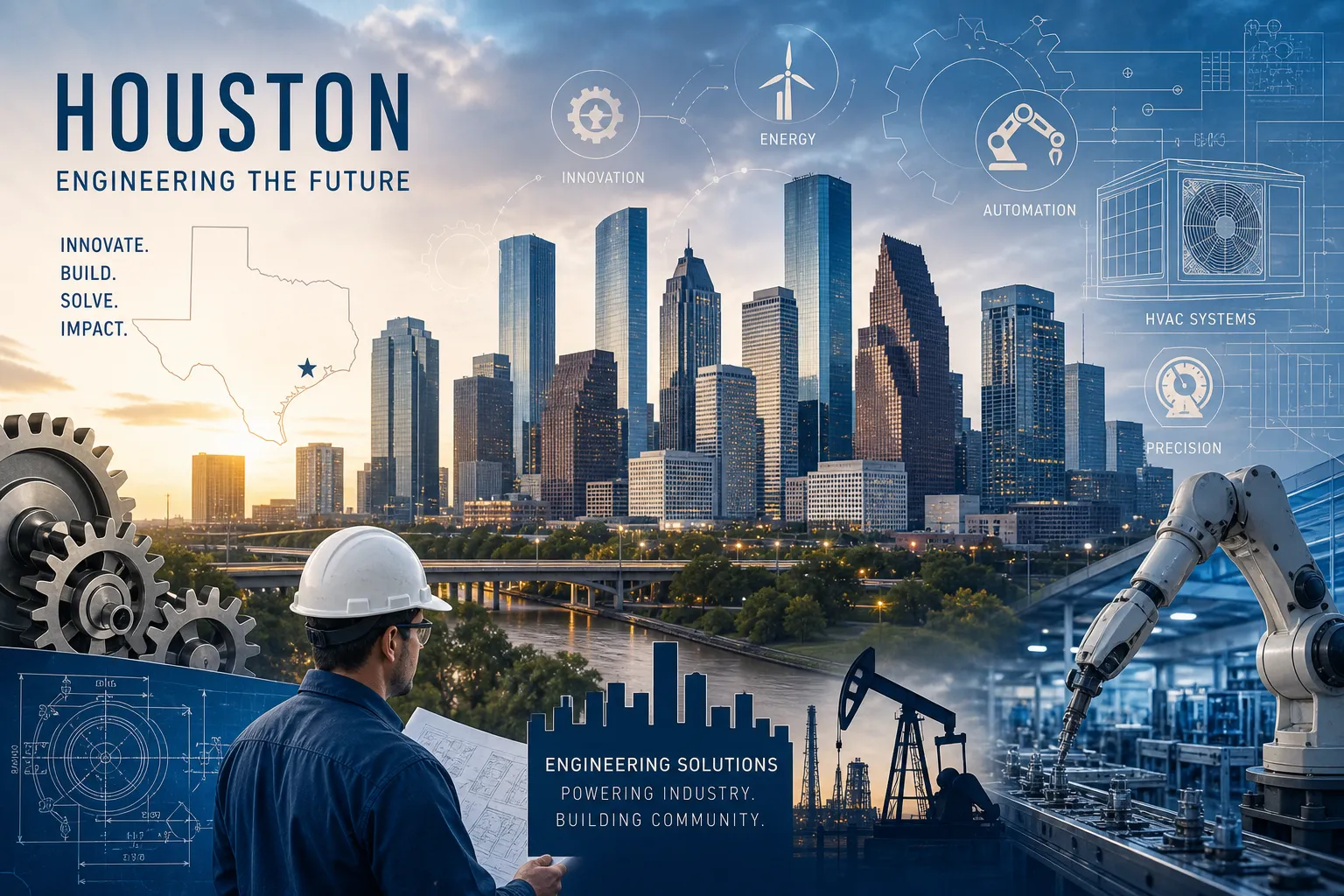
For Houston-area employers, the stakes are even higher. The local market blends manufacturing, energy, EPC, industrial services, supply chain, field operations, and advanced technical roles. Hiring managers need a recruiting partner that can move fast, screen intelligently, and reduce risk. For job seekers, the right recruiter can open access to better-fit opportunities, faster feedback, and roles that align with long-term career growth.
Clayton Services has served Greater Houston since 1984, giving employers and candidates something national chains often cannot match: deep local market knowledge, a decades-built talent network, and flexible hiring options that fit both short-term and long-term needs. From temporary staffing and temp-to-hire to direct hire recruiting, payrolling, executive search, and onsite/RPO support, the right recruiting model can make all the difference when hiring mechanical engineering talent.
Quick Answer: What Makes the Best Mechanical Engineering Recruiters?
The best mechanical engineering recruiters typically offer:
Technical specialization in engineering hiring
Fast response times and active candidate pipelines
Local market reach plus broader sourcing capability
Structured screening beyond keyword matching
Flexible hiring models such as temp, temp-to-hire, direct hire, and executive search
Placement guarantees that reduce employer risk
Strong communication with both clients and candidates
Compliance and payrolling support when needed
For many employers, the best recruiter is not simply the biggest brand. It is the firm most capable of delivering qualified, available, and well-matched engineers quickly - while protecting hiring outcomes through guarantees and process discipline.
What Competitor Pages Usually Get Right - and What They Miss
A review of leading mechanical engineering recruiter pages shows a few common themes:
What competitors emphasize
Specialized engineering recruiting
Nationwide reach
Contract, direct hire, and contract-to-hire options
Candidate screening
Speed to submit candidates
Testimonials and social proof
What many of them miss
Clear guidance on how to choose the right recruiter
A realistic explanation of when local knowledge matters
Specific detail on how guarantees reduce hiring risk
A practical framework for generalist vs specialist recruiting
Advice tailored to both employers and job seekers
The role of temp-to-hire, payrolling, and RPO/onsite recruiting for engineering teams
Regional context for markets like Houston, where engineering demand crosses many industries
This article fills those gaps.
Why Mechanical Engineering Roles Are Harder to Fill Than Many Employers Expect
Mechanical engineering sits at the intersection of theory and application. Employers are often hiring for more than a title - they are hiring for a toolset, an industry background, and a problem-solving style.
Common hiring challenges include:
Need for experience with specific CAD or PLM platforms
Industry-specific requirements in energy, manufacturing, HVAC, medical device, EPC, or automation
Balance between design capability and hands-on field or plant exposure
Communication demands across operations, production, project teams, and leadership
Competition for engineers with both technical depth and business maturity
"Mechanical engineers had a median annual wage of $102,320 in May 2024. Employment of mechanical engineers is projected to grow 9 percent from 2024 to 2034." - U.S. Bureau of Labor Statistics
"Engineering roles, including mechanical engineering, have an average time-to-fill of approximately 62 days." - BridgeView IT
That combination - high value, specialized skills, and long time-to-fill - makes recruiter quality matter more.
Mechanical Engineering Recruiters vs General Staffing Firms
A general staffing firm may be able to help with high-volume or broadly defined hiring. But when a role requires niche technical understanding, a specialist or engineering-capable recruiting partner usually delivers stronger results.
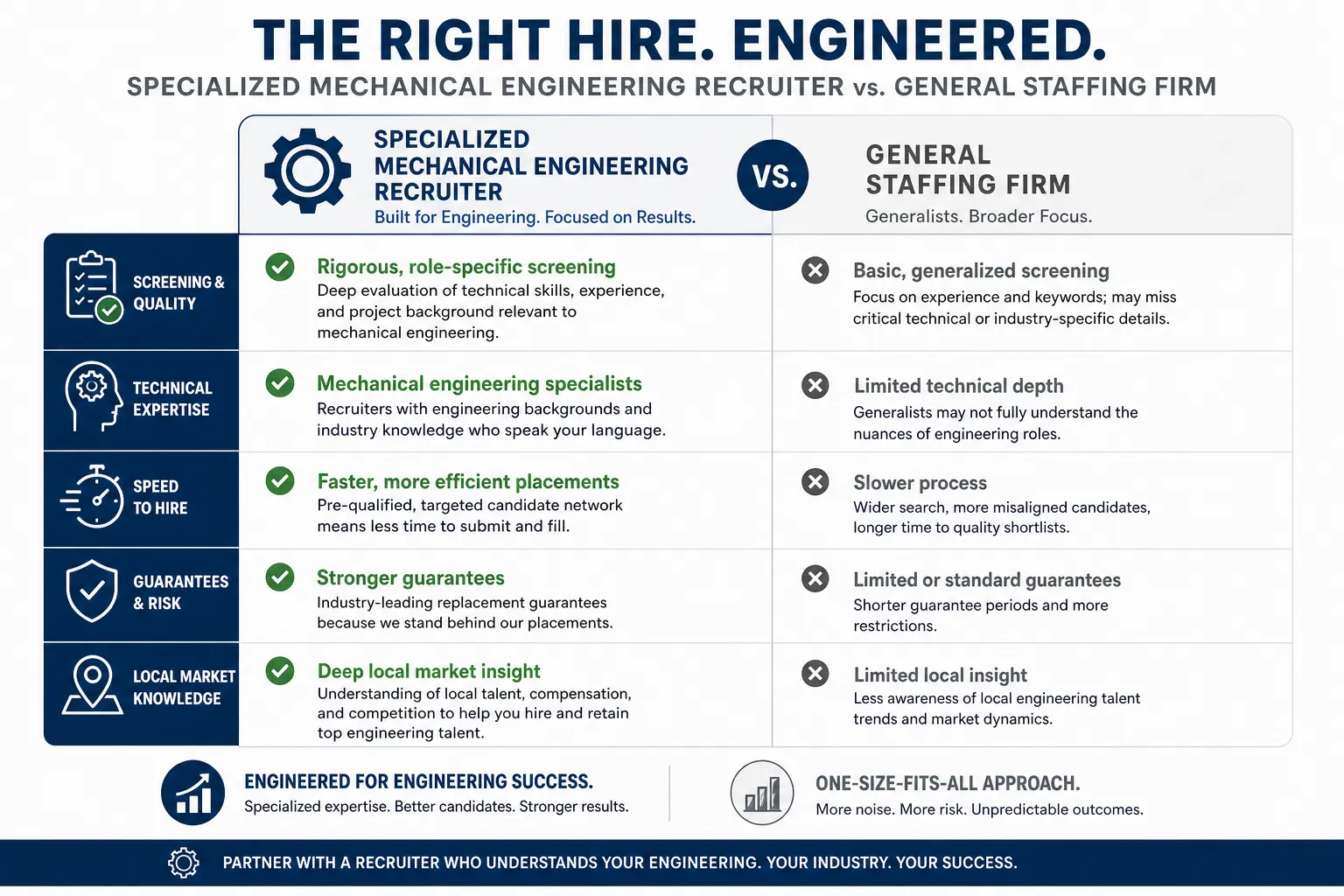
Factor | Specialized Mechanical Engineering Recruiter | General Staffing Firm |
Understanding of engineering roles | High | Often limited |
Screening for technical fit | More robust | Often keyword-based |
Access to passive candidates | Usually stronger | Varies |
Speed on niche roles | Faster when specialized pipeline exists | Often slower |
Hiring manager credibility | Higher in technical conversations | Mixed |
Risk reduction options | Often stronger if guarantees exist | Varies |
Local market nuance | Strong if regionally focused | Can be inconsistent |
Bottom line
If your role includes design ownership, manufacturing optimization, systems integration, product development, plant engineering, maintenance reliability, or technical leadership, specialized recruiting support is usually worth the investment.
What to Look for in the Best Mechanical Engineering Recruiters
1. True specialization in engineering hiring
Ask whether the recruiter regularly fills roles such as:
Mechanical Engineer
Design Engineer
Project Engineer
Manufacturing Engineer
Product Development Engineer
HVAC Engineer
Reliability Engineer
Maintenance Engineer
CAD Designer
Applications Engineer
Quality Engineer
Engineering Manager
A recruiter who fills these roles often will screen faster and present stronger candidates.
2. Strong local reach
If you are searching for mechanical engineering recruiters near me, local knowledge matters more than many firms admit. Compensation expectations, commuting patterns, plant locations, competitor activity, and candidate availability vary dramatically by market.
For Houston employers, that means understanding talent across:
Energy and oilfield manufacturing
Industrial services
EPC and project environments
HVAC and building systems
Fabrication and process industries
Distribution and logistics support operations
Skilled trades and technician adjacency
Clayton Services’ Houston-owned model is a real advantage here. A local recruiting team with long-standing market presence can often surface candidates faster than a remote account team following a generic national playbook.
3. Speed with discipline
Fast recruiting only matters if the candidates are qualified. The best firms combine urgency with structure.
Clayton Services supports fast placement timelines - often within 24 to 72 hours for appropriate staffing needs - while also offering broader direct hire and executive recruiting support when a more consultative search is needed.
4. Flexible hiring models
The best recruiters do not push one solution for every opening.
Hiring Need | Best-Fit Solution |
Immediate project support | Temporary staffing |
Need to evaluate before commitment | Temp-to-hire |
Long-term permanent addition | Direct hire |
Confidential or senior leadership role | Executive search |
Large hiring surge | RPO / onsite recruiting |
Need payroll and compliance handled | Payrolling / employer of record |
This flexibility reduces hiring friction and lets employers choose the level of risk they want to take on.
5. Guarantees that actually reduce employer risk
Most firms talk about quality. Fewer back it up.
Clayton Services stands out with:
180-day direct hire replacement guarantee
100% satisfaction guarantee on temporary placements
Those guarantees matter because mechanical engineering hires are expensive to replace. A recruiting partner that shares in the accountability is more aligned with the employer’s outcome.
Why Local Recruiters Can Outperform National Chains in Houston

National firms can have scale, but local recruiting firms often win on speed, context, and accountability.
Advantages of a Houston-based recruiting partner
Better understanding of local compensation pressure
Familiarity with area employers and talent movement
Faster candidate response due to regional relationships
Better read on commute tolerance, shift expectations, and cultural fit
More direct accountability to local clients
Clayton Services has built its network in the Houston market since 1984. That kind of local continuity is difficult to replicate with rotating national account coverage.
How the Best Mechanical Engineering Recruiters Screen Candidates
Good screening goes beyond resume buzzwords. A mechanical engineering recruiter should validate whether a candidate can actually perform in your environment.
A strong screening process includes
Resume and project history review
Industry alignment check
CAD/software/tool verification
Communication and stakeholder-fit assessment
Compensation and availability confirmation
Employment stability review
Motivation and career direction conversation
Reference or background steps as needed
Questions great recruiters ask
What kinds of mechanical systems has the candidate designed or supported?
Have they worked in a plant, office, field, or hybrid environment?
What regulations, codes, or standards apply in their background?
Are they stronger in design, manufacturing, test, quality, or project work?
Can they communicate effectively with operations, vendors, and leadership?
A Simple Decision Framework for Employers
If you are comparing recruiters, use this scorecard.
Evaluation Criteria | Why It Matters | What to Ask |
Mechanical engineering specialization | Better technical fit | What engineering roles do you fill most often? |
Local market knowledge | Better candidate targeting | How long have you recruited in Houston? |
Speed to shortlist | Reduces downtime | How quickly can you present qualified candidates? |
Screening quality | Saves manager time | How do you validate technical fit? |
Hiring model flexibility | Matches business need | Do you offer temp, temp-to-hire, direct hire, and payrolling? |
Guarantees | Reduces hiring risk | What happens if the hire does not work out? |
Communication process | Avoids delays | Who will manage the search and how often will we get updates? |
Candidate network depth | Improves pipeline quality | Do you recruit passive candidates or only applicants? |
Best use of this framework
A recruiter does not have to be perfect in every category, but weak performance in specialization, screening, and accountability is usually a red flag.
When Temp-to-Hire Makes More Sense Than Direct Hire
One major content gap on competitor pages is the lack of real discussion around risk-adjusted hiring models.
For many mechanical engineering roles, temp-to-hire is a smart move when:
The role is newly created
The reporting structure is evolving
You need immediate help but want to assess long-term fit
Technical capability is difficult to gauge in interviews alone
Project demand may shift
Internal approval for headcount is still developing
Clayton Services helps employers reduce hiring risk through temp-to-hire options, allowing companies to evaluate performance, communication style, and team fit before making a permanent decision.
That matters in engineering because even technically capable candidates can struggle if they are mismatched to pace, process, or plant culture.
When Direct Hire Recruiting Is the Better Choice
Direct hire is often the better fit when:
You need long-term continuity
The role is strategic or leadership-oriented
Confidentiality is important
You want to engage passive candidates
The hiring process needs market mapping and advisory support
Here the 180-day direct hire replacement guarantee becomes especially valuable. It lowers the financial and operational risk associated with permanent engineering hires.
Beyond Staffing: Why Payrolling and Employer of Record Support Matter
Some employers have already identified the engineer they want but still need help with onboarding, payroll administration, classification, or compliance.
That is where payrolling and employer of record support can be useful. Clayton Services can help employers:
Put talent to work quickly
Reduce internal administrative burden
Manage payroll and related employment processes
Stay nimble during project expansion or transitional hiring periods
This is especially helpful in project-based engineering environments, contractor-heavy operations, and periods of rapid scaling.
Executive Search and High-Volume Engineering Hiring
Not every mechanical engineering need is an individual contributor role.
Employers may also need:
Engineering managers
Plant leaders
Operations leaders with engineering depth
Senior design leadership
Multi-site technical management
Buildout support for large project teams
Clayton Services supports both executive search and RPO/onsite recruiting for larger-scale or more complex hiring environments. That means one recruiting partner can support urgent single-role searches and broader workforce strategies.
For Job Seekers: How to Choose the Right Mechanical Engineering Recruiter
The best recruiter for a job seeker is not just the one with openings today. It is the one who understands your niche and can represent your background accurately.
Look for a recruiter who:
Understands your engineering discipline
Gives honest feedback on marketability
Communicates clearly about role expectations
Knows the local employer landscape
Represents both contract and permanent options
Does not pressure you into mismatched roles
For mechanical engineers in Greater Houston, Clayton Services can be a useful partner not just for office and professional roles broadly, but also for engineering-adjacent and technical positions across industries including energy, manufacturing, logistics, administration, customer support, legal, accounting, and skilled trades.
Signs You Need a Better Mechanical Engineering Recruiting Partner
If any of these sound familiar, it may be time to switch:
You keep getting resumes but not viable candidates
Recruiters cannot explain the role back to you clearly
Submitted candidates are not aligned on compensation or location
Hiring drags on for weeks without momentum
Communication is inconsistent
The firm only offers one hiring model
There is no meaningful placement guarantee
Your managers are doing too much of the recruiter’s job
The best recruiter should remove friction, not add to it.
How Clayton Services Fits Employers Hiring Mechanical Engineers in Houston
Clayton Services is not positioned as a mechanical-engineering-only boutique. Its strength is different and, for many Houston employers, more useful: it combines broad business staffing capability with local market depth, responsive service, and lower-risk hiring structures.
Why that matters
Mechanical engineering roles do not exist in isolation. Companies hiring engineers often also need support in:
Administrative coordination
Customer service and inside support
Accounting and finance
Supply chain and logistics
Human resources
Legal support
IT and systems support
Skilled trades and light industrial operations
Leadership and executive hiring
A partner like Clayton Services can support the full hiring ecosystem around an engineering function, which is especially valuable for growing employers, plant operations, and project-based businesses.
Key Clayton Services differentiators
Houston-based since 1984
Deep Greater Houston candidate network
Fast placement timelines, often 24–72 hours
Temporary, temp-to-hire, and direct hire solutions
Executive search and onsite/RPO capability
Payrolling and employer of record support
180-day direct hire replacement guarantee
100% satisfaction guarantee on temporary placements
Best Mechanical Engineering Recruiters: Employer Checklist
Before choosing a recruiter, confirm these seven points:
They can explain the role in technical terms.
They understand your local market.
They have a realistic sourcing plan.
They offer the right hiring model for your risk tolerance.
They align candidates on pay, location, and timing before submission.
They communicate consistently.
They back their work with meaningful guarantees.
Final Verdict
The best mechanical engineering recruiters are not just fast resume providers. They are hiring partners who understand technical roles, local labor dynamics, and the financial risk of making the wrong hire.
For Houston-area employers, that means looking beyond brand size and asking sharper questions about specialization, process, flexibility, guarantees, and market knowledge. For job seekers, it means working with recruiters who understand both your discipline and the employers shaping the local engineering market.
Clayton Services offers a strong value proposition for companies that want a responsive, accountable, Houston-based recruiting partner with flexible staffing solutions, risk-reducing guarantees, and the ability to support not only engineering hires but the broader teams around them. If you need to hire mechanical engineering talent - or build the office, operational, and technical teams that support them - Clayton Services is well-positioned to help.
Need to hire now? Clayton Services can help employers across Greater Houston with temporary staffing, temp-to-hire, direct hire recruiting, executive search, payrolling, and onsite/RPO support - often with candidate turnaround in 24 to 72 hours for the right roles. That combination of speed, local knowledge, and hiring protection is exactly what many employers need in a competitive engineering market.
Mechanical Engineering Recruiter FAQs
What do mechanical engineering recruiters do?
Mechanical engineering recruiters help employers identify, attract, screen, and hire qualified engineering professionals for temporary, temp-to-hire, direct hire, executive search, and project-based positions. They reduce hiring timelines and improve candidate quality by leveraging specialized engineering recruiting expertise and established talent networks.
Why do companies use mechanical engineering recruiters?
Companies use mechanical engineering recruiters because engineering positions are often difficult to fill, highly specialized, and expensive to leave vacant. Recruiters help employers access passive candidates, reduce hiring risk, shorten time-to-fill, and improve hiring outcomes.
How do mechanical engineering recruiters find qualified candidates?
Mechanical engineering recruiters source candidates through industry networks, referrals, engineering associations, internal databases, passive candidate outreach, job boards, social media recruiting, and long-term talent relationship development.
What types of mechanical engineering positions do recruiters fill?
Mechanical engineering recruiters commonly fill Mechanical Engineer, Design Engineer, Manufacturing Engineer, Project Engineer, Product Development Engineer, Reliability Engineer, Maintenance Engineer, HVAC Engineer, Applications Engineer, Quality Engineer, Engineering Manager, and technical leadership positions.
What is the difference between a mechanical engineering recruiter and a general staffing agency?
Mechanical engineering recruiters specialize in technical recruiting and understand engineering disciplines, industry requirements, software platforms, technical qualifications, and candidate evaluation criteria. General staffing agencies often focus on broader recruiting and may not have the same technical depth.
Why is mechanical engineering hiring so competitive?
Mechanical engineers are in demand across manufacturing, energy, HVAC, automation, product development, aerospace, industrial services, and infrastructure industries. Many employers compete for the same candidates, making specialized recruiting support increasingly valuable.
How do engineering recruiters evaluate technical fit?
Engineering recruiters evaluate technical fit by reviewing project experience, software proficiency, industry background, engineering discipline specialization, certifications, communication skills, problem-solving ability, and alignment with the employer's technical requirements.
What should employers look for in a mechanical engineering recruiter?
Employers should evaluate engineering recruiting specialization, local market knowledge, screening methodology, candidate network depth, communication practices, placement guarantees, hiring model flexibility, and track record filling similar engineering positions.
How quickly can mechanical engineering recruiters provide candidates?
Timelines vary based on role complexity and market conditions, but experienced recruiters can often identify qualified candidates much faster than internal recruiting efforts because they maintain active engineering talent pipelines.
What are passive engineering candidates?
Passive candidates are engineers who are currently employed and not actively applying for jobs but may consider the right opportunity. Many of the strongest engineering candidates are passive candidates, making recruiter relationships especially valuable.
Why does local recruiting expertise matter for engineering hiring?
Local recruiters understand compensation expectations, competitor activity, commuting patterns, industry concentration, and labor market conditions within a specific geographic area. This often leads to stronger candidate targeting and faster hiring outcomes.
What industries commonly use mechanical engineering recruiters?
Mechanical engineering recruiters frequently support manufacturing, energy, oil and gas, EPC, industrial services, HVAC, automation, aerospace, transportation, product development, logistics, and advanced technology organizations.
What is the difference between temporary, temp-to-hire, and direct hire engineering recruiting?
Temporary staffing provides short-term engineering support. Temp-to-hire allows employers to evaluate an engineer before making a permanent offer. Direct hire recruiting places engineers directly on the employer's payroll as permanent employees.
When is temp-to-hire recruiting a good option for engineering roles?
Temp-to-hire recruiting works well when employers want to evaluate technical capability, communication style, project performance, leadership potential, and organizational fit before committing to a permanent hire.
When is direct hire recruiting the better choice?
Direct hire recruiting is often best for strategic engineering positions, leadership roles, confidential searches, long-term growth initiatives, and positions where continuity and retention are critical.
What is an engineering recruiter guarantee?
An engineering recruiter guarantee is a commitment to provide replacement recruiting services if a placed candidate leaves or does not work out within a specified guarantee period. Guarantees help reduce employer hiring risk.
How do engineering recruiters reduce hiring risk?
Recruiters reduce hiring risk through candidate screening, technical evaluation, compensation alignment, reference verification, replacement guarantees, market expertise, and structured recruiting processes designed to improve hiring accuracy.
Can mechanical engineering recruiters help with executive hiring?
Yes. Many engineering recruiting firms support executive search assignments for engineering managers, directors, plant leaders, operations executives, technical leaders, and senior engineering leadership positions.
What questions should employers ask a mechanical engineering recruiter?
Employers should ask about engineering specialization, candidate sourcing methods, screening processes, placement guarantees, communication practices, hiring timelines, local market expertise, and experience filling similar positions.
What makes a great mechanical engineering recruiter in Houston?
The best mechanical engineering recruiters in Houston combine technical recruiting expertise, local market knowledge, strong engineering talent networks, flexible hiring models, responsive communication, meaningful guarantees, and a proven history of successful engineering placements across multiple industries.