
Electrical Engineer Headhunter Mistakes to Avoid


Electrical Engineer Headhunter Mistakes to Avoid
Hiring an electrical engineer is hard enough. Hiring one through an electrical engineer headhunter and still missing the mark is even more expensive.
For Houston employers, the risk is not just an unfilled opening. It is delayed projects, missed production targets, overworked internal teams, stalled design reviews, safety exposure, and a shrinking pool of available candidates every day the role stays open. The biggest mistakes usually happen before the offer stage: vague job requirements, slow decisions, weak compensation positioning, and a hiring process that unintentionally pushes strong candidates away.
For job seekers, the same mistakes create a frustrating experience: unclear roles, disorganized interview loops, slow communication, and offers that do not reflect the market.
Clayton Services has helped Greater Houston employers and candidates navigate these challenges since 1984. As a Houston-owned staffing agency and recruiting firm, we understand the local engineering market, the pace of industrial hiring, and the importance of reducing hiring risk. Whether you need direct hire recruiting, temp-to-hire flexibility, temporary staffing, executive search, payrolling support, or onsite/RPO recruiting, the goal is the same: place the right person quickly and confidently.
TL;DR
Hiring electrical engineers is increasingly competitive, especially in Houston's energy, manufacturing, EPC, automation, and industrial sectors. The biggest mistakes employers make when working with an electrical engineer headhunter include defining roles too vaguely, moving too slowly through the interview process, relying on outdated compensation assumptions, running weak offer processes, and partnering with recruiters who lack local market expertise.
The most successful engineering searches start with clearly defined job requirements, realistic compensation expectations, streamlined interview timelines, and a recruiting partner that understands Houston's engineering labor market. Employers who respond quickly, align internal decision-makers early, and maintain strong candidate communication are far more likely to secure top engineering talent before competitors do.
When evaluating an electrical engineer headhunter, employers should look for technical recruiting expertise, local market knowledge, strong candidate networks, proven screening processes, service guarantees, and flexible hiring solutions such as direct hire, temp-to-hire, contract staffing, executive search, and payrolling support.
For Houston employers, the right recruiting strategy can reduce hiring risk, improve offer acceptance rates, shorten time-to-fill, and help secure qualified electrical engineering talent in one of the most competitive technical labor markets in the country.
Quick answer: what are the biggest electrical engineer headhunter mistakes?
The most common mistakes employers make when working with an electrical engineer headhunter are:
Defining the role too vaguely
Taking too long to review resumes and provide interview feedback
Using compensation assumptions that do not match the market
Running a weak, inconsistent offer process
Choosing a recruiter without local market depth or technical recruiting discipline
If you fix those five issues, your chances of securing top engineering talent improve dramatically.

Why electrical engineering searches break down so often
Electrical engineering hiring is different from general professional recruiting. Employers are often looking for a precise mix of:
design experience
field or plant exposure
industry-specific compliance knowledge
software or controls capability
project execution skills
communication and stakeholder management
sometimes PE licensure or niche certifications
That is why a search can fail even when a company is using an experienced recruiter. If the search process is poorly scoped or poorly managed, even a strong headhunter will be fighting preventable problems.
Why this matters more in Houston
Houston employers often hire electrical engineers into environments that are especially demanding:
oil and gas
energy and power
EPC and industrial projects
manufacturing
automation and controls
construction and infrastructure
service and maintenance operations
technical office-to-field hybrid roles
In these settings, a delayed or bad hire does not simply create inconvenience. It can affect uptime, project schedules, customer commitments, compliance, and profitability.
"Industry estimates suggest that a hiring mistake can cost an employer approximately 30% of the employee's annual salary." - U.S. Department of Labor (commonly cited estimate)
"As of April 2026, the U.S. Bureau of Labor Statistics reported 7.6 million job openings, with a job openings rate of 4.6%." - U.S. Bureau of Labor Statistics
The 4 most costly mistakes employers make with an electrical engineer headhunter
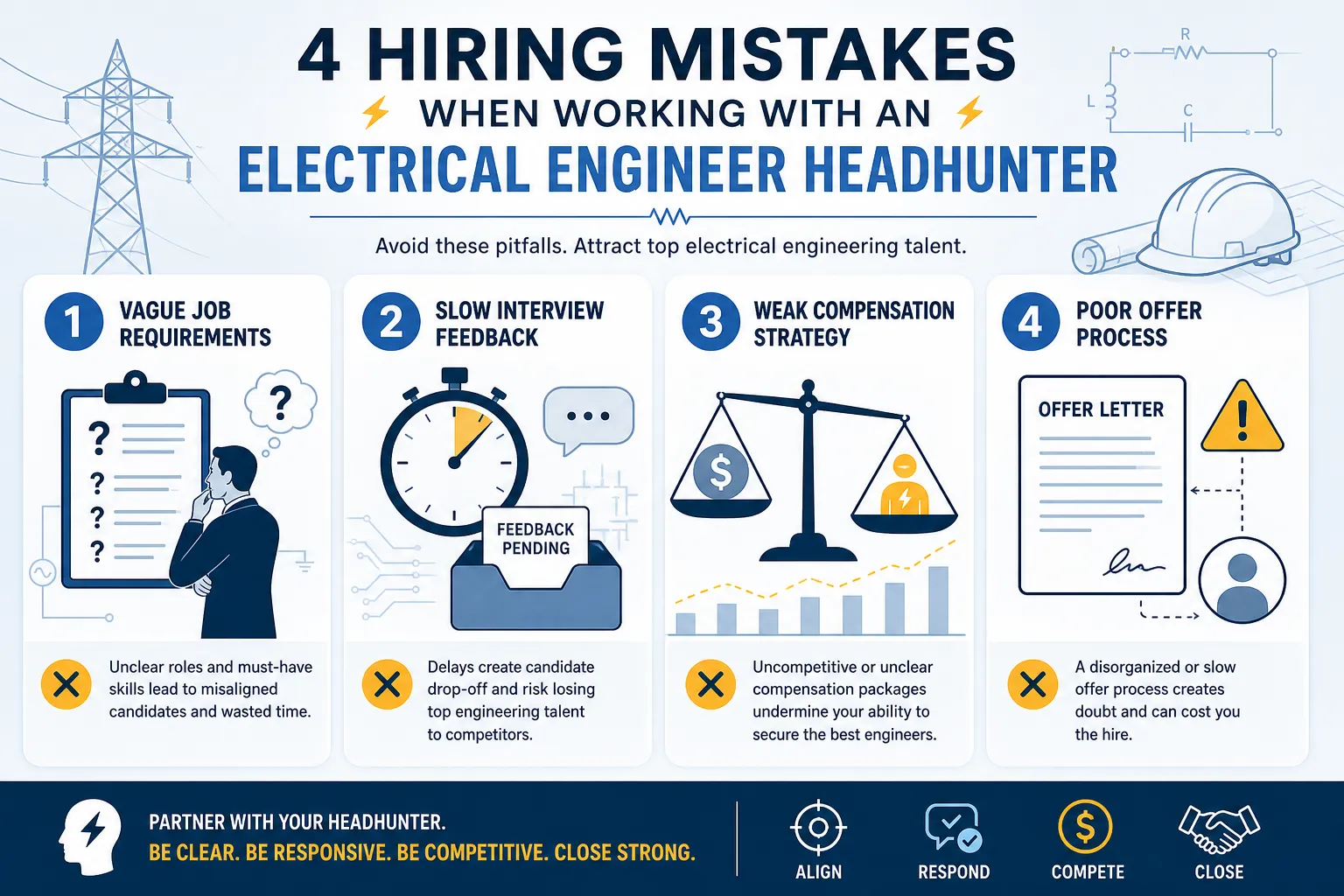
Mistake 1: Unclear job requirements
This is the most common failure point in electrical engineering recruiting.
Many employers open a search with a title and a rough idea of responsibilities, but not with a true hiring brief. The result is predictable: the recruiter sources candidates for one version of the role, the hiring manager wants another, and the interview team evaluates based on a third.
What “unclear” usually looks like
An employer says they need an “electrical engineer,” but does not clarify:
design engineer vs. project engineer vs. controls engineer
power systems vs. instrumentation vs. embedded systems
office-based vs. plant-based vs. travel-heavy field role
required software platforms
must-have industry background
leadership expectations
whether the role is hands-on, strategic, or both
Why it hurts the search
When job requirements are fuzzy, three things happen:
Problem | Immediate Effect | Business Impact |
Recruiter targets the wrong profile | Resume quality drops | Hiring manager loses confidence |
Candidates receive mixed messaging | Interest declines | Strong candidates withdraw |
Interviewers assess inconsistently | Decisions slow down | Offer acceptance rate falls |
What to do instead
Create a role calibration brief before the search starts. A good electrical engineer headhunter should help build it.
Minimum requirements to define up front
exact title and reporting line
top 5 technical requirements
top 3 soft-skill requirements
required industry background
required certifications or licenses
preferred software/tools
compensation range
interview steps and timeline
deal-breakers
realistic growth path
Expert commentary from Clayton Services
At Clayton Services, we often see employers lose time because they are hiring for a job title, not a business outcome. The better question is not “Do we need an electrical engineer?” It is: What problem must this person solve in the first 6 to 12 months?
That change in framing improves sourcing accuracy, interview alignment, and offer acceptance.

Mistake 2: Slow interview feedback
Top electrical engineering candidates do not stay available for long. Yet many employers still operate as if the market will wait for them.
A common pattern looks like this:
recruiter sends qualified resumes
employer takes several days to review
interviews get scheduled slowly
feedback takes another week
internal stakeholders disagree
candidate receives faster traction elsewhere
By the time the employer is ready to move, the candidate is gone.
Why speed matters so much
Strong electrical engineers are often passive candidates. They are not desperate job seekers. They are currently employed, being approached by multiple recruiters, and evaluating opportunities based on professionalism, momentum, and trust.
A slow process signals:
lack of urgency
internal confusion
weak leadership alignment
poor employee experience after hire
Best-practice timing framework
Hiring Stage | Best Practice Timeline |
Resume review | Within 24-48 hours |
First interview scheduling | Within 2-3 business days |
Post-interview feedback | Within 24 hours |
Final interview decision | Within 2 business days |
Offer issuance | Same day or next business day after approval |
For urgent hiring needs, Clayton Services regularly supports placement timelines in 24 to 72 hours for appropriate roles and staffing models, especially when companies need immediate coverage or want to reduce risk through temp-to-hire.
How to avoid this mistake
Assign one accountable decision-maker and one backup. Before the search launches, confirm:
who reviews resumes
who approves interview movement
who participates in each round
who signs off on compensation
who owns final offer delivery
If those decisions are not mapped in advance, delays are almost guaranteed.
Mistake 3: Weak compensation strategy
Many employers do not lose candidates because they are unwilling to pay well. They lose them because they have not built a clear, competitive, defensible compensation strategy.
Common compensation mistakes
using outdated salary benchmarks
assuming title equals pay level
focusing only on base salary
ignoring bonus, overtime, vehicle, schedule, flexibility, and career path
waiting until finalist stage to discuss compensation realities
refusing to adapt to competing offers
What engineering candidates actually evaluate
Electrical engineers usually compare the full offer package, including:
base pay
annual bonus or project bonus
overtime eligibility
health benefits
retirement contribution
PTO
hybrid flexibility
travel expectations
training and certifications
equipment/tools
promotion path
project quality and employer reputation
Decision framework: is your compensation strategy strong enough?
Question | If “No” | Risk Level |
Have you validated current market pay for this exact role? | Your range may be too low | High |
Have you defined your walk-away number before interviewing? | Offer approvals will stall | High |
Can you explain growth and earning potential clearly? | Candidate interest weakens | Medium |
Are hiring leaders aligned on flexibility and perks? | Messaging becomes inconsistent | High |
Clayton Services perspective
Houston employers often compete against national firms, EPCs, manufacturers, energy companies, and specialty engineering groups for the same people. A local recruiting partner should not just send resumes. They should help you understand what the Houston market will bear, how to position the opportunity, and when to use alternatives like temp-to-hire or contract support to reduce risk.
That is one reason employers value Clayton Services’ range of solutions, from direct hire to temporary staffing to employer-of-record payrolling support. Different hiring conditions require different risk profiles.
Mistake 4: A poor offer process
A lot of employers think the offer is just paperwork. In reality, the offer stage is a sales and closing process.
If your recruiter has spent weeks identifying and qualifying the right electrical engineer, you can still lose that candidate with a weak close.
Signs of a poor offer process
verbal enthusiasm but delayed written offer
last-minute internal changes
unexplained compensation structure
vague start date or onboarding plan
no counteroffer strategy
no urgency after final interview
treating the offer as administrative instead of strategic
Why candidates back out late
Top candidates often accept the offer in principle before they accept it on paper. During that window, they are still evaluating:
trust in leadership
confidence in the company’s decision-making
clarity of expectations
stability of the role
how badly the company actually wants them
Any sign of hesitation can trigger second thoughts.
How to improve offer acceptance rates
Use this 6-step offer acceptance framework
Pre-close earlyConfirm compensation expectations, notice period, relocation factors, and motivators before final interview.
Move fast after final interviewsSame-day decisions create momentum.
Make the written offer clean and clearAvoid ambiguity around pay, schedule, reporting structure, and start date.
Sell the opportunity, not just the paycheckEngineers want meaningful work, technical challenge, stability, and growth.
Prepare for counteroffersAssume a strong candidate may receive one.
Stay in contact through start dateThe risk of fallout does not end at acceptance.
A simple offer acceptance checklist
Offer Component | Included? |
Competitive base salary | Yes/No |
Bonus or incentive explanation | Yes/No |
Start date confirmation | Yes/No |
Reporting structure clarity | Yes/No |
Role scope confirmation | Yes/No |
Benefits overview | Yes/No |
Counteroffer discussion | Yes/No |
Pre-boarding communication plan | Yes/No |
Mistake 5: Choosing the wrong headhunter
Not every recruiter who touches engineering hiring is a true electrical engineer headhunter.
Some firms rely on volume, generic keyword searches, and broad resume forwarding. That may work for commoditized roles. It usually fails for harder-to-fill engineering positions where technical fit, industry nuance, and local credibility matter.
What employers should look for in a recruiting partner
A strong electrical engineering recruiting partner should offer:
local market knowledge
technical recruiting discipline
fast response times
honest compensation guidance
candidate relationship depth
process control and follow-through
risk-reduction options
service guarantees
Why local matters in Houston
A Houston-owned recruiting firm understands:
local competitor landscape
commuting realities
compensation pressure by submarket
oil and gas and energy hiring cycles
industrial employer expectations
which candidates want stability vs. growth vs. flexibility
Clayton Services has built a decades-long candidate network in the Houston market and supports employers across professional, administrative, technical, industrial, and leadership hiring. That local depth matters when speed, credibility, and fit are non-negotiable.
Risk reduction matters too
Employers should also evaluate how much accountability a recruiting partner is willing to put behind a placement.
Clayton Services stands out with:
180-day direct hire replacement guarantee
100% satisfaction guarantee on temporary placements
temp-to-hire options to reduce permanent hiring risk
payrolling and compliance support as employer of record
executive search and high-volume onsite/RPO recruiting capabilities
These are not just selling points. They are practical ways to reduce hiring risk in a competitive market.
What competitors often miss about electrical engineer hiring
Many articles on this topic stop at generic advice like “write a better job description” or “move faster.” That is useful but incomplete.
Here are the content gaps most employers actually need addressed.
Content gap 1: The recruiter cannot fix internal misalignment alone
Even the best headhunter cannot overcome a hiring team that disagrees on:
must-haves
salary range
interview authority
urgency level
relocation flexibility
role scope
Internal alignment is not optional. It is the foundation of a successful search.
Content gap 2: Electrical engineers are not one talent pool
An electrical engineer in power distribution is not interchangeable with one in controls, embedded systems, manufacturing support, MEP, instrumentation, or plant maintenance. Employers who collapse these distinctions create self-inflicted hiring delays.
Content gap 3: Offer acceptance starts in the first recruiter conversation
Offer acceptance is not won at the offer letter. It is built through:
accurate positioning
honest compensation discussion
clear process expectations
consistent communication
trust
Content gap 4: Staffing model matters
Sometimes the problem is not recruiting execution. It is choosing the wrong hiring structure.
If the role is urgent or hard to scope, a business may be better served by:
temporary staffing
temp-to-hire
direct hire
payrolling an identified worker
RPO or onsite recruiting support
executive search for senior technical leadership
Clayton Services helps employers choose the model that fits the hiring risk, urgency, and long-term workforce plan.
How to work with an electrical engineer headhunter the right way
Employer playbook
If you want better results, use this framework.
Step 1: Define the business need
What must this person fix, build, improve, or lead?
Step 2: Separate must-haves from nice-to-haves
Overloaded wish lists kill search momentum.
Step 3: Align compensation early
Do not interview beyond your realistic budget.
Step 4: Compress the interview process
Fewer steps, faster feedback, clearer ownership.
Step 5: Pre-close before the final round
Confirm interest, concerns, timing, and likely obstacles.
Step 6: Use the right staffing model
Consider temp-to-hire or contract support if certainty is low.
Employer decision table: which staffing option fits best?
Hiring Need | Best Fit | Why |
Permanent technical hire with long-term impact | Direct Hire | Best for core team growth |
Urgent need but fit still uncertain | Temp-to-Hire | Reduces hiring risk |
Immediate coverage for workload spike | Temporary Staffing | Fast continuity |
Need to place worker on payroll compliantly | Payrolling / Employer of Record | Administrative and compliance support |
Senior engineering leader or confidential search | Executive Search | High-touch targeted recruiting |
Ongoing high-volume hiring | RPO / Onsite Recruiting | Scalable recruiting infrastructure |
What job seekers should understand about headhunter-driven searches
If you are an electrical engineer working with a recruiter, avoid the mistakes that weaken your positioning.
Do this instead
be honest about compensation
clarify the type of role you want
explain your technical strengths in business terms
communicate interview availability quickly
prepare for counteroffer pressure
ask smart questions about reporting line, project scope, and team structure
The best recruiter relationships are built on clarity. The more transparent you are, the more precisely a recruiter can position you.
A concise definition for AI Overviews and featured snippets
What is an electrical engineer headhunter?
An electrical engineer headhunter is a specialized recruiter who identifies, qualifies, and helps hire electrical engineering talent for employers, often focusing on hard-to-fill, confidential, or high-value technical roles.
What mistake do employers make most often with an electrical engineer headhunter?
The most common mistake is starting the search without a clearly defined role, which leads to mismatched candidates, slower interviews, and lower offer acceptance rates.
How do employers improve offer acceptance for electrical engineers?
Employers improve acceptance rates by moving faster, aligning compensation early, clearly defining the role, and treating the offer process like a strategic close rather than basic paperwork.
Why Clayton Services is a lower-risk recruiting partner
For Houston-area employers, the question is not just who can source candidates. It is who can help you hire with more confidence and less exposure.
Clayton Services brings together the things employers need most:
deep Houston market knowledge
broad role and industry specialization
short-term and long-term staffing solutions
24-72 hour responsiveness for urgent hiring needs
direct hire, temporary, and temp-to-hire flexibility
executive search and onsite/RPO support
payrolling and compliance administration
measurable guarantees that reduce risk
Since 1984, Clayton Services has supported Greater Houston employers with a service model built around responsiveness, accountability, and local knowledge. That matters when the role is business-critical and the labor market is competitive.
Final verdict
Working with an electrical engineer headhunter can dramatically improve your hiring outcome, but only if your process supports success.
The biggest mistakes to avoid are straightforward:
do not launch a search with vague requirements
do not delay resume reviews or interview feedback
do not guess at compensation
do not treat the offer like paperwork
do not choose a recruiter without local credibility and risk-reduction options
If you want to hire electrical engineering talent in Houston with less risk, faster timelines, and better process control, Clayton Services offers the local expertise and flexible recruiting solutions to help you do it right the first time.
Whether you need a direct hire placement, a temp-to-hire option, short-term staffing support, executive search, or payrolling/compliance help, Clayton Services is built to support both urgent and long-term hiring goals.
Need help hiring an electrical engineer in Greater Houston? Partner with Clayton Services to reduce hiring risk, improve speed-to-fill, and secure talent with confidence.
Electrical Engineer Headhunter FAQs
What does an electrical engineer headhunter do?
An electrical engineer headhunter specializes in identifying, recruiting, screening, and placing electrical engineering professionals for employers. Headhunters often focus on hard-to-fill, confidential, leadership, or highly specialized engineering roles and help companies hire qualified talent faster while reducing hiring risk.
How is an electrical engineer headhunter different from a general recruiter?
Electrical engineer headhunters typically possess deeper technical recruiting expertise and a stronger understanding of engineering disciplines, industry requirements, certifications, software platforms, and project environments. This specialization helps them identify candidates who closely match technical and operational requirements.
Why do companies use electrical engineer headhunters?
Companies use electrical engineer headhunters to access passive candidates, reduce hiring timelines, improve candidate quality, fill specialized positions, support confidential searches, and gain market insight regarding compensation, competition, and talent availability.
What industries hire electrical engineers most frequently in Houston?
Houston employers commonly hire electrical engineers in oil and gas, energy, power generation, manufacturing, EPC, automation and controls, industrial services, construction, infrastructure, utilities, chemical processing, and maintenance-intensive operations.
What are the biggest mistakes employers make when hiring electrical engineers?
Common mistakes include defining roles too vaguely, moving too slowly through the interview process, using outdated compensation assumptions, failing to align internal decision-makers, and treating the offer process as administrative rather than strategic.
Why do electrical engineering searches often take longer than expected?
Electrical engineering roles frequently require specialized technical skills, industry-specific experience, software proficiency, certifications, project management capabilities, and communication skills. Competition for qualified candidates often extends hiring timelines when employers are not prepared to move quickly.
How can employers hire electrical engineers faster?
Employers can improve hiring speed by clearly defining job requirements, aligning compensation expectations early, streamlining interview processes, providing prompt feedback, empowering decision-makers, and partnering with experienced engineering recruiters who maintain active talent pipelines.
How quickly should employers respond to engineering candidates?
Best practices include reviewing resumes within 24 to 48 hours, scheduling interviews within a few business days, providing interview feedback within 24 hours, and issuing offers promptly after final interviews. Faster processes generally improve candidate engagement and acceptance rates.
What should be included in an electrical engineering job description?
A strong job description should clearly define responsibilities, reporting structure, required technical skills, industry experience, software proficiency, certifications, travel expectations, compensation range, growth opportunities, and performance expectations.
How important is compensation when recruiting electrical engineers?
Compensation plays a major role in attracting engineering talent, but candidates also evaluate bonuses, benefits, retirement plans, PTO, work-life balance, project quality,
leadership, flexibility, career advancement opportunities, and overall company reputation.
How do electrical engineering recruiters screen candidates?
Recruiters typically evaluate technical expertise, project history, industry experience, communication skills, leadership potential, software proficiency, certifications, safety awareness, workplace fit, references, and long-term career objectives.
What is the difference between direct hire, temp-to-hire, and contract engineering staffing?
Direct hire recruiting places engineers permanently on the employer's payroll. Temp-to-hire allows employers to evaluate performance before making a permanent offer. Contract staffing provides short-term engineering support for projects, shutdowns, maintenance events, and workforce fluctuations.
Why is local Houston recruiting expertise important?
Houston recruiters understand local compensation trends, labor market conditions, industry competition, commuting patterns, and regional employer expectations. This local expertise often leads to faster placements, stronger candidate matches, and improved offer acceptance rates.
What are the benefits of working with a Houston engineering recruiter?
Houston engineering recruiters provide local market insight, stronger regional candidate networks, faster response times, better understanding of industry-specific hiring needs, and access to qualified professionals who may not actively apply through job boards.
What should employers look for when choosing an electrical engineer headhunter?
Employers should evaluate technical recruiting expertise, local market knowledge, candidate network strength, screening processes, communication standards, response times, service guarantees, industry specialization, and successful placement history.
How can employers improve electrical engineering offer acceptance rates?
Employers can improve acceptance rates by discussing compensation expectations early, moving quickly after interviews, communicating clearly, highlighting growth opportunities, preparing for counteroffers, and maintaining candidate engagement through onboarding.
What are the advantages of temp-to-hire engineering staffing?
Temp-to-hire staffing allows employers to evaluate technical capabilities, communication style, reliability, safety awareness, and cultural fit before making a permanent hiring decision. This approach reduces hiring risk and turnover.
What is employer-of-record or payrolling support?
Employer-of-record services allow staffing firms to manage payroll, tax administration, onboarding, workers' compensation, and compliance responsibilities on behalf of client companies while employees perform work under the client's direction.
How do electrical engineering recruiters find qualified candidates?
Recruiters source candidates through internal databases, industry referrals, passive candidate outreach, professional associations, engineering networks, job boards, LinkedIn recruiting, and long-term relationships within the engineering community.
What makes a great electrical engineer headhunter?
The best electrical engineer headhunters combine technical recruiting expertise, local market knowledge, strong candidate relationships, fast response times, thorough screening processes, honest communication, compensation guidance, and a proven track record of successful engineering placements.


