
Executive Search Company: How to Choose the Best


Executive Search Company: How to Choose the Best
TL;DR
If you are hiring for a senior leadership role, choosing the right executive search company can significantly reduce hiring risk, improve candidate quality, and shorten time to fill. The best partner is not simply the biggest name or the lowest fee. It is the firm that understands your business, knows your market, can reach passive executive talent, uses a disciplined search process, and stands behind its work with meaningful accountability.
For Houston employers, that means looking beyond generic promises. Prioritize local market knowledge, function and industry specialization, senior recruiter involvement, realistic timelines, candidate assessment rigor, and post-placement support. Clayton Services brings those advantages together with Houston-rooted recruiting expertise, fast response times, flexible staffing solutions, executive search capability, payrolling and compliance support, and strong hiring guarantees that help employers hire with confidence.

Why Choosing the Right Executive Search Company Matters
When a business hires a senior leader, it is making a strategic decision, not just filling an opening. The right executive can improve performance, strengthen culture, accelerate growth, and build capable teams. The wrong hire can create disruption across departments, delay business goals, and increase turnover far beyond the leadership role itself.
Houston employers often feel this pressure acutely. Whether you are hiring a CFO, operations leader, HR executive, engineering director, plant manager, general counsel, or customer-facing business unit leader, the pool of truly qualified candidates is smaller than it appears. The most desirable executives are often not actively applying. They are already employed, already performing, and usually only willing to engage through a credible recruiter or executive search recruiter with the right market insight.
That is where an executive search agency becomes valuable. But not all executive search firms deliver the same level of search discipline, communication, candidate quality, or accountability.
"A failed executive hire can cost up to 213% of the position's annual salary." - Forbes
Quick Answer: What Is an Executive Search Company?
An executive search company is a recruiting firm that specializes in finding, evaluating, and helping employers hire senior-level leaders. Unlike standard recruiting models that depend heavily on applicants, executive headhunters proactively identify and approach qualified passive talent, assess leadership fit, manage confidentiality, and guide both client and candidate through a high-stakes hiring process.
In practical terms, an executive search company should help you:
Define the role and success profile clearly
Map the market and identify target companies
Reach passive and active executive talent
Evaluate experience, leadership style, and cultural fit
Manage a confidential, structured process
Improve the odds of long-term retention
When to Use an Executive Search Firm
Not every hire requires retained executive search. But there are clear situations where using an executive recruiting agency is the smarter move.
Use executive search when the role is business critical
If the person you hire will shape revenue, compliance, operations, people strategy, customer experience, or growth execution, the hire is too important for a casual recruiting process.
Use executive search when qualified candidates are hard to reach
The best executive headhunter firms do not wait for resumes to appear. They go into the market, identify the right leaders, and create interest among people who are not job hunting.
Use executive search when confidentiality matters
Replacing a current leader, planning succession, entering a new market, or restructuring a business unit often requires discretion. A professional executive search group can protect confidentiality while still reaching strong candidates.
Use executive search when internal bandwidth is limited
Many HR teams and hiring managers are already balancing urgent openings, onboarding, retention, and day-to-day operations. A specialized executive search company adds dedicated bandwidth and senior-level recruiting focus.
Use executive search when the cost of a miss is too high
If a mis-hire could set the company back six to twelve months, the right search process is worth the investment.
What the Best Executive Search Firms Do Differently
Many firms say they offer executive search solutions. Fewer actually operate with the rigor employers need. Here is what separates the best executive search firms from average providers.
They learn the business before they present candidates
Strong executive search operations begin with deep intake, not shallow intake. They want to know the business model, leadership team, reporting structure, cultural realities, growth priorities, compensation framework, and the difference between preferred traits and must-have traits.
If a firm starts sending resumes before it understands your business, that is a warning sign.
They evaluate fit, not just credentials
A candidate can look impressive on paper and still fail in your environment. The best executive search firms assess leadership style, communication ability, team impact, adaptability, motivation, and the specific kind of pressure the role will involve.
They have access to passive executive talent
The strongest firms know how to reach executives who are not applying online. That is one of the most important distinctions between professional headhunters and traditional resume-based recruiting.
They use a defined, repeatable search process
Top executive search companies do not rely on instinct alone. They use structure. That includes market mapping, calibrated outreach, screening, interviews, candidate evaluation, reference checking, and search updates tied to milestones.
They are transparent about risk, timelines, and market realities
A credible executive search recruiter will tell you what the talent market looks like, whether your compensation is aligned, what candidate objections may arise, and what tradeoffs you may need to make.
A Better Decision Framework for Houston Employers
Many articles explain what executive search is, but they stop short of giving employers a practical evaluation model. Here is a simple framework you can use when comparing any executive search firm.
The 7-Factor Executive Search Scorecard
Factor | What to Look For | Why It Matters |
Market Knowledge | Deep understanding of Houston and your hiring geography | Improves candidate targeting and close rates |
Industry Expertise | Relevant placements in your sector or adjacent sectors | Reduces ramp time and improves judgment |
Functional Expertise | Experience hiring for the exact leadership function | Better evaluation of leadership capability |
Search Process | Clear, structured methodology with milestones | Improves consistency and accountability |
Candidate Quality | Evidence of passive talent access and strong vetting | Reduces interviewing waste |
Communication | Fast updates, honest feedback, direct access to lead recruiter | Keeps momentum and trust high |
Guarantees and Support | Replacement guarantee, onboarding support, client care | Reduces employer risk |
A firm does not need to be perfect in every category. But if it is weak in several, you are likely taking on unnecessary hiring risk.
Executive Search vs Traditional Recruiting vs Temp-to-Hire
Houston employers often have more than one viable path depending on the role. Executive search is not the answer to every hiring challenge. A strong recruiting partner should help you choose the right model, not push the same answer for everything.
Hiring Need | Best Fit | Why |
C-suite, VP, director, confidential replacement | Executive search | High-touch search, passive candidate outreach, leadership assessment |
Professional salaried roles with active market talent | Direct hire recruiting | Faster process for manager and specialist roles |
Uncertain long-term fit or immediate coverage need | Temp-to-hire | Reduces risk while evaluating on-the-job performance |
Sudden staffing gaps or project surges | Temporary staffing | Speed and workforce flexibility |
Multi-role hiring or embedded recruiting support | RPO or onsite recruiting | Scalable process support |
Need to engage talent without adding to payroll burden | Payrolling services | Employer of record and compliance support |
This is one reason Clayton Services is especially valuable to Houston employers. The company is not limited to a single hiring model. It supports direct hire recruiting, temporary staffing, temp-to-hire, executive searches, onsite/RPO recruiting, and payrolling support. That flexibility helps employers choose based on business need, timeline, and risk tolerance, not just agency preference.
The Executive Search Process Employers Should Expect
A strong executive search company should be able to walk you through each phase of the engagement with clarity.
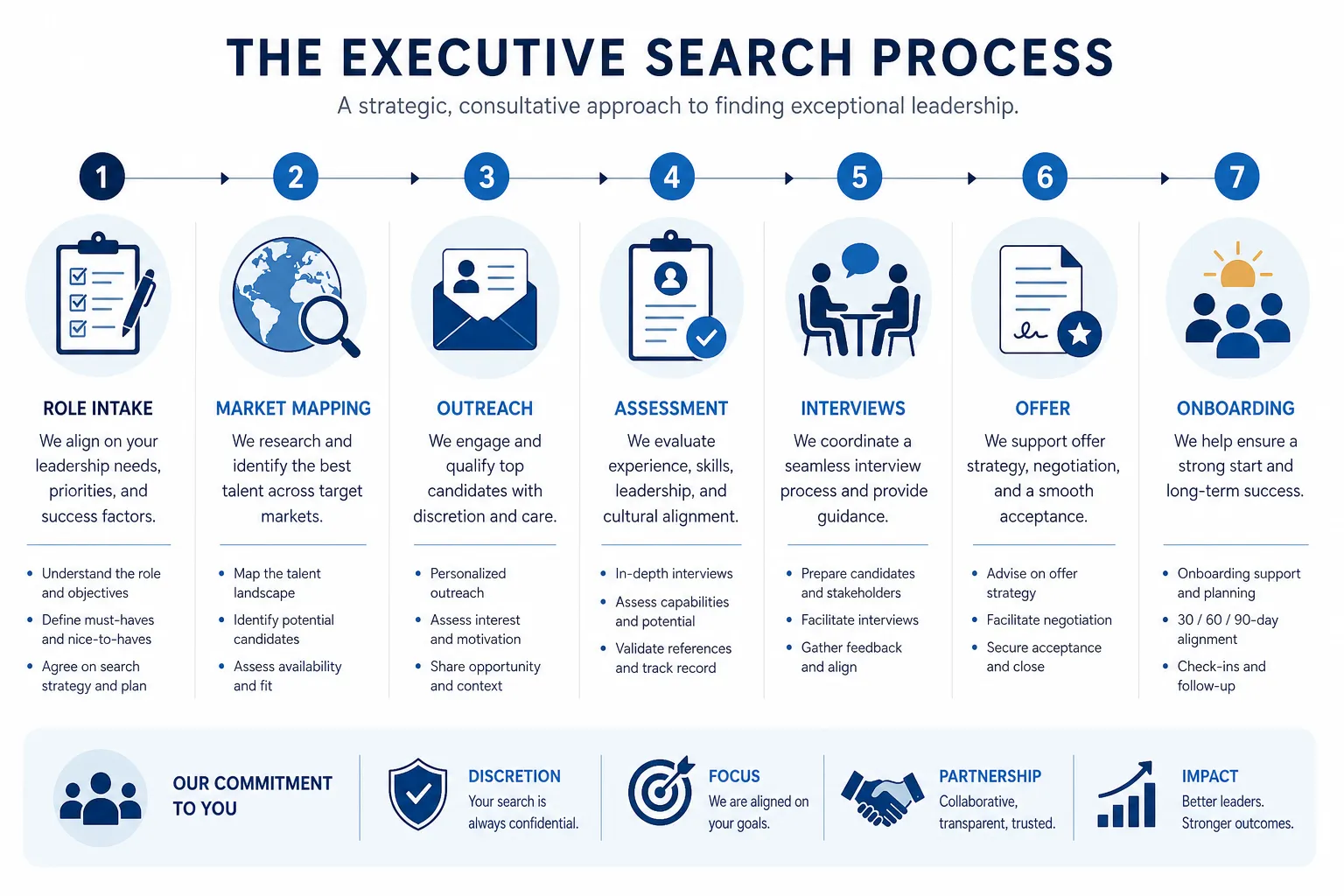
1. Discovery and role calibration
This phase should cover business context, reporting structure, success metrics, leadership challenges, compensation, and hiring process alignment.
2. Market mapping and target identification
The firm identifies likely talent sources, competitor organizations, adjacent backgrounds, and candidate profiles worth pursuing.
3. Outreach and engagement
This is where executive search headhunters add value. They contact relevant leaders directly, position the opportunity professionally, and gauge interest.
4. Screening and assessment
Candidates should be assessed for technical qualifications, leadership impact, communication, motivation, stability, and fit with your business stage and culture.
5. Shortlist presentation
You should receive a curated slate, not a stack of loosely relevant resumes.
6. Interview coordination and feedback management
The firm should keep momentum moving, manage scheduling, prepare candidates, gather feedback, and help your team make efficient decisions.
7. Offer strategy and close
Senior-level offers require care. Compensation, relocation, bonus structure, timing, resignation risk, and competing opportunities all need active management.
8. Post-placement follow-through
The process should not end at acceptance. Strong firms support onboarding and retention, especially in the first 90 to 180 days.
Red Flags to Watch for When Evaluating Executive Search Firms
If you are comparing executive search companies, here are the most common warning signs.
Generic sales language
If the firm sounds polished but cannot explain how it will run your search differently from any other role, be cautious.
Junior team handoff
Some firms sell with senior talent and deliver with less experienced recruiters. Ask exactly who will lead the assignment.
Overreliance on a database
A database can support a search. It should not be the search strategy. Great executive job recruiter work depends on relationships, targeting, and outreach.
Unrealistic promises
No credible firm can guarantee the perfect candidate immediately. Executive searches require rigor, calibration, and persistence.
Weak intake process
If the recruiter does not ask about business objectives, team dynamics, leadership gaps, or culture, it is not doing true executive search.
Vague references to candidate fit
Ask how the firm evaluates leadership style, stakeholder management, decision-making, and retention factors.
No meaningful guarantee
For high-stakes hiring, accountability matters. A firm that stands behind its work gives employers more confidence.

What Houston Employers Should Ask Before Hiring an Executive Search Company
Use these questions in your evaluation process.
About experience and specialization
What executive roles have you filled that are similar to ours?
Which industries and functions do you know best?
How familiar are you with the Houston market for this type of leader?
About the search process
How do you identify and engage passive candidates?
How do you assess leadership fit and culture fit?
What does your reporting cadence look like during the search?
How many qualified candidates do you typically present?
About execution
Who will personally lead the search?
How many searches are they handling right now?
What timeline do you believe is realistic for this role?
About accountability
What happens if the placement does not work out?
What guarantees do you provide?
How do you support the employer and candidate after acceptance?
What Executive Search Fees Usually Look Like
Executive search fees vary by role seniority, market complexity, compensation level, and search scope. In many cases, firms charge a percentage of first-year base salary or total compensation. For leadership hiring, employers should focus less on price in isolation and more on total value.
A lower fee can become very expensive if the process is weak, the candidate pool is thin, or the hire fails. The right question is not just "What does the search cost?" but "What risk does the search reduce?"
For employers weighing alternatives, Clayton Services offers another strategic advantage. In addition to executive search, it can support direct hire, temp-to-hire, temporary staffing, and payrolling. That means employers can choose a lower-risk or staged hiring approach where appropriate, especially when long-term fit is not fully clear at the start.
The Often-Missed Content Gap: How to Judge Candidate Quality Before the Interview
Most articles tell employers to ask about process. Fewer explain how to judge whether the candidates coming from an executive search agency are actually high quality before you start interviewing.
Use this checklist:
Candidate Quality Signal | What Good Looks Like |
Clear relevance | Experience aligns directly with your business needs |
Career logic | Job moves make sense and show progression |
Leadership scope | Team size, budget, complexity, and decision authority are defined |
Measurable impact | Results are concrete, not vague |
Motivation | Candidate has a believable reason to consider your role |
Communication | Summary and presentation reflect executive-level clarity |
Fit rationale | Recruiter explains why this person fits your environment |
If profiles arrive without this context, you are doing too much of the recruiter’s work.
Another Missed Content Gap: Executive Search for Mid-Sized and Growth-Stage Companies
Many guides imply executive search is only for massive corporations. That is not true.
Mid-sized businesses often need executive search even more because each leadership hire has an outsized effect on culture, execution, and growth. A new controller, operations executive, head of HR, engineering leader, or division director can reshape the business quickly, for better or worse.
Houston-based growth companies also face a common challenge. They need leadership talent sophisticated enough to scale systems and teams, but practical enough to thrive in hands-on environments. This is where a locally knowledgeable recruiting partner can outperform a generic national provider. Clayton Services has built its candidate network in the Houston market over decades, which helps employers access professionals who understand the region, the industries, and the pace at which local businesses operate.
Why Local Market Knowledge Matters More Than Many Employers Realize
A national search firm may have broad reach. That can be useful. But reach alone does not equal insight.
For Houston employers, local knowledge can improve outcomes in several ways:
Better understanding of compensation expectations by industry and submarket
Familiarity with regional commuting realities and relocation objections
Awareness of which employers produce strong talent in certain functions
Better judgment about cultural fit within Houston business environments
Faster, more credible communication with local candidates
Clayton Services has served Greater Houston since 1984. That local longevity matters. It means the recruiting team is not learning the market as it goes. It already knows the market, the employers, and the talent patterns that shape hiring success here.
Executive Search for Job Seekers: What Candidates Should Know
While this guide is aimed primarily at employers, job seekers also search for answers about executive search firm jobs, executive search firms for candidates, and best executive search firms for job seekers. Here is the most useful truth.
Executive search firms work for the employer, but strong firms still create value for candidates by presenting relevant roles, communicating clearly, and protecting confidentiality. The best executive search firms for candidates do not pressure people into poor-fit moves. They provide context, set expectations, and advocate for alignment between the employer’s needs and the executive’s long-term goals.
For professionals in Houston exploring leadership opportunities, it is smart to build relationships with recruiters who specialize in your function and market, not just submit resumes broadly.
"According to Gallup, 42% of employee turnover is preventable but often ignored." - Gallup
That insight matters in executive recruiting. Retention starts before the offer is signed. It begins with accurate role definition, honest communication, fit assessment, and onboarding support.
How Clayton Services Helps Employers Reduce Hiring Risk
Choosing an executive search company is really about choosing a risk-management partner for one of your most important hiring decisions. Clayton Services offers several practical advantages for Houston-area employers.
Houston-owned and locally knowledgeable
Clayton Services is not a distant national chain trying to approximate the Houston market. It is a Houston-based staffing agency and recruiting firm with decades of local presence and candidate relationships.
Broad specialization across industries and roles
The company supports hiring across accounting and finance, administrative, customer service, engineering, HR, IT, legal, marketing, medical administrative, oil and gas and energy, sales, supply chain and logistics, light industrial, and skilled trades. That breadth helps when leadership roles intersect with specialized business functions.
Flexible hiring solutions beyond executive search
If your hiring need changes midstream, Clayton Services can support short-term staffing, long-term hiring, temp-to-hire transitions, direct hire recruiting, onsite/RPO recruiting, and payrolling services as employer of record. That flexibility is especially useful for companies balancing urgency with uncertainty.
Fast response for urgent hiring needs
For many staffing and recruiting needs, Clayton Services can move quickly with placement timelines in the 24 to 72 hour range. While executive search naturally requires more calibration and assessment, responsiveness still matters, and speed in adjacent hiring categories can keep operations moving.
Strong guarantees that reduce employer risk
Clayton Services publicly emphasizes a 180-day direct hire replacement guarantee and a 100% satisfaction guarantee on temporary placements. For employers, this reflects accountability, confidence, and a real commitment to outcomes.
Payrolling and compliance support
Some employers need access to talent without taking on immediate employer-of-record obligations. Clayton Services can support payrolling and compliance, helping companies stay focused on operations while reducing administrative burden.
How to Choose the Best Executive Search Company: Final Checklist
If you want a concise decision tool, use this final checklist.
Choose the firm that can clearly answer yes to most of these questions
Do they understand our industry and leadership function?
Do they know the Houston market well?
Will a senior recruiter lead the work?
Can they explain their search process step by step?
Do they reach passive executive talent directly?
Do they assess leadership and cultural fit in a structured way?
Will they communicate consistently and honestly?
Do they offer a meaningful guarantee or risk-sharing element?
Can they support other hiring models if our needs evolve?
Do we trust them to represent our company well in the market?
If the answer is no on several of those points, keep looking.
Final Verdict
The best executive search company is not simply the most recognizable name, the biggest office footprint, or the firm with the smoothest pitch. It is the partner that understands your business, knows your hiring market, reaches the right leaders, communicates clearly, and stands behind results.
For Houston employers, that decision should also include local credibility, speed, hiring flexibility, and reduced risk. Clayton Services brings all of those together. With a Houston-owned recruiting team, decades-long market network, executive search capability, temp-to-hire and direct hire solutions, employer-of-record support, and strong placement guarantees, Clayton Services offers a practical and accountable path to better hiring outcomes.
If you need help with a confidential leadership hire, a hard-to-fill professional role, or a broader recruiting strategy, Clayton Services is built to support both immediate needs and long-term workforce goals.
Frequently Asked Questions
What is an executive search company?
An executive search company is a recruiting firm that specializes in finding, evaluating, and helping employers hire senior-level leaders. Unlike standard recruiting that depends heavily on applicants, executive search firms proactively identify and approach qualified passive talent, assess leadership fit, manage confidentiality, and guide both client and candidate through a high-stakes process. A strong firm helps you define the success profile, map the market, reach passive executives, evaluate leadership style and cultural fit, and improve long-term retention.
How do I choose the best executive search firm?
Look beyond brand name and fee. Evaluate firms across seven factors: local market knowledge, industry expertise, functional expertise in the exact leadership role, a clear and structured search process, candidate quality and passive-talent access, communication and direct access to the lead recruiter, and meaningful guarantees with post-placement support. A firm doesn't need to be perfect in every category, but weakness across several means you're taking on unnecessary hiring risk.
When should I use an executive search firm?
Use executive search when the role is business-critical and will shape revenue, compliance, operations, or growth; when qualified candidates are hard to reach and aren't applying online; when confidentiality matters for a replacement, succession, or restructuring; when internal HR bandwidth is limited; and when the cost of a mis-hire is too high. If a bad hire could set the company back six to twelve months, a disciplined search process is worth the investment.
How much does a bad executive hire cost?
A failed executive hire can cost up to 213% of the position's annual salary according to Forbes. That's why leadership hiring should be evaluated on risk reduction, not fee alone. A lower search fee becomes very expensive if the process is weak, the candidate pool is thin, or the hire fails—so the right question isn't just "what does the search cost?" but "what risk does the search reduce?"
How much do executive search firms charge?
Executive search fees vary by role seniority, market complexity, compensation level, and search scope. Firms commonly charge a percentage of the executive's first-year base salary or total compensation, often through a retained structure paid in stages. For leadership hiring, employers should focus less on price in isolation and more on total value and the risk the search reduces. Clayton Services also offers lower-risk alternatives like direct hire and temp-to-hire when long-term fit isn't clear at the start.
What does the executive search process look like?
A strong engagement moves through eight phases: discovery and role calibration, market mapping and target identification, direct outreach and engagement, screening and leadership assessment, shortlist presentation of a curated slate, interview coordination and feedback management, offer strategy and close, and post-placement follow-through during the first 90 to 180 days. The process shouldn't end at acceptance—onboarding and retention support are where strong firms separate themselves.
What are the warning signs of a weak executive search firm?
Watch for generic sales language that can't explain how your search will differ from any other, selling with senior talent but delivering with junior recruiters, overreliance on a database instead of active outreach, unrealistic promises of an immediate perfect candidate, a weak intake process that skips business objectives and culture, vague references to candidate fit, and no meaningful guarantee. For high-stakes hiring, accountability and senior recruiter involvement matter most.
What is the difference between executive search and traditional recruiting?
Executive search is a high-touch, proactive process for C-suite, VP, director, and confidential roles—built around passive candidate outreach and leadership assessment. Traditional direct hire recruiting is faster and fits professional or specialist roles where active market talent exists. For uncertain long-term fit you might use temp-to-hire, for sudden gaps temporary staffing, and for multi-role hiring RPO or onsite recruiting. The best partner helps you choose the right model rather than pushing the same answer for everything.
Do mid-sized and growth-stage companies need executive search?
Yes—often more than large corporations. Each leadership hire at a smaller company has an outsized effect on culture, execution, and growth, so a mis-hire is harder to absorb. Houston growth companies face a particular challenge: they need leaders sophisticated enough to scale systems and teams but practical enough to thrive hands-on. A locally knowledgeable partner often outperforms a generic national provider because it knows which local talent fits that profile.
Why does local Houston market knowledge matter in executive search?
National reach doesn't equal local insight. Houston market knowledge improves outcomes through better understanding of compensation expectations by industry and submarket, familiarity with commuting and relocation objections, awareness of which employers produce strong functional talent, sharper judgment about cultural fit, and faster, more credible communication with local candidates. Clayton Services has served Greater Houston since 1984, so its team already knows the market, employers, and talent patterns rather than learning as it goes.


