
How Third-Party Recruiters Help Houston Teams Hire


How Third-Party Recruiters Help Houston Teams Hire
Hiring in Houston moves fast, but not always in a straight line. One week you need an accounting manager, two customer service reps, and a forklift-certified warehouse lead. The next week, an urgent project creates demand for contract staff, or a department leader resigns and leaves a gap that cannot stay open for long. That is exactly where third party recruiters, third party recruiting companies, and a trusted third party job recruiter can create real value.
For Houston-area employers, the right recruiting partner does much more than send resumes. A strong third-party recruiting firm helps reduce hiring delays, improve candidate quality, lower compliance risk, and give hiring managers back their time. For job seekers, the right recruiter can open doors to better-fit opportunities, faster interview cycles, and roles that may never be posted publicly.
Clayton Services has supported employers and candidates across Greater Houston since 1984. As a Houston-owned staffing agency and recruiting firm, we understand the local labor market in ways national chains often cannot. From direct hire recruiting and temporary staffing to temp-to-hire, payrolling, executive search, and onsite/RPO support, we help Houston teams hire with more confidence and less risk.

What Are Third-Party Recruiters?
Third-party recruiters are outside recruiting specialists hired by employers to source, screen, and present qualified candidates for open roles. They are not internal HR staff, but they work as an extension of the hiring team.
A third-party recruiter may support:
Direct hire searches for permanent employees
Temporary staffing for short-term workload spikes
Temp-to-hire placements to reduce hiring risk
Executive search for leadership and confidential roles
Payrolling services when a company identifies talent but needs an employer of record
Onsite or RPO recruiting for high-volume or ongoing hiring
In practice, this means a Houston employer can lean on a recruiting partner to handle time-consuming tasks like talent sourcing, pre-screening, interview coordination, reference checks, market feedback, and candidate communication.
Why Houston Employers Turn to Third Party Recruiting Companies
Houston is not a one-size-fits-all hiring market. Employers here often hire across a broad mix of office, industrial, technical, and leadership roles. That creates a challenge: the sourcing strategy for an administrative assistant is different from the strategy for a project engineer, accounts payable specialist, customer service rep, CDL-related logistics hire, or skilled trades professional.
Third party recruiting companies help solve that complexity by bringing:
Existing talent pipelines
Specialized recruiters by function or industry
Faster response times
Screening discipline
Local compensation awareness
Backup hiring options when internal recruiting bandwidth is limited
"As of March 2026, there were approximately 6.87 million job openings in the United States." - U.S. Bureau of Labor Statistics
That level of competition matters. When employers wait too long, strong candidates are often already interviewing elsewhere. A responsive recruiting partner helps keep your process moving before talent disappears from the market.
How Third-Party Recruiters Actually Help Teams Hire Faster
Many articles stop at “recruiters save time,” but the real advantage is more specific. Third-party recruiters speed up hiring because they shorten the slowest parts of the process.
1. They compress sourcing time
Instead of posting a job and hoping applicants appear, recruiters actively search their database, referrals, passive-candidate network, and local contacts. Clayton Services has built that Houston network over decades, which matters when the best candidates are not actively applying.
2. They pre-qualify candidates before your team gets involved
A quality recruiter does more than confirm a resume. They validate:
Relevant experience
Stability and work history
Availability
Compensation expectations
Location and commute fit
Technical skills
Communication quality
Interest level in the role
This means hiring managers spend less time reviewing unqualified applicants.
3. They keep momentum with candidate communication
One hidden cause of slow hiring is silence. Candidates lose interest when nobody follows up. Third-party recruiters keep communication moving between employer and applicant, reducing drop-off.
4. They align the search with the real market
If the job title, pay range, requirements, or timeline do not match market reality, a good recruiter will say so early. That feedback can prevent weeks of wasted effort.
5. They provide flexible hiring paths
Sometimes the fastest permanent hire starts as temporary or temp-to-hire. When timing is critical, a recruiter can help you put productive talent in place while you evaluate long-term fit.
The Recruiting Workflow: Where a Third Party Job Recruiter Adds Value
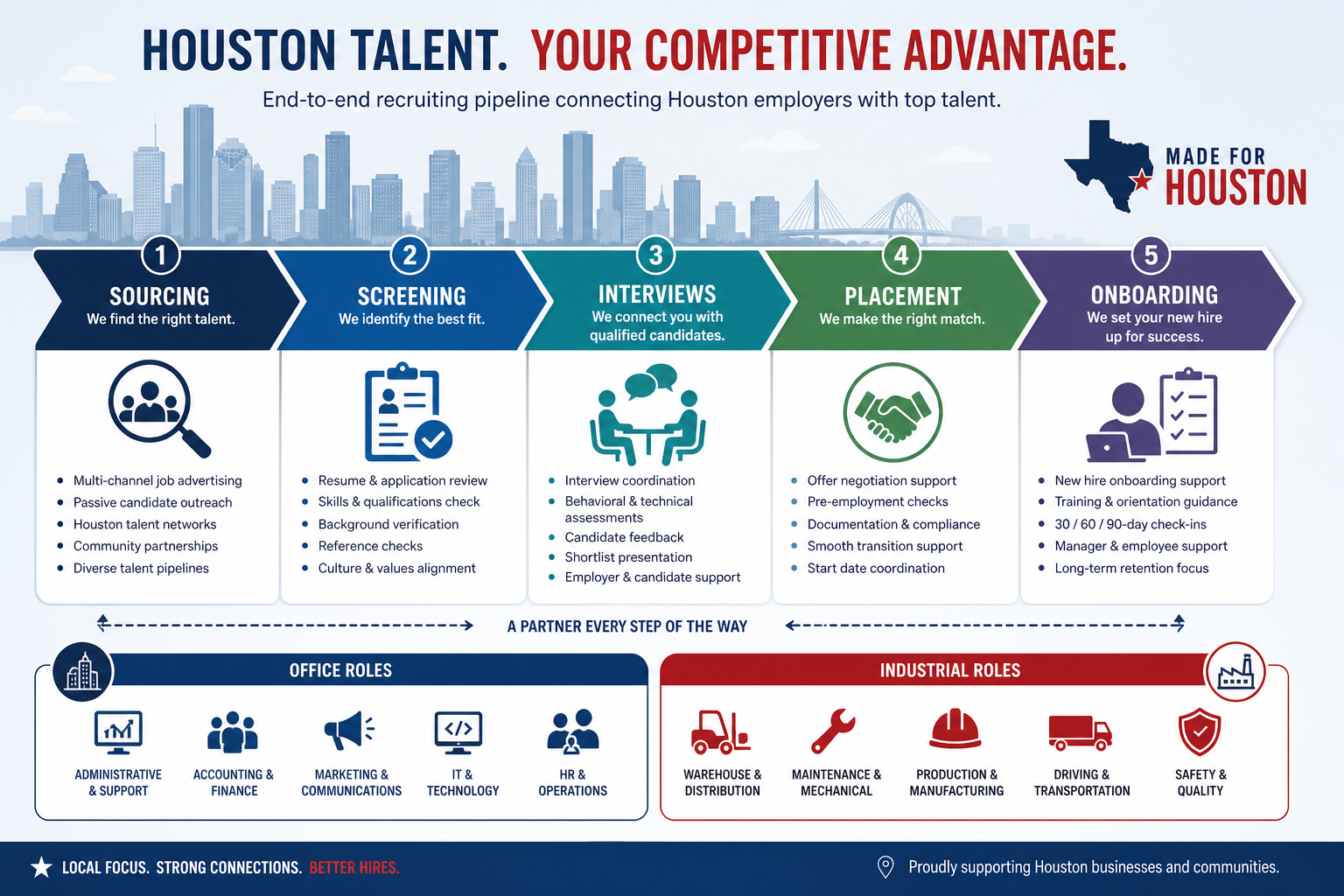
Here is how the process usually works when employers use a third-party recruiting partner effectively:
Hiring Stage | What the Employer Handles | What the Recruiter Handles |
Intake | Define business need, goals, team context | Refine job profile, advise on market conditions |
Sourcing | Final approval of requirements | Search database, referrals, passive talent, outreach |
Screening | Review shortlist | Resume review, phone screens, qualification checks |
Interviewing | Conduct interviews, team evaluations | Schedule interviews, prep candidates, gather feedback |
Offer Stage | Make final decision and offer | Negotiate expectations, maintain engagement |
Start/Onboarding | Internal onboarding plan | Pre-start follow-up, risk mitigation, transition support |
At Clayton Services, this workflow is tailored to the type of search. Some clients need one critical direct-hire professional. Others need a short-term staffing solution within 24 to 72 hours. Others need payrolling support or a full onsite recruiting structure for higher-volume hiring.
Where Third-Party Recruiters Make the Biggest Difference
Not every role is equally difficult to fill, but third-party recruiters tend to deliver the strongest return in a few common situations.
Hard-to-fill professional roles
These include positions in:
Accounting and finance
Human resources
Legal support
Engineering
Information technology
Marketing
Sales
Medical administrative
Supply chain and logistics
These roles often require a narrower skill set and stronger soft-skill alignment than job boards alone can reliably deliver.
Time-sensitive hiring
If a vacancy is affecting service, production, customer response, project delivery, or team morale, speed matters. A local recruiter can often produce qualified candidates faster than an internal team starting from scratch.
Confidential hiring
When replacing a current employee or searching for leadership, discretion matters. Executive search support helps protect confidentiality while maintaining process quality.
Short-term or variable staffing needs
For project-based work, leave coverage, seasonal volume, or demand spikes, temporary staffing gives employers flexibility without overcommitting.
Risk-sensitive permanent hiring
Temp-to-hire can be the right middle ground when an employer wants to evaluate performance, reliability, and team fit before making a long-term commitment.
Why Local Houston Market Knowledge Matters
A recruiter who knows Houston understands more than zip codes. They understand the differences between labor pools, commuting patterns, industry clusters, compensation expectations, and candidate behavior across the metro area.
"From November 2025 to February 2026, Houston payrolls increased at an annualized rate of 1.2%, adding approximately 10,300 jobs." - Federal Reserve Bank of Dallas
That kind of market movement affects candidate availability, pay pressure, and speed to hire.
A Houston-focused recruiting partner can advise on realities such as:
Whether a Northwest Houston commute will limit applicant flow
How energy hiring affects engineering and administrative competition
Which suburban submarkets are stronger for industrial labor
How pay rates compare across similar roles
When to use temp-to-hire instead of direct hire
Whether your job description is too narrow for the current market
Clayton Services has served Greater Houston since 1984, which gives employers practical, local insight that goes beyond generic recruiting advice.

Third-Party Recruiters vs. Internal Hiring Teams
This is not an either-or decision. The best recruiting outcomes often come when internal teams and external recruiters work together clearly.
Internal teams are strongest at:
Employer branding
Internal approvals
Team-based interview decisions
Onboarding and retention
Long-term workforce planning
Third-party recruiters are strongest at:
Speed and urgency
Passive-candidate outreach
Specialized niche searches
Temporary staffing and temp-to-hire
Hiring surges and backfill support
Market intelligence and compensation feedback
For many Houston employers, the best setup is using a trusted outside partner when hiring volume spikes, internal bandwidth tightens, or a role is too important to leave open.
Common Use Cases for Houston Employers
Below are some of the most common ways local employers use third party recruiting companies.
Direct hire recruiting
Best when you need a full-time employee and want a stronger slate of qualified candidates than job board applicants alone.
Clayton Services supports direct hire searches with a 180-day replacement guarantee, which helps reduce employer risk on important permanent hires.
Temporary staffing
Best for immediate needs, project support, employee leave coverage, and seasonal demand. This is especially valuable when productivity cannot wait for a full permanent search.
Clayton Services backs temporary placements with a 100% satisfaction guarantee, helping employers move quickly with more confidence.
Temp-to-hire staffing
Best when you want to evaluate attendance, technical ability, work habits, and team fit before extending a permanent offer.
This model reduces hiring risk and is often ideal for employers who have been burned by rushed permanent hires in the past.
Payrolling services
Best when you have already found the worker but need support with onboarding, payroll taxes, workers’ compensation, and employer-of-record compliance.
This can simplify expansion, contract hiring, and project staffing.
Executive search
Best for leadership, confidential replacements, and highly specialized business-critical roles where the cost of a bad hire is substantial.
Onsite/RPO recruiting
Best for employers with recurring or high-volume needs that require deeper recruiting support embedded into the operation.
What Good Screening Support Should Include
One major reason employers use a third party job recruiter is screening. But “screening” should mean more than a resume keyword check.
A strong recruiting process should evaluate:
Core technical fit
Industry relevance
Tenure patterns
Communication skills
Motivation for change
Availability and notice period
Compensation alignment
Shift or schedule compatibility
Transportation or commute reliability
Culture and manager-fit factors
For industrial and skilled roles, this may also include:
Safety awareness
Certification validation
Equipment familiarity
Physical job compatibility
Schedule flexibility
For office and professional roles, it may include:
Software proficiency
Presentation and communication quality
Stakeholder management ability
Multi-tasking or customer-facing readiness
The goal is not just to send resumes. It is to send candidates who are realistically placeable.
What Competitor Articles Often Miss
Many articles about third-party recruiters explain the basics but miss the operational details employers actually care about. These are the content gaps that matter most.
They rarely explain risk reduction clearly
The real question is not just “Should I use a recruiter?” It is “How does a recruiter lower the chance of a bad hire?” The answer includes:
Temp-to-hire options
Replacement guarantees
Better pre-screening
Faster backfill support
Payrolling and compliance management
Reduced downtime from open seats
Clayton Services stands out here with a 180-day direct hire replacement guarantee and 100% satisfaction guarantee on temporary placements.
They underplay response speed
For many employers, the issue is not finding a recruiter. It is finding one who can move now. For urgent staffing needs, Clayton Services can often deliver qualified candidates within 24 to 72 hours, depending on role type and requirements.
They overlook employer-of-record and compliance support
A lot of businesses need flexibility without adding HR or payroll complexity. Payrolling services and employer-of-record support can be a major operational advantage, especially for projects, trial periods, or specialized contract talent.
They do not connect recruiting strategy to job type
The right hiring model depends on the role, urgency, and business risk. A recruiter should help you choose between direct hire, temp, temp-to-hire, executive search, or RPO instead of pushing one model for every situation.
How to Choose the Right Third-Party Recruiting Partner in Houston
Not all recruiters operate the same way. If you are evaluating third party recruiting companies, ask these questions:
1. Do they know the Houston market?
A local firm should be able to discuss labor availability, compensation pressure, commute realities, and industry trends across Greater Houston.
2. Do they recruit in your function or industry?
General staffing can help in some cases, but specialized recruiting usually improves quality for business-critical roles.
3. How fast can they realistically deliver candidates?
Ask for typical timelines by role type. Speed without quality is not enough, but slow recruiting can be expensive too.
4. What screening steps do they actually perform?
You want clarity on interviews, references, skill validation, and fit assessment.
5. What guarantees back the service?
Guarantees show accountability. Clayton Services’ direct hire and temporary placement guarantees are meaningful differentiators for risk-conscious employers.
6. Can they scale with your needs?
A recruiter should support both short-term and long-term hiring, from one-off placements to high-volume recruiting support.
7. Do they offer payrolling or employer-of-record support?
That flexibility can be valuable when headcount rules, project structures, or onboarding timing create internal constraints.
Signs It Is Time to Use a Third Party Job Recruiter
You may benefit from outside recruiting support if:
Your team is overloaded with resumes but not seeing quality
Roles stay open longer than expected
Managers are spending too much time interviewing poor-fit candidates
You need hiring help across both office and industrial roles
A confidential or leadership search is coming up
Turnover has made you cautious about direct hire risk
You need staff fast, but your internal process is stretched
You have found talent but need payroll/compliance support
You need a recruiting partner, not just a resume sender
How Clayton Services Helps Houston Teams Hire Smarter
Clayton Services is built for Houston employers who need hiring support that is responsive, accountable, and locally informed.
What makes Clayton Services different
Clayton Services Advantage | Why It Matters to Employers |
Houston-owned since 1984 | Deep local market knowledge and long-standing candidate relationships |
Broad specialization across office, professional, technical, industrial, and leadership roles | One partner can support multiple departments and hiring types |
Fast placement timelines, often within 24–72 hours for urgent needs | Reduces downtime and operational disruption |
180-day direct hire replacement guarantee | Lowers risk on permanent hiring decisions |
100% satisfaction guarantee on temporary placements | Adds confidence and accountability for short-term staffing |
Temp-to-hire solutions | Lets employers assess fit before making permanent offers |
Payrolling and employer-of-record support | Simplifies compliance, onboarding, and payroll administration |
Executive search and onsite/RPO capabilities | Supports both strategic leadership hires and large-scale hiring demands |
Clayton Services works across key hiring areas including:
Accounting and finance
Administrative and office support
Customer service
Engineering
Human resources
Information technology
Legal
Marketing
Medical administrative
Oil and gas/energy
Sales
Supply chain and logistics
Light industrial
Skilled trades
That breadth matters because many Houston companies do not hire in just one category. They need a staffing partner who can solve multiple hiring problems without relearning the business every time.

For Job Seekers: Why Working With a Recruiter Can Help
Third-party recruiters do not only support employers. For job seekers in Greater Houston, the right recruiter can help you:
Access roles not broadly posted online
Get introduced faster to hiring managers
Understand salary expectations in the local market
Improve resume positioning
Prepare for interviews
Find a better match by industry, manager style, and growth opportunity
This is especially helpful for candidates in accounting, administration, engineering, legal support, customer service, supply chain, skilled trades, and other office and industrial roles where timing and fit matter.
Final Takeaway
Third-party recruiters are most valuable when hiring needs are urgent, specialized, high-risk, or difficult to manage internally. The best ones do more than fill seats. They improve hiring accuracy, shorten the search timeline, reduce friction for your team, and create flexible options when the market is tight.
For Houston employers, local expertise matters. So do accountability, speed, and guarantees that reduce risk. Clayton Services brings all of that together through decades of Houston market experience, broad functional specialization, fast staffing support, direct hire and temporary placement guarantees, and flexible solutions that scale from a single opening to ongoing recruiting partnerships.
If your team needs a staffing and recruiting partner that understands Houston, moves quickly, and stands behind its work, Clayton Services is ready to help.
FAQ
How much do 3rd party recruiters make?
Most 3rd party recruiters are paid by the employer, often through a fee tied to the position’s salary for direct hire roles or through a bill rate margin for temporary staffing. Compensation varies widely based on the recruiter’s specialty, placement volume, and the types of roles they fill.
What are red flags for recruiters?
Red flags include poor communication, vague job details, pressure to accept a role too quickly, little understanding of the local market, and no clear screening process. Employers should also be cautious if a recruiter cannot explain timelines, guarantees, or how they qualify candidates before submission.
Frequently Asked Questions About Third-Party Recruiters in Houston
What does a third-party recruiter do for employers?
A third-party recruiter helps companies find, screen, interview, and hire qualified candidates faster. Recruiting firms can support direct hire, temporary staffing, temp-to-hire, executive search, and payrolling services depending on the employer’s hiring needs. In competitive hiring markets like Houston, recruiters also help employers improve hiring speed, reduce turnover risk, and access talent that may not actively apply online.
Are third-party recruiters worth it for Houston companies?
Yes, especially when hiring is urgent, specialized, confidential, or difficult to manage internally. A strong recruiting partner can reduce time-to-fill, improve candidate quality, minimize downtime, and lower the risk of bad hires through better screening and replacement guarantees. Houston employers often use recruiters to stay competitive in industries facing skilled labor shortages.
What industries use staffing and recruiting firms the most in Houston?
Houston staffing firms commonly support industries including engineering, oil and gas, accounting, administrative support, customer service, information technology, supply chain, legal, manufacturing, skilled trades, healthcare administration, and human resources. Companies often partner with recruiters when internal hiring teams become overloaded or specialized talent is difficult to attract.
What is the difference between direct hire and temp-to-hire recruiting?
Direct hire recruiting places employees permanently with the company from day one, while temp-to-hire allows employers to evaluate a candidate on assignment before making a long-term hiring decision. Temp-to-hire can reduce hiring risk and improve retention when employers want to assess performance, reliability, and culture fit first.
How quickly can a staffing agency fill positions in Houston?
Timelines depend on the position, skill level, and market demand. For many administrative, customer service, light industrial, and operational roles, qualified candidates can often be presented within 24 to 72 hours. Specialized engineering, executive, or technical searches may take longer depending on talent availability and screening requirements.
What should employers ask before choosing a recruiting firm?
Houston employers should ask about industry specialization, candidate screening methods, average placement timelines, replacement guarantees, recruiting process transparency, local market knowledge, and scalability. It is also important to ask whether the firm offers temp staffing, payrolling, employer-of-record support, and executive recruiting services.
What are the benefits of using a local Houston recruiting agency?
A local Houston recruiting firm understands compensation trends, commute patterns, labor shortages, industry competition, and local hiring expectations. Local recruiters also tend to have stronger regional candidate relationships and can move faster because they actively recruit within the Greater Houston market every day.
How do staffing agencies screen candidates?
Most recruiting firms conduct resume reviews, phone interviews, skill evaluations, reference checks, employment verification, and culture-fit assessments before presenting candidates to employers. Some staffing agencies also provide background checks, drug screening coordination, software testing, and technical evaluations depending on the role requirements.
What is employer-of-record or payrolling support?
Employer-of-record and payrolling services allow businesses to place workers on a staffing company’s payroll while maintaining operational oversight. This helps companies simplify onboarding, payroll taxes, workers’ compensation, ACA compliance, unemployment administration, and HR paperwork while remaining flexible with headcount planning.
How do recruiters help reduce hiring risk?
Recruiters reduce hiring risk by improving candidate screening, validating experience, assessing fit, and offering guarantees on placements. Temp-to-hire programs, replacement guarantees, and deeper candidate vetting can help employers avoid costly turnover and hiring mistakes.
Can recruiters help with urgent hiring needs?
Yes. Staffing firms are often used when companies need to hire quickly due to growth, turnover, projects, seasonal demand, or operational disruptions. Many recruiting firms maintain active candidate pipelines that allow them to respond faster than traditional internal hiring processes.
Why do Houston companies outsource recruiting?
Companies outsource recruiting to save time, improve hiring quality, gain access to passive candidates, reduce internal workload, and scale hiring more efficiently. Third-party recruiters also help businesses stay competitive in tight labor markets where experienced talent is difficult to attract through job postings alone.
What are signs a company needs a staffing agency?
A company may benefit from staffing support if roles stay open too long, managers are overwhelmed by interviews, turnover increases, hiring quality declines, urgent staffing gaps impact operations, or internal HR teams lack bandwidth for sourcing and screening. Staffing agencies also help during periods of rapid growth or expansion.
Do recruiters help job seekers in Houston?
Yes. Recruiters help job seekers access unadvertised opportunities, prepare for interviews, understand salary expectations, improve resume positioning, and connect directly with hiring managers. Many employers rely heavily on recruiting firms for professional, technical, and office hires throughout Houston.
What makes a good staffing and recruiting partner?
The best recruiting partners combine speed, communication, accountability, local market expertise, strong candidate networks, and transparent hiring processes. Employers should look for firms with proven placement success, industry specialization, flexible hiring solutions, and guarantees that reduce risk throughout the hiring process.