
Inside Sales Recruiters: 7 Mistakes Employers Avoid

Inside Sales Recruiters: 7 Mistakes Employers Avoid
TL;DR
If you are evaluating inside sales recruiters in Houston, the biggest hiring mistakes are rarely just about speed or fee percentage. The real problems come from vague role definitions, weak screening for sales behavior, poor local market insight, the wrong hiring model, shallow onboarding support, overreliance on resumes, and service promises with no accountability.
The best recruiting partner should help you:
reduce time-to-fill without lowering quality
protect revenue by improving sales-fit accuracy
access stronger passive candidates
support temporary, temp-to-hire, and direct hire needs
lower hiring risk with guarantees and measurable follow-through
For Houston employers, Clayton Services brings local market knowledge, fast placement timelines within 24 to 72 hours for many urgent needs, a 180-day direct hire replacement guarantee, and a 100% satisfaction guarantee on temporary placements.

Quick Answer: What causes inside sales hiring failures?
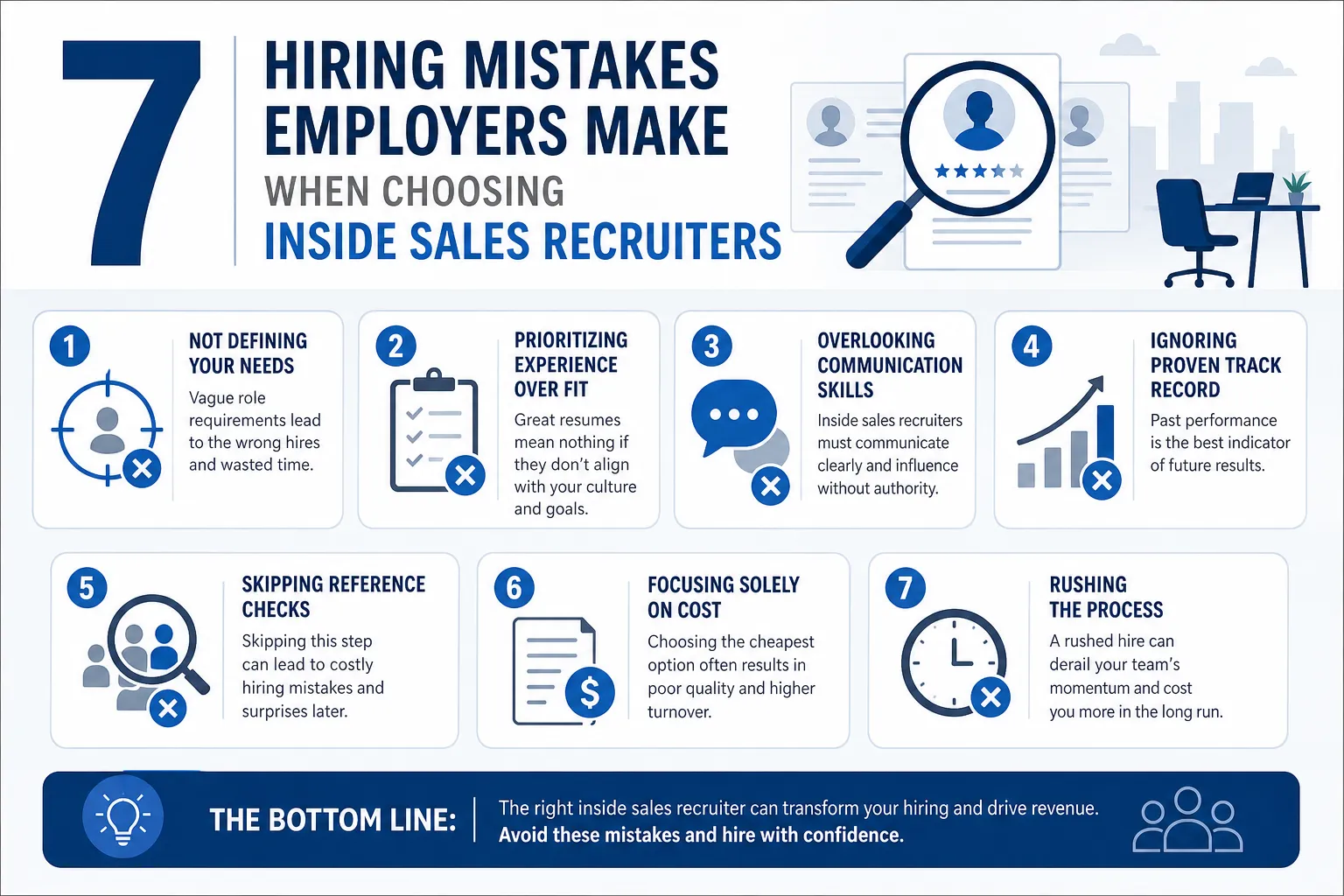
Most inside sales hiring failures happen when employers choose a recruiting partner that does not understand how revenue roles actually perform inside the business. That mismatch usually appears in seven predictable ways.
Hiring mistake | What it causes |
Choosing recruiters based on price alone | lower candidate quality, higher turnover, wasted manager time |
Failing to define the actual sales motion | mismatched candidates and missed ramp expectations |
Assuming all sales screening is equal | poor pipeline management, weak objection handling, low close rates |
Using the wrong hiring model | avoidable risk and slower hiring outcomes |
Ignoring local labor market realities | slower fills and weaker offer acceptance |
Underestimating onboarding and ramp support | delayed productivity and early attrition |
Accepting vague promises instead of measurable accountability | no recourse when placements fail |
Why inside sales hiring carries more risk than many employers expect
Inside sales is often treated as easier to hire for than field sales or executive-level sales leadership. In reality, that assumption creates expensive mistakes. A poor inside sales hire can affect lead follow-up speed, CRM hygiene, conversion rates, account growth, customer retention, and overall pipeline predictability.
"A bad hire can cost a company up to 30% of the employee's first-year earnings." - U.S. Department of Labor, cited by SHRM
"95% of CFOs say a poor hiring decision affects team morale, and 35% say morale is greatly affected." - SHRM
Those costs are amplified in Houston's competitive hiring market, where strong sales and marketing talent often has multiple options. Employers comparing recruiting firms for sales professionals or recruitment agencies for marketing roles need more than resumes. They need a partner that can evaluate performance drivers, selling style, coachability, and long-term fit.
What many articles miss about inside sales recruiting
A lot of hiring advice stops at general statements like "screen carefully" or "hire for culture." That is not enough for revenue roles.
The deeper issues are:
sales hiring quality is a process issue, not just a sourcing issue
the fastest candidate is not always the most productive hire
inside sales success depends on role context, not just past titles
guarantees matter because they reflect confidence and accountability
temp-to-hire is often a smart risk-control strategy for uncertain fit
This is especially important when employers are comparing best sales recruiting firms, marketing and sales recruitment agencies, or sales executive recruitment agencies and trying to understand what actually separates strong recruiting from generic candidate forwarding.
A practical framework for evaluating inside sales recruiters
Before looking at the seven mistakes in detail, use this six-point checklist.
The 6-point inside sales recruiter evaluation checklist
A strong recruiting partner should be able to answer these questions clearly:
How do you screen for inside sales skills beyond resume keywords?
How do you assess communication style, coachability, and sales process fit?
Can you support temporary, temp-to-hire, and direct hire hiring needs?
What guarantees or replacement terms do you provide?
How quickly can you realistically fill roles in Greater Houston?
What do you know about compensation, competition, and candidate behavior in this local market?
If the answers sound generic, that is usually a warning sign.

Mistake 1: Choosing inside sales recruiters based on price alone
The lowest fee does not create the lowest total hiring cost. Employers often focus on search fees or staffing markups and miss the hidden cost drivers that matter more.
Why a price-first decision backfires
When employers choose among best recruitment agencies for sales jobs based only on cost, corners are often cut in the areas that determine hiring success:
candidate outreach quality
recruiter time spent qualifying motivation
sales-specific interviewing
reference validation
post-placement follow-up
local compensation guidance
That creates a familiar pattern. The hire looks acceptable on paper, starts quickly, then underperforms in prospecting, pipeline discipline, or follow-up consistency.
Better approach
Compare total value, not just cost. Ask:
How does the firm measure candidate quality?
What is the realistic timeline for qualified submissions?
What happens if the placement does not work out?
How involved is the recruiter after the start date?
Can they support urgent coverage as well as long-term hiring?
Clayton Services reduces hiring risk with a 180-day direct hire replacement guarantee and a 100% satisfaction guarantee on temporary placements, which gives employers more than a transactional introduction.
Mistake 2: Failing to define the role beyond the job title
A request for "inside sales rep," "BDR," "account executive," or "sales support" often hides major differences in day-to-day expectations. That lack of role calibration is one of the biggest reasons recruiting efforts miss the mark.

What a job title does not tell a recruiter
A qualified sales executive recruiter or tech sales recruiter should clarify details such as:
inbound vs outbound focus
hunter vs farmer expectations
lead source quality
average deal size
sales cycle length
CRM workflow discipline
call volume expectations
email and follow-up cadence
demo or presentation requirements
collaboration with marketing or account management
reporting structure
compensation plan realities
A company hiring for sales representatives may actually need someone closer to a customer success hybrid, while another may need a true outbound prospector with resilience and high activity tolerance.
Better approach
Treat the intake process like revenue planning. The more specific the role design, the more accurate the search. This is where leading recruitment agencies for sales jobs separate themselves from generic recruiters.
Clayton Services works closely with Houston employers to calibrate roles before sourcing begins, which improves both speed and fit across sales, marketing, customer service, administrative, and leadership hiring.
Mistake 3: Assuming all screening is equal
This is one of the biggest blind spots in sales recruiting. Many firms say they "screen thoroughly," but few explain what that means in an inside sales environment.
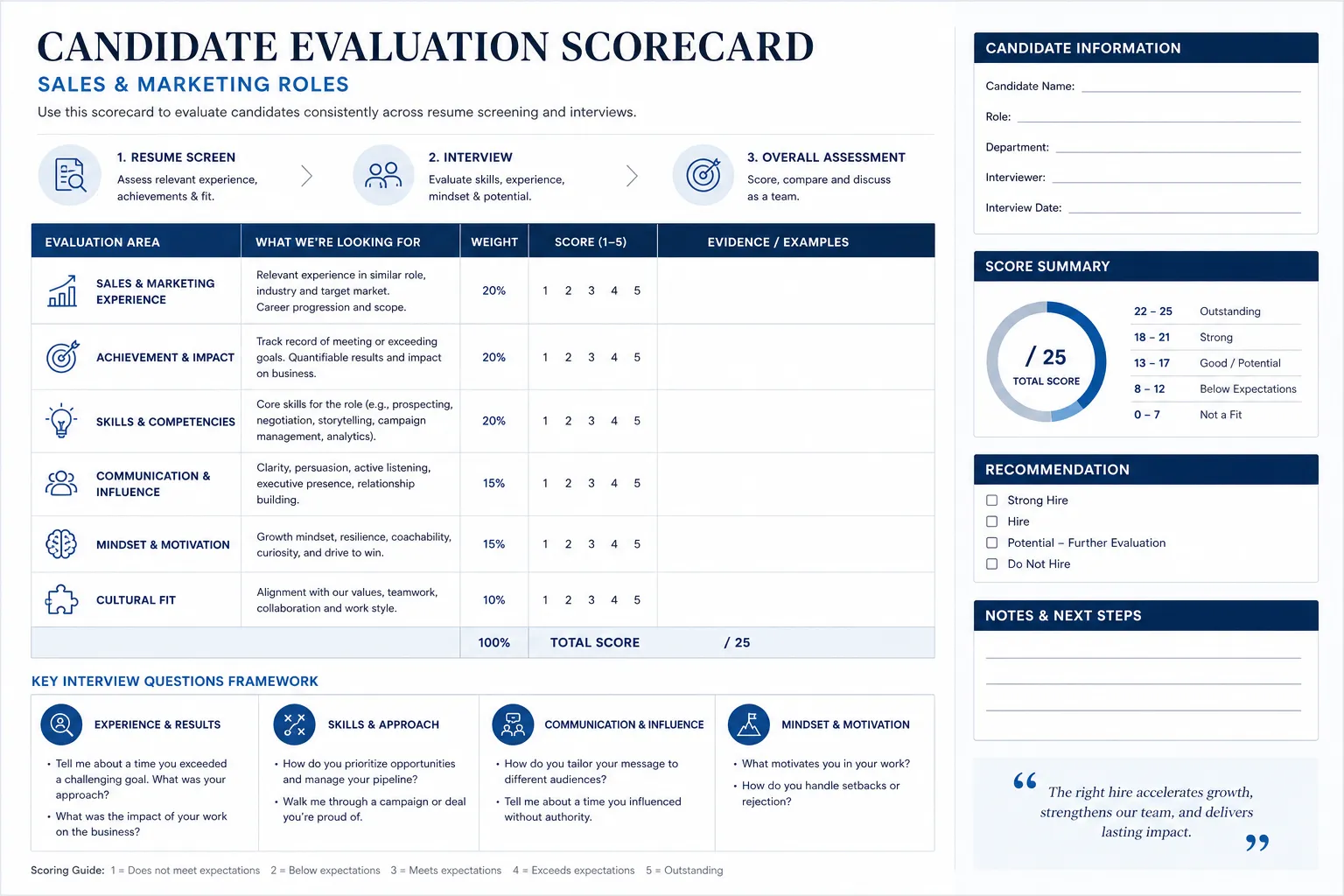
What strong inside sales screening should include
Depending on the role, strong screening may involve:
work history pattern review
quota or performance discussion
call reluctance evaluation
communication clarity and listening ability
objection-handling assessment
CRM usage habits
pipeline organization discipline
motivation and compensation drivers
coachability indicators
reference checks
culture and manager fit discussion
Why resumes are not enough in sales hiring
A resume may say "top producer," but it often leaves out what matters most:
Was success driven by inbound demand or outbound hustle?
Was the candidate selling a premium solution or a commodity?
Did they work with long cycles or quick transactions?
Were they self-sourcing or heavily supported by marketing?
Did they thrive under structure or need independence?
That matters whether you are working with enterprise sales recruiters, technical sales recruiters, IT sales recruiters, or recruitment agencies for sales professionals. Titles can look similar while the underlying sales motion is completely different.
Better approach
Ask recruiters to walk through their exact screening process. If the answer is vague, that is a concern. Strong inside sales recruiters should be able to explain how they assess behavior, selling style, and operational discipline, not just confirm years of experience.
Mistake 4: Using the wrong hiring model for the role
Not every sales role should be filled the same way. Many employers default to direct hire even when the risk profile suggests a different approach.
Which hiring model fits best for inside sales?
Hiring need | Best-fit model | Why |
Immediate coverage for lead follow-up or customer demand | Temporary staffing | Fast response and flexible duration |
Need to evaluate reliability, adaptability, and performance before a permanent offer | Temp-to-hire | Lowers risk before long-term commitment |
Permanent quota-carrying role with long-term growth expectations | Direct hire recruiting | Best for retention-focused permanent hiring |
Sales leadership or highly strategic revenue role | Executive search | Better for confidential and high-impact hires |
High-volume ramp for a sales team, call center, or multi-role expansion | RPO or onsite recruiting | Scalable, repeatable hiring support |
Need to onboard talent without internal payroll burden | Payrolling / employer of record | Simplifies compliance and administration |
Better approach
Choose the model based on urgency, complexity, and risk.
For example:
Temporary staffing is useful for short-term coverage or immediate business continuity.
Temp-to-hire helps when employers want to validate dependability and fit before committing.
Direct hire works best for stable long-term needs.
Executive search is more appropriate for sales directors, revenue leaders, and strategic hires.
RPO and onsite recruiting help when volume is high or ongoing.
Clayton Services supports all of these models, which means employers do not need to force every opening into the same process.
Mistake 5: Ignoring the local Houston hiring market
National reach can sound impressive, but inside sales hiring is still highly local in practice. Candidate expectations, commute tolerance, salary pressure, and competition vary by submarket.
Why local knowledge matters
In Greater Houston, hiring outcomes can shift based on:
traffic and commute realities
in-office vs hybrid expectations
pay competition across industries
energy, industrial, healthcare, and technology demand
candidate preferences for culture and career path
competition for bilingual or industry-experienced talent
This is why employers searching for top sales recruiters, best sales recruiters, or best marketing recruitment agencies in Houston are often really looking for local market intelligence, not just access to a database.
Better approach
Work with a Houston-owned recruiting firm that understands the market as it exists now, not as it looks in a national playbook.
Clayton Services has served employers and job seekers across Greater Houston since 1984. That long-standing local presence helps employers hire more strategically in sales, marketing, administrative, engineering, HR, legal, IT, supply chain, and other business-critical functions.
Mistake 6: Underestimating onboarding and ramp-to-productivity
A good hire can still fail if the handoff into the business is weak. This is one of the most overlooked gaps in discussions about inside sales recruiting.
Why onboarding matters more in sales roles
Inside sales hires are often expected to contribute quickly. But without structured onboarding, even talented people can struggle with:
product complexity
CRM workflow confusion
unclear lead ownership
inconsistent messaging
misaligned performance metrics
weak manager coaching cadence
Poor onboarding creates false negatives. Employers may blame the recruiter when the real issue is internal ramp support.
Better approach
Ask whether your hiring process includes a realistic ramp plan. For many employers, the best recruiting outcome comes from pairing strong recruiting with clear onboarding milestones for the first 30, 60, and 90 days.
Clayton Services helps employers think beyond the offer letter. That broader staffing mindset is one reason businesses rely on Clayton for both short-term staffing support and long-term recruiting strategy.
Mistake 7: Accepting vague service promises instead of measurable accountability
Many firms promise quality, speed, or partnership. Fewer attach those promises to a real service model.
Red flags to watch for
Be cautious if a recruiting partner cannot explain:
expected fill timelines
replacement terms
communication cadence
escalation path
ownership after placement
how success is measured
whether they can support compliance, payrolling, or employer-of-record needs
This matters whether you are evaluating sales and marketing recruitment agencies, marketing and communications recruitment agencies, sales executive search firms, or technical sales recruiters. Accountability should be visible in the process, not just mentioned in a pitch.
Better approach
Look for concrete commitments.
Clayton Services stands out because accountability is built into the service model:
24 to 72 hour placement timelines for many staffing needs
180-day direct hire replacement guarantee
100% satisfaction guarantee on temporary placements
support across temporary staffing, temp-to-hire, direct hire, executive search, payrolling, and RPO/onsite recruiting
a Houston-owned, locally knowledgeable recruiting team
decades of candidate relationship-building in the local market
That structure lowers hiring risk for employers and creates better backup options if a placement fails.
Concise answer block: How do you avoid mistakes when choosing inside sales recruiters?
To avoid mistakes when choosing inside sales recruiters:
define the role beyond the title
compare value, not just fee percentage
ask for a sales-specific screening process
choose the right hiring model for the role
prioritize local Houston market knowledge
support the hire with strong onboarding
insist on guarantees and clear accountability
This approach helps reduce turnover, improve ramp speed, and protect revenue performance.
A practical comparison scorecard for inside sales recruiters
If you are comparing inside sales recruiters, use this scorecard to evaluate options side by side.
Evaluation area | What to ask | Why it matters |
Fill speed | How quickly can you provide qualified candidates? | Open revenue seats are expensive |
Sales screening quality | How do you assess prospecting ability, communication, and pipeline discipline? | Better fit and stronger productivity |
Local market knowledge | What Houston sectors and talent pools do you know best? | Improves realism on timing and compensation |
Hiring model flexibility | Do you offer temp, temp-to-hire, direct hire, and executive search? | Aligns process to business need |
Guarantees | What happens if the hire does not work out? | Creates accountability |
Industry specialization | Have you hired in our sales environment before? | Reduces learning curve |
Compliance support | Can you help with payrolling and employer-of-record services? | Lowers administrative burden |
Communication | Who owns follow-up after placement? | Improves retention and issue resolution |
When should employers use a recruiter instead of hiring on their own?
Internal recruiting can work well when:
the role is easy to source
your team has time to screen carefully
turnover risk is low
the sales motion is straightforward
you are not under immediate growth pressure
A recruiter is often the better option when:
hiring needs to happen fast
the role is difficult to fill
offer competition is high
your hiring team is stretched
you want better access to passive candidates
a failed hire would be expensive
you need support across multiple departments or role types
That includes employers looking for recruitment agencies for sales representatives, sales director recruitment agencies, recruitment agencies for sales and marketing, or even more specialized support such as enterprise sales recruiters and tech sales recruitment agencies.
Beyond inside sales: why cross-functional recruiting matters
One content gap many articles overlook is how often sales hiring overlaps with adjacent functions. A strong inside sales team depends on coordination with marketing, customer service, operations, and leadership.
That is why many employers benefit from a recruiting partner with broader specialization, not just a narrow sales-only focus. Clayton Services supports hiring across:
sales
marketing
customer service
administrative
accounting and finance
engineering
HR
IT
legal
medical administrative
supply chain and logistics
light industrial
skilled trades
executive leadership
This broader capability is valuable when one hire often leads to several related needs.
Why employers choose Clayton Services for sales and marketing hiring in Houston
Clayton Services is a Houston-based staffing agency and recruiting firm with deep roots in the local market and a service model designed to reduce hiring risk.
What sets Clayton Services apart
Houston-owned and locally knowledgeable recruiting team
serving Greater Houston since 1984
staffing solutions for both short-term and long-term hiring needs
temporary, temp-to-hire, and direct hire options
fast placement timelines within 24 to 72 hours for many urgent needs
180-day direct hire replacement guarantee
100% satisfaction guarantee on temporary placements
payrolling and compliance support as employer of record
executive search capability for leadership hiring
high-volume RPO and onsite recruiting support
decades-long candidate network built in the Houston market
reduced hiring risk through temp-to-hire and guaranteed placements
For employers, that means a more accountable path to hiring sales and marketing talent. For job seekers, it means access to legitimate opportunities across professional, administrative, technical, industrial, and leadership roles throughout Greater Houston.
Final verdict
The biggest mistakes employers make with inside sales recruiters are usually preventable. Problems start when companies choose on cost alone, skip role calibration, accept weak screening, ignore Houston labor market realities, underestimate onboarding, use the wrong hiring model, or work with recruiters that offer no measurable accountability.
The better path is to choose a recruiting partner that understands revenue roles, supports multiple staffing models, and stands behind its work with real guarantees.
If your company needs faster access to qualified sales, marketing, or cross-functional talent in Houston, Clayton Services offers the local expertise, flexible hiring options, and service accountability that help employers hire with confidence.
Frequently Asked Questions
What causes most inside sales hiring failures?
Most inside sales hiring failures happen when employers choose a recruiting partner that doesn't understand how revenue roles actually perform inside the business. That mismatch shows up in seven predictable ways: choosing recruiters on price alone, failing to define the actual sales motion, assuming all sales screening is equal, using the wrong hiring model, ignoring local labor market realities, underestimating onboarding and ramp support, and accepting vague promises with no accountability.
Why is inside sales hiring riskier than employers expect?
Inside sales is often assumed to be easier to hire for than field sales, and that assumption creates expensive mistakes. A poor inside sales hire affects lead follow-up speed, CRM hygiene, conversion rates, account growth, customer retention, and pipeline predictability. A bad hire can cost up to 30% of the employee's first-year earnings (U.S. Department of Labor), and 95% of CFOs say a poor hiring decision affects team morale (SHRM). In Houston's competitive market, strong sales talent usually has multiple options.
How should I define an inside sales role beyond the job title?
Titles like "inside sales rep," "BDR," or "account executive" hide major differences in day-to-day expectations. A strong recruiter should clarify inbound vs. outbound focus, hunter vs. farmer expectations, lead source quality, average deal size, sales cycle length, CRM workflow discipline, call volume, follow-up cadence, demo requirements, collaboration with marketing, reporting structure, and compensation realities. One company's "sales rep" may really need a customer-success hybrid; another needs a resilient outbound prospector. Treat intake like revenue planning.
What should strong inside sales screening include?
Effective screening goes well beyond a resume that says "top producer." Depending on the role it should include work-history pattern review, quota and performance discussion, call-reluctance evaluation, communication clarity and listening ability, objection-handling assessment, CRM usage habits, pipeline organization discipline, motivation and compensation drivers, coachability indicators, reference checks, and manager fit. Resumes rarely reveal whether success came from inbound demand or outbound hustle, long cycles or quick transactions, or self-sourcing versus heavy marketing support.
Which hiring model is best for inside sales roles?
Match the model to the need: temporary staffing for immediate lead-follow-up or demand coverage, temp-to-hire to evaluate reliability and performance before a permanent offer, direct hire for permanent quota-carrying roles with long-term growth expectations, executive search for sales leadership or strategic revenue roles, RPO or onsite recruiting for high-volume team ramps, and payrolling/EOR to onboard talent without internal payroll burden. Defaulting to direct hire for every role ignores the actual risk profile.
Why shouldn't I choose inside sales recruiters on price alone?
The lowest fee doesn't create the lowest total hiring cost. Price-first decisions usually mean corners are cut in outreach quality, motivation qualification, sales-specific interviewing, reference validation, post-placement follow-up, and local compensation guidance. The result is a familiar pattern: the hire looks acceptable on paper, starts quickly, then underperforms in prospecting, pipeline discipline, or follow-up. Compare total value—candidate quality measurement, realistic timelines, and what happens if the placement fails.
Why does onboarding matter so much for inside sales hires?
Inside sales hires are expected to contribute quickly, but without structured onboarding even talented people struggle with product complexity, CRM workflow confusion, unclear lead ownership, inconsistent messaging, and weak coaching cadence. Poor onboarding creates false negatives—employers blame the recruiter when the real issue is internal ramp support. The best outcomes pair strong recruiting with clear 30-, 60-, and 90-day onboarding milestones.
Why does local Houston market knowledge matter in sales hiring?
Inside sales hiring is highly local in practice—candidate expectations, commute tolerance, salary pressure, in-office vs. hybrid expectations, and competition vary by submarket. Houston outcomes shift based on traffic realities, pay competition across energy, industrial, healthcare, and tech, and demand for bilingual or industry-experienced talent. Employers searching for "top sales recruiters in Houston" usually need local market intelligence, not just a database. Clayton Services has served Greater Houston since 1984.
What guarantees and accountability should an inside sales recruiter offer?
Look for concrete commitments rather than vague promises—clear fill timelines, defined replacement terms, communication cadence, an escalation path, ownership after placement, and how success is measured. Accountability should be visible in the process, not just mentioned in a pitch. Clayton Services offers 24 to 72 hour placement timelines for many needs, a 180-day direct hire replacement guarantee, and a 100% satisfaction guarantee on temporary placements.
When should I use a recruiter instead of hiring inside sales reps myself?
Internal recruiting works when the role is easy to source, your team has time to screen, turnover risk is low, the sales motion is straightforward, and you're not under growth pressure. Use a recruiter when hiring must happen fast, the role is hard to fill, offer competition is high, your team is stretched, you want better access to passive candidates, a failed hire would be expensive, or you need support across multiple departments—since sales hiring often overlaps with marketing, customer service, and operations.


