
Oil and Gas Executive Recruiters in Houston
- Travis Leonard
- 2 hours ago
- 15 min read


TL;DR
Houston employers hiring senior leaders in energy need more than a recruiter with a broad network. They need an executive search partner who understands upstream, midstream, downstream, petrochemicals, field operations, engineering leadership, HSE, project controls, finance, and the local Houston talent market.
The best oil and gas executive recruiters in Houston typically stand out in six areas:
True industry specialization
Local market depth
Clear search process and communication
Strong guarantee structure
Ability to scale beyond one-off hiring
Risk reduction through flexible hiring models
For employers, the right partner should help fill critical leadership roles faster, reduce the odds of a mis-hire, protect confidentiality, and support both urgent and long-range hiring needs. For candidates, the right recruiting team opens access to better opportunities and more strategic career moves.
Clayton Services brings a Houston-owned approach, decades of local recruiting experience since 1984, a long-standing regional candidate network, executive search capability, temp-to-hire options, payrolling and compliance support, high-volume RPO and onsite recruiting, fast placement timelines, a 180-day direct hire replacement guarantee, and a 100% satisfaction guarantee on temporary placements.

Oil and Gas Executive Recruiters in Houston
Houston is one of the most demanding executive hiring markets in the country for energy companies. Leadership hiring in this space is rarely simple. Employers are often balancing technical requirements, operational urgency, safety culture, investor pressure, succession planning, and the realities of a highly competitive local talent market.
That is why selecting among oil and gas executive recruiters is not just a vendor decision. It is a business risk decision.
A high-performing recruiter should do far more than send resumes. The right search partner should understand how your operation actually works, what success looks like in the role, where the likely talent pools exist, how to attract passive candidates, how to preserve confidentiality, and how to structure the process so you can make a strong hire without unnecessary delay.
For Houston employers, this matters even more because the local market moves fast. Energy companies here compete for the same senior engineers, operations leaders, plant managers, project executives, finance leaders, and commercial talent. Delays in leadership hiring can slow projects, disrupt teams, and create very real operational cost.
Quick Answer: What Should Houston Employers Look for?
If you are evaluating oil and gas recruiting firms for executive hiring, prioritize these criteria first:
Selection Factor | Why It Matters | What Strong Firms Usually Show |
Industry specialization | Executive energy roles require technical and commercial fluency | Recruiters who understand the value chain and role-specific requirements |
Houston market knowledge | Local hiring dynamics affect speed, compensation, and candidate availability | Deep candidate relationships built in Greater Houston |
Search process | Leadership hiring requires structure and discretion | Defined intake, outreach, screening, calibration, and offer support |
Guarantee structure | Guarantees reflect accountability | Meaningful replacement coverage, not vague promises |
Speed and responsiveness | Delays cost money and increase risk | Qualified candidates presented quickly and communication stays consistent |
Hiring model flexibility | One search model does not fit every need | Direct hire, executive search, temp-to-hire, contract, and payrolling support |
Scalability | Many employers need more than one leader | Ability to support departments, project ramps, and onsite or RPO recruiting |
Why Houston Is a Different Market for Energy Leadership Hiring
Houston is not just a large city with energy jobs. It is a concentrated energy ecosystem where technical talent, executive leadership, capital projects, refining, logistics, engineering, and corporate headquarters all intersect.
"Houston hosts 21 Fortune 500 energy headquarters, underscoring its central role in the industry." - HOUSTON FACTS
That density creates opportunity, but it also creates competition. Senior candidates often have multiple options, strong local networks, and very specific expectations around compensation, reporting structure, relocation, travel, private equity exposure, turnaround expectations, and long-term growth.
"In 2023, the Houston Metropolitan Statistical Area accounted for 26.4% of the nation's jobs in oil and gas extraction." - HOUSTON FACTS
For employers, the practical takeaway is simple: a recruiter who is merely "national" is not automatically effective in Houston. Local market fluency is often what separates a good search from a stalled one.
What Oil and Gas Executive Recruiters Actually Do
Executive recruiting in energy is a more specialized process than general staffing. At the leadership level, the challenge is not just finding qualified people. It is identifying the right combination of technical credibility, business judgment, cultural fit, and readiness for the specific environment.
Core functions of an executive recruiter
An effective recruiter should help employers:
Define the role beyond the job description
Benchmark compensation against the local market
Map target companies and candidate pools
Approach passive candidates confidentially
Screen for technical, leadership, and cultural fit
Coordinate interviews and stakeholder feedback
Manage candidate engagement throughout the process
Support negotiation and close
Reduce hiring risk through guarantees and replacement support
For job seekers, strong oil and gas job recruiters can also create value by helping candidates understand whether a role is truly aligned with their long-term goals instead of simply pushing them into the next opening.
The Content Gap Most Articles Miss: Executive Search Is About Risk, Not Just Reach
A common mistake in leadership hiring content is treating executive recruiting as a network game. Network matters, but it is not enough.
The real issue is risk management.
Every executive or senior leadership hire carries risk in five areas:
Operational risk
Safety and compliance risk
Financial risk
Cultural risk
Timing risk
A poor VP of Operations hire can destabilize a plant, field team, or division. A weak commercial leader can miss growth targets. A mismatched engineering leader can stall capital programs. A rushed hire who looks good on paper but fails to align with team expectations can cost months of momentum.
That is why guarantee structure, recruiter discipline, screening quality, and flexible hiring

Which Roles Commonly Require Executive or Senior-Level Search Support?
Houston energy employers often use executive or specialized recruiting support for roles such as:
VP of Operations
VP of Engineering
Director of Projects
Plant Manager
Operations Manager
Asset Manager
HSE Director
Engineering Manager
Director of Supply Chain
Commercial Director
Controller or CFO with oil and gas accounting depth
Corporate Development or business development leadership
Project Executive for EPC or capital programs
Division leaders in upstream, midstream, or downstream operations
The need for support often increases when the employer requires one or more of the following:
Strict confidentiality
Passive candidate outreach
Specialized technical screening
Multi-stakeholder interview coordination
Urgent timelines
Candidate relocation analysis
Succession planning
Private equity or board visibility
How to Evaluate Oil and Gas Recruiting Firms in Houston
The smartest way to evaluate a recruiting partner is to use a decision framework instead of relying on branding alone.
1. Measure specialization, not just enthusiasm
A recruiter should be able to speak intelligently about:
Upstream, midstream, and downstream distinctions
Refining, petrochemical, pipeline, and field operations environments
Capital project versus maintenance leadership roles
HSE and regulatory expectations
ERP, engineering, finance, or plant systems relevant to the role
The difference between technical excellence and leadership readiness
If they cannot ask sharp questions in intake, they will struggle to screen effectively later.
2. Test local market knowledge
For Houston searches, ask:
How long have you recruited in Greater Houston?
What parts of the local energy market do you know best?
How quickly can you identify local candidates versus relocation candidates?
What compensation patterns are you seeing for comparable roles?
How do you approach candidates who are already well-positioned in Houston?
A Houston-owned recruiting firm with long local roots often has an advantage because it has spent years building real relationships rather than just pulling names from databases.
3. Review the process in detail
Ask for the actual search workflow.
Strong executive recruiting processes usually include:
Search Stage | What Should Happen |
Intake | Deep discovery on business context, reporting lines, goals, and risks |
Market mapping | Identification of talent pools, competitor backgrounds, and likely candidate sources |
Outreach | Confidential contact with active and passive candidates |
Screening | Assessment of technical fit, leadership scope, stability, and motivation |
Calibration | Early feedback loop to refine the search criteria |
Interview management | Scheduling, prep, feedback capture, and alignment |
Offer stage | Compensation guidance, objection handling, and close support |
Post-placement follow-up | Retention check-ins and guarantee execution if needed |
4. Look closely at guarantees
Guarantees are one of the clearest signs of accountability.
Some firms keep guarantees vague or short. That may limit employer protection on a hire that takes months to fully evaluate. In energy leadership hiring, where ramp time can be significant, stronger guarantees reduce risk.
Clayton Services offers a 180-day direct hire replacement guarantee, which is unusually employer-friendly and especially valuable for leadership and specialized technical hires. For shorter-term staffing needs, Clayton Services also offers a 100% satisfaction guarantee on temporary placements, which helps employers move quickly without feeling exposed.
5. Ask about hiring model flexibility
Not every leadership need should be solved the same way.
Sometimes a retained-style executive search is appropriate. Sometimes a direct hire search is enough. Sometimes an employer needs a contract leader, interim expert, or temp-to-hire path to reduce risk. Sometimes the issue is not just one leader but a broader workforce buildout, which calls for RPO or onsite recruiting support.
The best recruiting firms help you choose the right model rather than forcing every problem into the same solution.
Executive Search Models Explained
Many employers know they need help, but they are less certain which search structure is best. Here is a practical guide.
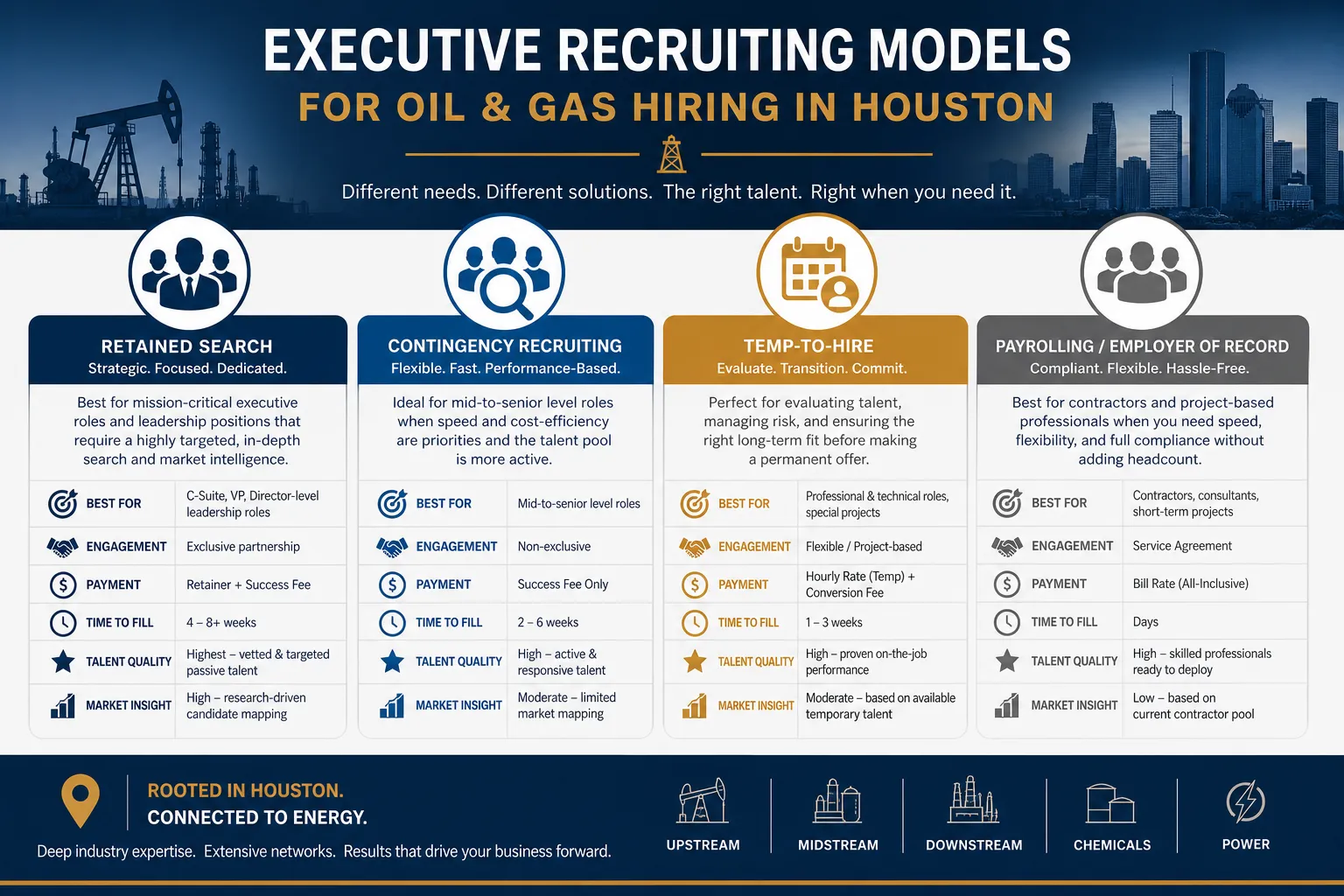
Retained or executive search
Best for:
Confidential leadership hiring
Hard-to-find strategic roles
Board-level or C-suite searches
Roles requiring broad market mapping and deep passive outreach
Advantages:
High focus and discipline
Structured search process
Better fit for high-stakes roles
Direct hire recruiting
Best for:
Permanent professional and leadership roles
Employers who want speed and accountability
Roles that are specialized but not necessarily board-level
Advantages:
Efficient and practical
Strong fit for many operations, engineering, finance, and management hires
Backed by replacement guarantees when structured well
Temp-to-hire
Best for:
Employers who want to reduce hiring risk
Roles where team fit and execution style are critical
Situations where the company wants to evaluate on-the-job performance first
Advantages:
Lowers long-term mis-hire risk
Gives both parties real-world validation
Particularly useful in fast-moving operational environments
Contract or interim staffing
Best for:
Turnarounds
Shutdowns
Project surges
Leave coverage
Urgent technical or management gaps
Advantages:
Fast deployment
Immediate support without long permanent hiring cycles
Useful for short-term continuity
Payrolling and employer-of-record support
Best for:
Employers who have identified talent but want administrative relief
Projects that require compliant onboarding and worker management
Contract labor situations where speed and risk control matter
Advantages:
Simplifies employment administration
Supports compliance and payroll execution
Reduces internal administrative burden
How Fast Should a Strong Recruiting Partner Move?
Executive roles require care, but that should not become an excuse for delay.
For many professional and specialized hiring needs in Houston, the best recruiters can present qualified candidates quickly because they already have decades of local network depth and active relationships. For contract, temp, and urgent professional placements, fast timelines often matter even more.
Clayton Services is positioned to support employers with placement timelines as fast as 24 to 72 hours for many staffing and urgent hiring needs, while still supporting more consultative executive search work for senior roles. That combination is useful for energy employers that may need both immediate operational support and long-term leadership hires at the same time.
What Good Recruiters Screen for That Average Recruiters Miss
At the executive and senior technical level, resumes do not tell the full story. Strong recruiters go beyond title matching.
They screen for contextual fit
A strong recruiter should clarify:
Scope of budget and P&L ownership
Size of teams led
Type of facilities or assets managed
Regulatory and safety environment
Public company, private company, or PE-backed experience
M&A or integration exposure
Capital project scale
Change management track record
Stakeholder sophistication
They screen for motivation
Candidates at this level often care about:
Decision-making authority
Stability of ownership
Growth trajectory
Reporting structure
Team quality
Capital availability
Strategic clarity
Relocation requirements
Compensation upside
They screen for staying power
This is critical in oil and gas leadership hiring. Employers should want evidence of commitment, resilience through cycles, and the ability to lead through ambiguity rather than just perform in ideal conditions.
Red Flags When Choosing Oil and Gas Job Recruitment Agencies
Not all recruiters are equally prepared for Houston energy leadership hiring. Watch for these warning signs:
They rely heavily on generic job board sourcing
They cannot explain the local market in practical terms
They offer no meaningful guarantee
They cannot describe their screening process clearly
They talk about volume more than precision
They send resumes before understanding the role
They lack options beyond standard direct hire
They do not ask about culture, reporting dynamics, or business goals
They cannot support payrolling, contract staffing, or hiring scale if your needs expand
What Employers Should Expect During the Search
A high-performing search partner should make the process clearer, not more confusing.
In the first conversation
Expect discussion around:
Why the role is open
What business problem the hire needs to solve
What success should look like in 6 and 12 months
Required technical background
Team structure and reporting lines
Compensation band and flexibility
Search urgency and confidentiality needs
Within the first week
You should start seeing:
Role calibration
Messaging refinement
Market feedback
Early candidate activity
Clear communication cadence
Through offer and onboarding
Your recruiter should help with:
Candidate prep
Interview scheduling
Stakeholder alignment
Competitive offer management
Counteroffer risk
Notice period navigation
Early retention monitoring
A Practical Scorecard for Comparing Recruiters
Use the scorecard below when you evaluate firms.
Evaluation Area | Questions to Ask | What Strong Looks Like |
Energy specialization | Do they understand your segment and role? | Specific, technical, and commercially aware intake questions |
Houston depth | How strong is their local network? | Long market tenure and regional candidate relationships |
Search speed | How fast can they launch and present? | Immediate intake and fast early traction |
Candidate quality | How do they screen? | Structured evaluation beyond resume keywords |
Guarantees | What protection do you get? | Clear replacement terms and accountability |
Flexibility | Can they support other hiring models? | Temp-to-hire, contract, payrolling, executive search, RPO |
Communication | How often will they update you? | Predictable, proactive updates |
Risk reduction | How do they lower mis-hire risk? | Deep vetting, guarantees, temp-to-hire options |
Why Guarantee Structure Matters More in Energy Than in Many Other Industries
Leadership mistakes in energy can be expensive. Even one failed hire can affect safety, maintenance planning, production continuity, vendor relationships, or project execution. That makes guarantee structure more than a marketing feature.
A meaningful guarantee helps align the recruiter with the employer's long-term outcome, not just the initial placement. It signals confidence in screening quality and long-term fit.
For Houston employers, this is one of the strongest reasons to work with a firm that offers both:
A 180-day direct hire replacement guarantee for permanent hires
A 100% satisfaction guarantee on temporary placements for interim and project support
This is especially valuable when the employer is deciding between direct hire and temp-to-hire for leadership-adjacent or highly specialized roles.
Why Flexible Hiring Models Help Oil and Gas Employers Make Better Decisions
One major content gap in most articles is that they treat executive hiring as separate from broader workforce planning. In real life, those decisions are connected.
For example:
A company hiring a new operations leader may also need project coordinators, document control support, or technical specialists.
A plant leadership transition may require temporary administrative or field support during the handoff.
A confidential executive search may be followed by rapid team buildout.
A private equity-backed platform company may need executive search, payrolling, and high-volume recruiting support in phases.
This is where a broader staffing and recruiting firm can create significant value.
Clayton Services supports employers with:
Direct hire recruiting
Temp-to-hire staffing
Temporary staffing
Executive search
Payrolling and employer-of-record support
RPO and onsite recruiting
That range allows employers to solve for both the immediate vacancy and the larger talent strategy behind it.

For Job Seekers: How to Tell If a Recruiter Is Worth Your Time
While this guide is employer-focused, experienced candidates also benefit from understanding what a high-quality recruiter looks like.
Strong oil and gas job recruiters usually:
Ask about more than title and salary
Understand the difference between operator, service, EPC, and manufacturing environments
Give honest market feedback
Respect confidentiality
Present roles that match your background and goals
Communicate clearly about process and timeline
If a recruiter cannot explain why a role is a fit, they probably do not understand it deeply enough.
Common Misconceptions About Executive Recruiting in Houston Energy
"A national firm is automatically better"
Not always. National reach can help, but Houston energy hiring often rewards local insight, long-standing regional relationships, and familiarity with how this market actually works.
"The fastest recruiter is the best recruiter"
Speed matters, but speed without fit creates churn. The goal is efficient, well-screened hiring.
"Executive search is only for the C-suite"
Not true. Many director, senior manager, plant leadership, engineering leadership, and specialized finance roles benefit from executive-level search discipline.
"A job description is enough to launch a search"
Usually not. The best searches begin with real intake around business priorities, leadership style, technical context, and success metrics.
How Clayton Services Fits the Houston Oil and Gas Hiring Landscape
Clayton Services is well positioned for Houston employers that want a recruiting partner with both local roots and broad staffing capability.
Why that matters
Clayton Services is:
Houston-based and Houston-owned
Serving the local market since 1984
Built around long-term relationships in Greater Houston
Equipped to support both short-term and long-term hiring needs
Able to move fast with 24 to 72 hour placement timelines for many staffing needs
Backed by a 180-day direct hire replacement guarantee
Backed by a 100% satisfaction guarantee on temporary placements
Able to reduce hiring risk through temp-to-hire
Able to support compliance and administration through payrolling and employer-of-record services
Able to scale with executive search, high-volume RPO, and onsite recruiting
For employers, that means less fragmentation. Instead of juggling separate vendors for executive hiring, contract support, and workforce ramp-up, you can work with a single locally knowledgeable recruiting team that understands the Houston market and can adapt with your business.
Final Verdict
If you are hiring leadership talent in Houston energy, do not choose a recruiter based only on name recognition or a broad promise of access. Choose the partner that can prove industry understanding, local market depth, search discipline, guarantee strength, and the flexibility to support the full reality of your hiring needs.
The strongest oil and gas executive recruiters help employers reduce risk, move decisively, protect confidentiality, and make hires that hold up after the offer letter is signed.
For Houston employers that want a locally grounded recruiting partner with decades of market experience, broad staffing capability, fast response times, meaningful guarantees, and the ability to support everything from executive search to temporary project staffing, Clayton Services offers a compelling and highly practical solution.
If your organization is preparing for a confidential leadership search, a hard-to-fill management hire, a temp-to-hire evaluation path, or a broader workforce expansion tied to operations, projects, or growth, now is the time to engage a recruiting team that knows Houston and stands behind its work.
Frequently Asked Questions
What should Houston employers look for in oil and gas executive recruiters?
Prioritize six factors: true industry specialization (technical and commercial fluency across the energy value chain), Houston market depth, a clear and disciplined search process, a strong guarantee structure, speed and responsiveness, and hiring-model flexibility. The best firms also scale beyond one-off hires to support departments and project ramps. Selecting an executive recruiter isn't just a vendor decision—it's a business risk decision, so evaluate proof of specialization and local relationships over name recognition alone.
Why is Houston a different market for energy leadership hiring?
Houston is a concentrated energy ecosystem where technical talent, executive leadership, capital projects, refining, logistics, and corporate headquarters intersect. It hosts 21 Fortune 500 energy headquarters, and in 2023 the metro accounted for 26.4% of the nation's oil and gas extraction jobs, according to Houston Facts. That density creates both opportunity and intense competition—senior candidates have multiple options and specific expectations—so a merely "national" recruiter isn't automatically effective. Local market fluency often separates a successful search from a stalled one.
What do oil and gas executive recruiters actually do?
An effective executive recruiter defines the role beyond the job description, benchmarks compensation against the local market, maps target companies and candidate pools, approaches passive candidates confidentially, screens for technical, leadership, and cultural fit, coordinates interviews and stakeholder feedback, manages candidate engagement, supports negotiation and close, and reduces hiring risk through guarantees. At the leadership level the challenge isn't just finding qualified people—it's identifying the right mix of technical credibility, business judgment, and readiness for your specific environment.
Which energy roles require executive or senior-level search support?
Houston energy employers commonly use executive or specialized search for VP of Operations, VP of Engineering, Director of Projects, Plant Manager, Operations and Asset Managers, HSE Director, Engineering Manager, Director of Supply Chain, Commercial Director, Controller or CFO with oil and gas depth, Corporate Development leaders, Project Executives for EPC or capital programs, and division leaders across upstream, midstream, and downstream. The need increases with strict confidentiality, passive outreach, specialized technical screening, urgent timelines, or succession planning.
How do I evaluate an oil and gas recruiting firm in Houston?
Use a decision framework, not branding. Measure specialization (can they speak intelligently about upstream, midstream, downstream, refining, HSE, and the difference between technical excellence and leadership readiness?), test local market knowledge (how long they've recruited in Greater Houston and what compensation patterns they see), review the actual search workflow in detail, look closely at guarantees, and ask about hiring-model flexibility. If a firm can't ask sharp intake questions, it will struggle to screen effectively later.
Why is executive search really about risk, not just network?
Network matters, but it isn't enough—every senior energy hire carries operational, safety and compliance, financial, cultural, and timing risk. A poor VP of Operations can destabilize a plant or field team, a weak commercial leader can miss growth targets, and a mismatched engineering leader can stall capital programs. That's why guarantee structure, recruiter discipline, screening quality, and flexible hiring options matter far more than reach alone in high-stakes leadership hiring.
How fast should an oil and gas recruiting partner move?
Executive roles require care, but that's not an excuse for delay. The best recruiters present qualified candidates quickly because they already have decades of local network depth and active relationships. Clayton Services supports placement timelines as fast as 24 to 72 hours for many staffing and urgent hiring needs, while still handling consultative executive search for senior roles—useful for energy employers needing both immediate operational support and long-term leadership hires at once.
What do strong energy recruiters screen for that average ones miss?
At the executive level, resumes don't tell the full story. Strong recruiters screen for contextual fit (budget and P&L ownership, team size, facility and asset type, regulatory environment, public/private/PE-backed experience, M&A exposure, capital project scale, change-management track record), motivation (decision authority, ownership stability, growth trajectory, capital availability), and staying power—evidence of commitment, resilience through cycles, and the ability to lead through ambiguity rather than perform only in ideal conditions.
Why do guarantees matter more in energy leadership hiring?
Leadership mistakes in energy are expensive—one failed hire can affect safety, maintenance planning, production continuity, vendor relationships, or project execution. A meaningful guarantee aligns the recruiter with the employer's long-term outcome, not just the initial placement, and signals confidence in screening quality. Because leadership ramp time is significant, longer coverage matters. Clayton Services offers a 180-day direct hire replacement guarantee for permanent hires and a 100% satisfaction guarantee on temporary placements.
What are the red flags when choosing an oil and gas recruiting agency?
Watch for firms that rely heavily on generic job-board sourcing, can't explain the local market in practical terms, offer no meaningful guarantee, can't describe their screening process clearly, talk about volume more than precision, send resumes before understanding the role, lack options beyond standard direct hire, don't ask about culture, reporting dynamics, or business goals, or can't support payrolling, contract staffing, or hiring scale if your needs expand. Also be skeptical of the myth that a national firm is automatically better.
Travis Leonard, Managing Director, Clayton Services
Travis Leonard is Managing Director of Clayton Services, a Houston-owned staffing and recruiting firm serving Greater Houston since 1984. A second-generation staffing and recruiting executive with more than a decade of industry experience, Travis has led more than 1,000 successful searches across professional, technical, administrative, and leadership roles. Born and raised in Houston and a graduate of the University of Houston, he advises employers throughout the region on hiring strategy — from single hard-to-fill direct hire placements to large-scale staffing programs.


