
Semiconductor and Advanced Manufacturing Staffing in Houston
- Travis Leonard
- 3 hours ago
- 12 min read

Semiconductor and Advanced Manufacturing Staffing in Houston
TL;DR
Houston is not a major wafer-fab or chip-design hub like Austin, Dallas, or Phoenix. Its strength in the semiconductor economy is different and highly valuable. Houston supports advanced manufacturing through supply chain, logistics, facilities, quality, electrical and mechanical assembly, skilled trades, maintenance, compliance, and back-office operations.
For employers, that means the real hiring challenge is often not finding IC designers. It is finding the people who keep production, distribution, maintenance, and growth moving. For job seekers, it means there are real opportunities in the surrounding ecosystem that semiconductor and advanced manufacturing expansion creates.
If you need fast, reliable hiring support in Greater Houston, Clayton Services offers:
Houston roots since 1984
24 to 72 hour placement speed for many urgent staffing needs
Flexible models including temporary, temp-to-hire, direct hire, payrolling, executive search, and onsite/RPO support
A 180-day direct hire replacement guarantee
A 100% satisfaction guarantee on temporary placements
Quick Answer
What does semiconductor and advanced manufacturing staffing look like in Houston?
It mostly means recruiting for the roles that help advanced manufacturing run at scale in this region: planners, buyers, warehouse and logistics talent, customer service, schedulers, document control, maintenance, quality, assembly, technicians, field support, facilities, and skilled trades. Houston employers need a staffing partner that understands both industrial operations and the local labor market.
Why Houston Matters in the Semiconductor Economy
Houston's role is often misunderstood. It is easy to look at Texas semiconductor growth and assume every major metro is hiring for the same things. That is not how the market works.
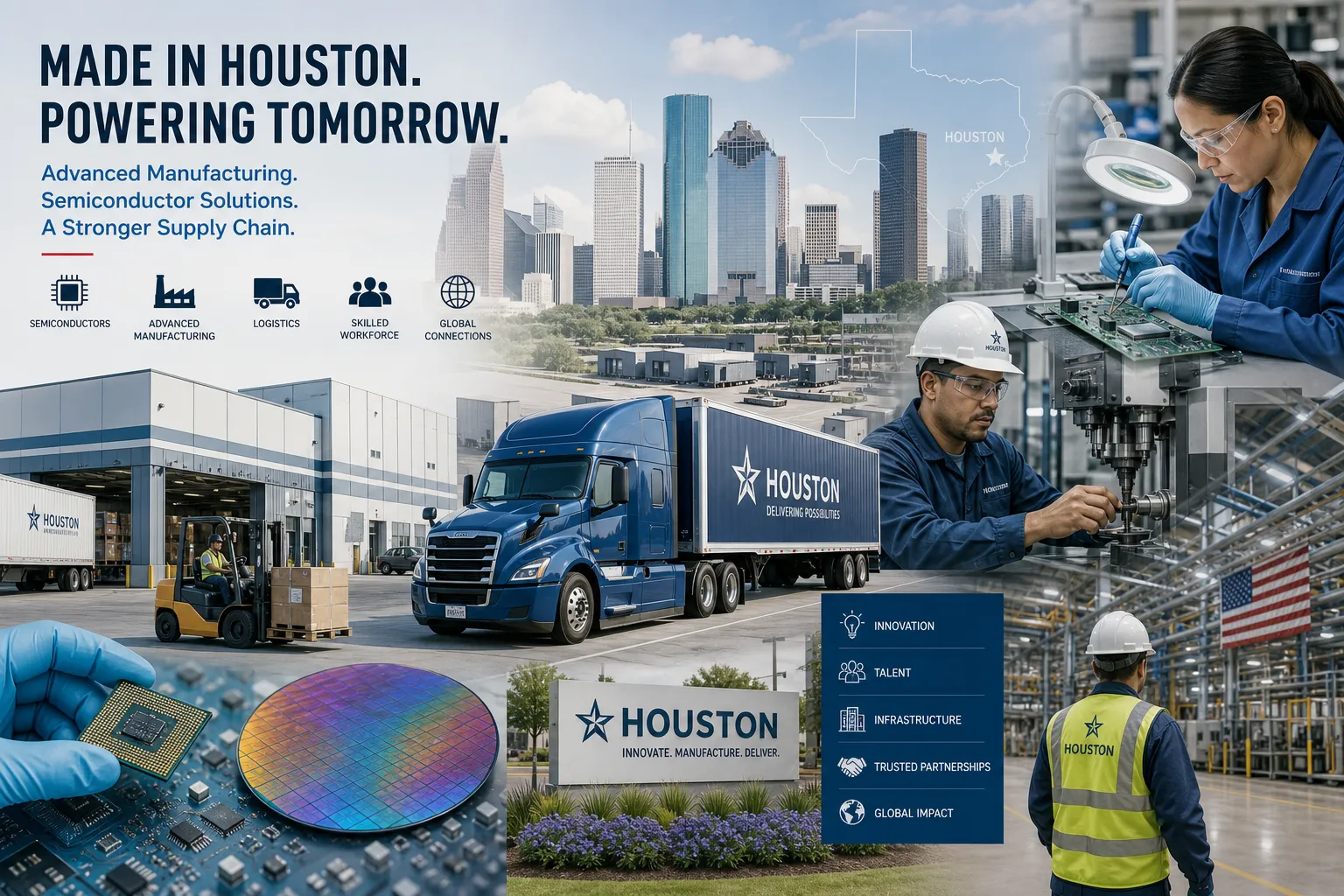
Houston is best understood as a supporting infrastructure and downstream execution market for semiconductor and advanced manufacturing growth. This includes:
Supply chain coordination
Import/export and distribution
Warehousing and inventory control
Equipment and facilities support
Electrical and mechanical assembly
Quality and compliance
Project coordination
Skilled trades and maintenance
Administrative and operational support
This distinction matters because it affects how companies should recruit.
A Houston-area employer serving advanced manufacturing does not always need a pure-play fab recruiter. More often, the company needs a local staffing partner that can fill the roles that keep product moving, equipment running, projects on schedule, and customer commitments intact.
"Texas is home to more than 47,000 semiconductor jobs, and semiconductor jobs in Texas have grown by 14.6% since the CHIPS and Science Act passed." - NIST
That growth creates pressure across the entire ecosystem, not only in chip design and wafer fabrication. As investment expands in Texas, demand rises for adjacent talent in procurement, scheduling, field services, maintenance, warehousing, technical support, and operations.
What the CHIPS Act Means for Houston Employers
The CHIPS and Science Act has increased attention, investment, and urgency across U.S. semiconductor manufacturing. Even when new fabs are built elsewhere, Houston still feels the impact.
The practical effect in Houston
Houston companies may support semiconductor and advanced manufacturing through:
Materials and component distribution
Industrial service and field support
Clean process support equipment
Construction and facility readiness
Testing, packaging, assembly, and related operations
Regional logistics and transportation
Compliance, documentation, and customer support
Shared services such as HR, accounting, and procurement
This means hiring demand often appears in roles that are not branded as "semiconductor" at all, even though they are directly tied to the sector's growth.
The Overlooked Hiring Gap That Actually Determines Growth
Here is the part many articles miss:
Advanced manufacturing does not run on engineers alone
A company can win business, secure equipment, and sign expansion plans, then still lose time and money because it cannot hire enough:
Buyers
Production coordinators
Inventory specialists
Quality inspectors
Maintenance technicians
Assemblers
Shipping and receiving talent
Schedulers
Document control staff
Customer service and inside sales support
Accounts payable, billing, and payroll support
Skilled electricians, mechanics, and industrial support staff
Wireman and panel builders
These are the roles that convert strategy into throughput.
In Houston, this gap is especially important because the region's value proposition is built around execution. Houston has deep strengths in logistics, industrial operations, field service, energy-adjacent manufacturing, engineering support, and workforce scale. That makes it ideal for support functions around semiconductor and advanced manufacturing growth.
Expert commentary from a Houston staffing perspective
At Clayton Services, we see the same pattern repeatedly. Employers often begin the search focused on a highly specialized technical title. But the actual bottleneck is usually broader and more operational. Production stalls because of late shipments, poor inventory accuracy, open maintenance positions, weak coordination between departments, or turnover in critical support roles.
That is why advanced manufacturing staffing in Houston has to be approached as a system, not a list of job titles.

The Roles Houston Employers Actually Need Most
Below is a practical view of the hiring categories most relevant to semiconductor and advanced manufacturing growth in Houston.
High-demand role categories in Houston
Hiring Category | Typical Houston Need | Why It Matters |
Supply chain and procurement | Buyers, planners, sourcing specialists, expeditors | Prevents shortages and keeps production schedules intact |
Logistics and warehouse operations | Inventory control, shipping/receiving, warehouse coordinators, logistics specialists | Supports on-time movement of materials and finished goods |
Skilled trades and maintenance | Electricians, maintenance techs, mechanics, installers, field service support | Reduces downtime and supports safe operations |
Electrical and mechanical assembly | Assemblers, test techs, cable and panel builders, equipment support | Converts parts into working products and systems |
Quality and compliance | QC inspectors, QA coordinators, document control, regulatory support | Protects yield, customer standards, and audit readiness |
Operations and production support | Supervisors, schedulers, production coordinators, admins | Improves throughput and cross-functional communication |
Back-office support | HR, accounting, payroll, customer service, executive assistants | Keeps hiring, reporting, and customer response on track |
Houston staffing priorities by business type
Employer Type | Most Common Hiring Priorities |
Contract manufacturers | Assemblers, quality, schedulers, buyers, supervisors |
Equipment and component suppliers | Warehouse, logistics, inside sales, field support, procurement |
Industrial service providers | Skilled trades, dispatch, coordinators, customer support |
Facilities and infrastructure firms | Project admins, document control, compliance, skilled trades |
Regional distribution operations | Inventory control, shipping, receiving, logistics analysts |
Technical service organizations | Technicians, service coordinators, parts specialists, billing support |
Why These Roles Are Hard to Fill
Even when the role itself is not rare, hiring can still be difficult because the strongest candidates are usually already working.
Common reasons advanced manufacturing employers struggle include:
1. Hybrid skill requirements
Many roles require a mix of:
Industrial experience
Administrative precision
ERP familiarity
Compliance awareness
Urgency under pressure
Customer-facing professionalism
That combination narrows the candidate pool.
2. Competition from multiple industries
Houston employers are not only competing within manufacturing. They are also competing with:
Energy
Distribution
Construction
Engineering services
Medical manufacturing
Chemical and industrial operations
3. Hiring speed mismatch
Operations leaders often need help now. Internal hiring processes often move too slowly, especially when approvals, interviews, and background steps are fragmented.
4. Inconsistent candidate quality
When hiring volume increases, companies often see too many resumes but too few true matches. Screening becomes the hidden cost.
5. Compliance and onboarding complexity
For temporary and contract labor, employers must think beyond recruiting. They also need compliant onboarding, payroll handling, documentation, and workforce management support.
A Houston Wage Signal Employers Should Pay Attention To
Hiring conditions are shaped by wage pressure, even outside specialized engineering roles.
"Workers in the Houston-Pasadena-The Woodlands Metropolitan Statistical Area earned an average hourly wage of $31.87 in May 2024." - U.S. Bureau of Labor Statistics
That average covers all occupations, but it reinforces a key point: employers cannot rely on outdated pay assumptions. In a market shaped by industrial competition and supply chain demand, compensation strategy matters. So do schedule, commute, stability, growth path, and speed of offer.
How to Choose a Staffing Partner for Semiconductor and Advanced Manufacturing Hiring
Not every recruiter who says they understand manufacturing can support this kind of hiring well.
Look for a partner with these traits
Local Houston market depth
Houston hiring is neighborhood-specific, industry-specific, and timing-sensitive. A local firm knows where talent is concentrated, what competitors are doing, and how commute patterns affect acceptance rates.
Breadth across role types
Advanced manufacturing growth creates needs across front-line operations, professional support, and leadership. Your staffing partner should be able to recruit beyond one narrow function.
Fast response capability
If open roles affect production, waiting weeks is costly. Speed matters.
Flexible hiring models
Different roles call for different structures. Some should be temporary. Some are ideal for temp-to-hire. Some require a direct hire search.
Guarantees that reduce risk
A staffing firm should stand behind its placements in a meaningful way.
Why Houston Employers Choose Clayton Services
Clayton Services is uniquely positioned for this market because our value is aligned with the way Houston companies actually hire.
Houston-owned and locally knowledgeable
Clayton Services has served the Greater Houston market since 1984. That long-standing local presence matters because industrial hiring is not generic. Employers need recruiters who understand the region, the labor market, and the realities of business here.
Broad specialization across critical hiring functions
We support hiring across many of the roles advanced manufacturing depends on, including:
Supply chain and logistics
Administrative and operations support
Accounting and finance
Customer service
Engineering support functions
Human resources
Legal and compliance support
Light industrial
Skilled trades
Sales and inside support roles
Flexible hiring models for short-term and long-term needs
Clayton Services supports:
Temporary staffing
Temp-to-hire staffing
Direct hire recruiting
Payrolling services as employer of record
Executive search
High-volume RPO and onsite recruiting support
Speed when urgency is real
For many active needs, we can deliver candidates within 24 to 72 hours, helping employers stabilize operations faster.
Guarantees that lower hiring risk
Clayton Services offers:
A 180-day direct hire replacement guarantee
A 100% satisfaction guarantee on temporary placements
That accountability is a major advantage for employers who need to move quickly without increasing hiring risk.
Best Hiring Models for Advanced Manufacturing Employers
The right staffing model depends on the role, urgency, budget, and uncertainty around headcount.
Hiring model comparison
Hiring Model | Best For | Pros | Watchouts |
Temporary staffing | Coverage gaps, seasonal demand, project spikes, urgent backfill | Fast deployment, flexible, lower disruption | Not every role is suited for long-term temp use |
Temp-to-hire | Roles where fit, reliability, and retention matter | Reduces hiring risk, evaluates performance on the job | Requires clear conversion planning |
Direct hire | Permanent strategic roles, experienced specialists, supervisors, key support staff | Strong long-term solution, better for retention planning | Takes more search precision upfront |
Payrolling / employer of record | Independent candidate identified, but employer wants compliant payroll and onboarding support | Simplifies admin, reduces compliance burden | Best when role and candidate are already selected |
Executive search | Senior leaders, confidential hiring, hard-to-find management talent | High-touch process, targeted outreach | Longer cycle, best for business-critical hires |
Onsite / RPO | High volume or ongoing multi-role hiring | Scales recruiting process, standardizes hiring | Most effective when demand is sustained |
A simple decision framework
Use temporary staffing when:
You need coverage now
Demand is volatile
The role is essential but not finalized as permanent
Overtime or missed shipments are becoming expensive
Use temp-to-hire when:
Reliability and attendance are crucial
Team fit matters
You want to reduce the risk of a permanent hiring mistake
Use direct hire when:
The role is long-term and business-critical
You need stronger candidate commitment upfront
The position affects quality, customer relationships, or supervision
What Job Seekers Should Know About This Market
For job seekers in Houston, semiconductor-related growth is not limited to chip-design jobs. Many opportunities sit in the surrounding ecosystem.
Good-fit backgrounds often include:
Manufacturing operations
Warehouse and distribution
Quality assurance or inspection
Maintenance and field service
Administrative support
Procurement or inventory
Customer service in industrial settings
Accounting or payroll in operations-heavy companies
Skilled trades and technical assembly
What employers value most
Employers often prioritize:
Reliability
Safety awareness
Documentation accuracy
ERP or systems experience
Communication skills
Mechanical aptitude
Ability to work in structured, process-driven environments
For candidates, partnering with a Houston-based recruiting team can help uncover roles that are not always easy to find through job boards alone.
Common Hiring Mistakes in Advanced Manufacturing Support Roles
Overemphasizing title matching
The best candidate may come from an adjacent environment with highly transferable experience.
Delaying offers
In-demand support talent often moves quickly. Slow feedback loses strong candidates.
Underestimating soft skills
In logistics, quality, and operational support roles, communication and consistency matter as much as technical fit.
Ignoring commute reality
Houston geography matters. A strong candidate who faces an unrealistic commute may never start or stay.
Treating every opening as a direct hire
Some roles are better served through temp-to-hire or temporary staffing, especially when urgency and fit are both important.
What Great Semiconductor Supply Chain Recruiting Looks Like in Houston
Strong recruiting in this space means understanding how one open role affects the whole operation.
For example:
An open buyer role can delay material availability
A missing maintenance technician can increase downtime
An unfilled shipping coordinator role can impact customer service and cash flow
A weak quality hire can create scrap, returns, or compliance issues
A missing scheduler can disrupt production planning across departments
This is why the right staffing strategy is not just about filling seats. It is about protecting throughput, quality, and customer commitments.
Why Local Matters More Than National Reach for Houston Hiring
National scale sounds impressive, but for many Houston employers, execution wins.
A local recruiting partner can often deliver better results because they understand:
Which submarkets attract which candidates
How local wage expectations are moving
What shift patterns are realistic
Which industries are pulling from the same labor pool
How to present opportunities in a way that resonates with Houston candidates
Clayton Services brings that local market knowledge together with flexible staffing infrastructure, broad functional coverage, and proven accountability.
Final Verdict
Houston's opportunity in semiconductor and advanced manufacturing is real, but it is not primarily about wafer fabs or elite chip-design recruiting. It is about the supporting and downstream roles that make growth possible across supply chain, logistics, facilities, maintenance, assembly, quality, and operations support.
That is exactly where many employers struggle.
If your business needs help hiring for the operational backbone of advanced manufacturing, Clayton Services offers a practical, lower-risk solution. Since 1984, we have helped Houston employers hire faster and smarter with local expertise, broad role specialization, flexible staffing models, payrolling and compliance support, and strong placement guarantees.
If you need dependable talent in 24 to 72 hours, or a long-term recruiting partner who understands the Houston market, Clayton Services is ready to help.
Frequently Asked Questions
What does semiconductor and advanced manufacturing staffing look like in Houston?
It mostly means recruiting for the roles that help advanced manufacturing run at scale in this region—planners, buyers, warehouse and logistics talent, customer service, schedulers, document control, maintenance, quality, assembly, technicians, field support, facilities, and skilled trades. Houston isn't a major wafer-fab or chip-design hub like Austin, Dallas, or Phoenix; its strength is in the supply chain, logistics, and operational backbone that semiconductor and advanced manufacturing growth depends on.
Is Houston a semiconductor hub?
Not in the way Austin, Dallas, or Phoenix are for wafer fabrication and chip design. Houston's role in the semiconductor economy is as a supporting-infrastructure and downstream-execution market—supply chain coordination, distribution, warehousing, equipment and facilities support, electrical and mechanical assembly, quality and compliance, and operational support. That distinction matters because it changes how companies should recruit: most need a local industrial-operations staffing partner, not a pure-play fab recruiter.
How is the CHIPS Act affecting Houston hiring?
Even when new fabs are built elsewhere, Houston feels the impact through materials and component distribution, industrial service and field support, construction and facility readiness, regional logistics, and shared services like HR, accounting, and procurement. Texas is home to more than 47,000 semiconductor jobs, with growth of 14.6% since the CHIPS and Science Act passed, according to NIST—and that pressure spreads across the entire ecosystem, not just chip design. Much of Houston's resulting demand appears in roles not even branded as "semiconductor."
What roles do Houston advanced manufacturing employers hire for most?
The highest-demand categories are supply chain and procurement (buyers, planners, expeditors), logistics and warehouse operations (inventory control, shipping/receiving, coordinators), skilled trades and maintenance (electricians, maintenance techs, mechanics, field service), electrical and mechanical assembly (assemblers, test techs, panel builders), quality and compliance (QC inspectors, document control), operations and production support (supervisors, schedulers, coordinators), and back-office support (HR, accounting, payroll, customer service). These are the roles that convert strategy into throughput.
What is the overlooked hiring gap in advanced manufacturing?
Advanced manufacturing doesn't run on engineers alone. A company can win business, secure equipment, and sign expansion plans, then still lose time and money because it can't hire enough buyers, production coordinators, inventory specialists, quality inspectors, maintenance technicians, assemblers, schedulers, and support staff. The real bottleneck is usually broader and more operational than a specialized technical title—production stalls from late shipments, poor inventory accuracy, open maintenance roles, or turnover in critical support positions.
Why are advanced manufacturing support roles hard to fill in Houston?
Several factors compound: many roles require hybrid skills (industrial experience plus administrative precision, ERP familiarity, and compliance awareness), which narrows the pool; Houston employers compete with energy, distribution, construction, and chemical operations for the same talent; operations leaders need help faster than fragmented internal processes can move; high hiring volume produces many resumes but few true matches; and temporary or contract labor adds compliance and onboarding complexity beyond just recruiting.
How fast can a Houston staffing agency fill advanced manufacturing roles?
For many active needs, qualified candidates can be delivered within 24 to 72 hours, which helps employers stabilize operations faster when open roles are affecting production, shipments, or maintenance. Clayton Services supports these timelines while still screening for fit—because when a single open buyer, scheduler, or maintenance role can disrupt throughput across departments, speed paired with accuracy matters most.
Which hiring model is best for advanced manufacturing employers?
Match the model to the need: temporary staffing for coverage gaps, seasonal demand, and urgent backfill; temp-to-hire when reliability, attendance, and team fit matter and you want to reduce the risk of a permanent mistake; direct hire for long-term, business-critical roles affecting quality, customers, or supervision; payrolling/EOR when you've identified a candidate but need compliant onboarding; executive search for confidential or senior management hires; and onsite/RPO for high-volume or ongoing multi-role hiring.
What should I look for in a staffing partner for semiconductor and advanced manufacturing hiring?
Look for genuine local Houston market depth (knowing where talent is concentrated and how commute patterns affect acceptance), breadth across front-line, professional, and leadership roles, fast response capability when open roles affect production, flexible hiring models, and guarantees that reduce risk. Not every recruiter who claims to understand manufacturing can support this hiring well—the best partners treat it as a system, not a list of job titles. Clayton Services has served Greater Houston since 1984.
What should job seekers know about semiconductor-related opportunities in Houston?
Semiconductor-related growth in Houston isn't limited to chip-design jobs—many opportunities sit in the surrounding ecosystem. Strong-fit backgrounds include manufacturing operations, warehouse and distribution, quality assurance, maintenance and field service, procurement or inventory, customer service in industrial settings, accounting or payroll in operations-heavy companies, and skilled trades. Employers most value reliability, safety awareness, documentation accuracy, ERP experience, and the ability to work in structured, process-driven environments.


