
Skilled Trades Recruiter: How to Hire Faster


Skilled Trades Recruiter: How to Hire Faster
Hiring skilled trades talent in Houston is rarely a simple “post and wait” process. If you need electricians, welders, machinists, maintenance technicians, industrial mechanics, or other hard-to-source trade professionals, the real challenge is not just finding applicants. It is finding people who can show up, work safely, meet production or project demands, and stay.
For Houston employers, delays in skilled trades recruiting can quickly affect output, safety, overtime costs, service timelines, and customer satisfaction. That is why many companies turn to a skilled trades recruiter instead of relying only on job boards or internal hiring bandwidth. A specialized recruiter can shorten time-to-fill, improve fit, and reduce hiring risk, especially when local labor competition is intense.
Clayton Services helps Houston-area employers hire faster with flexible staffing and recruiting solutions for short-term, temp-to-hire, and direct hire needs. As a Houston-owned staffing and recruiting firm serving the market since 1984, Clayton Services brings local labor market insight, a decades-deep candidate network, and the ability to move quickly, often within 24 to 72 hours for urgent staffing needs. For employers who want speed without sacrificing quality, that local advantage matters.
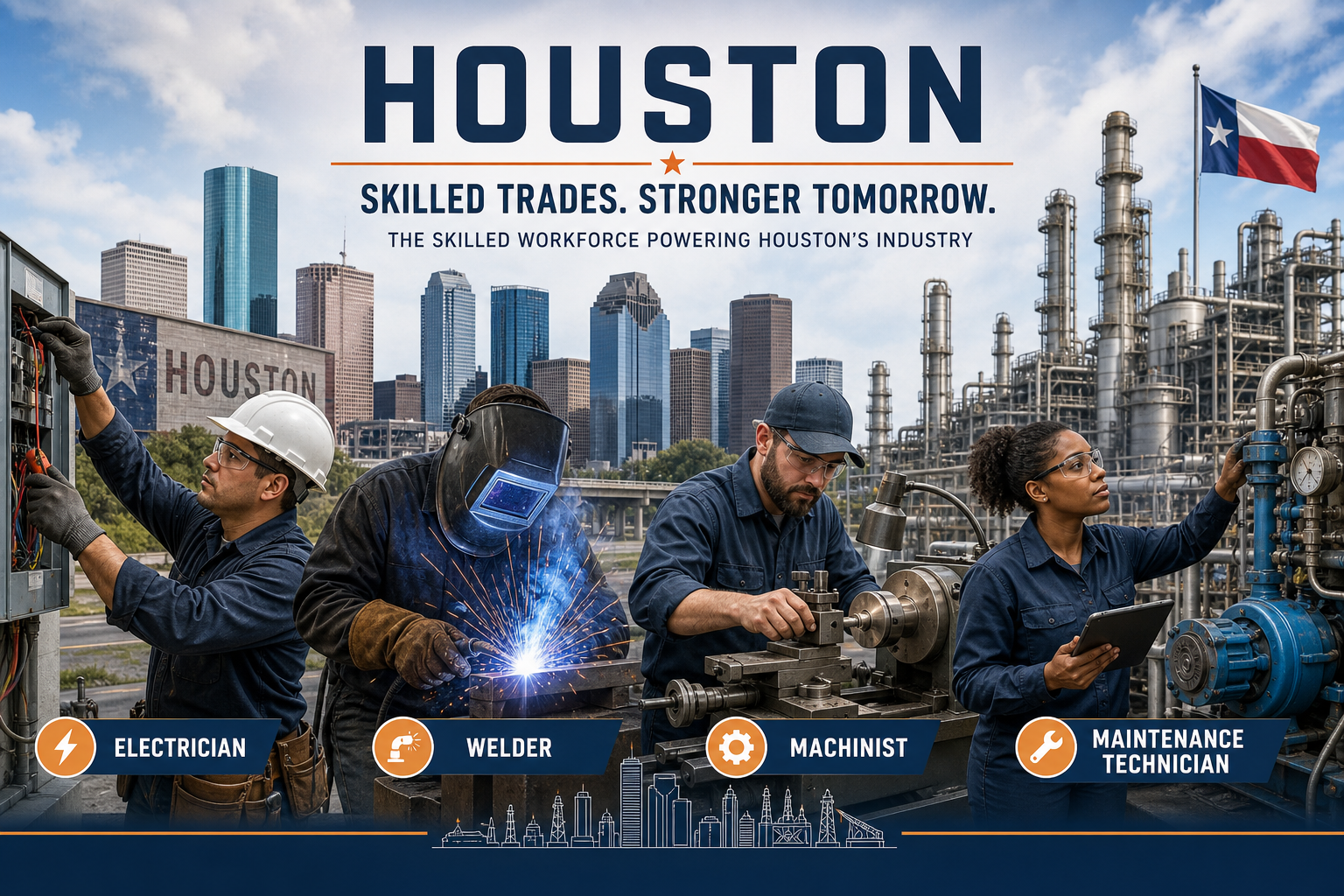
Why Skilled Trades Hiring Takes So Long
The biggest reason skilled trade recruiters add value is simple: these roles are hard to fill well. Houston employers are often competing for the same limited pool of experienced candidates across construction, manufacturing, energy, logistics, facilities, and industrial operations.
Common reasons skilled trades hiring slows down include:
Too few qualified applicants
Candidates with the wrong certifications or equipment background
Poor response rates from passive talent
Slow internal interview scheduling
Candidates accepting offers elsewhere before a decision is made
Weak screening for reliability, safety awareness, and long-term fit
Unclear compensation or shift expectations
Competitor articles often focus on broad advice such as using job boards, referrals, and better branding. That is useful, but it misses a critical operational reality for Houston employers: speed only matters if the recruiter also understands the exact trade environment, site demands, shift structures, pay competitiveness, and compliance requirements around the role.
"The United States is facing a significant shortage in skilled trades labor, with projections indicating that by 2030, approximately 2.1 million positions could remain unfilled." - JLL
What a Skilled Trades Recruiter Actually Does
A skilled trades recruiter does much more than collect resumes. The right recruiter acts as a hiring partner who helps define the role, identify qualified talent, pre-screen candidates, verify fit, and keep the process moving.
Core functions of skilled trade recruiters
A strong skilled trades recruiter typically helps with:
Recruiting Function | How It Helps Employers Hire Faster |
Role scoping | Clarifies must-have skills, certifications, tools, shift availability, and environment |
Candidate sourcing | Reaches active and passive candidates beyond job boards |
Screening | Filters for technical background, work history, safety mindset, and reliability |
Interview coordination | Reduces scheduling delays and candidate drop-off |
Offer management | Helps align pay, expectations, and start dates quickly |
Hiring model selection | Supports direct hire, temp-to-hire, temporary staffing, or payrolling |
Risk reduction | Improves fit and lowers turnover through more targeted matching |
At Clayton Services, this process is backed by broad specialization across office, professional, industrial, technical, and leadership hiring, which is especially valuable when skilled trades roles intersect with engineering, supply chain, customer operations, or plant leadership.
When to Use Skilled Trades Recruiting Support
Not every open role requires outside recruiting help. But many Houston employers wait too long before bringing in a recruiting partner, and that delay can cost far more than they expect.
You should consider a skilled trades recruiter when:
The role has been open for more than 2 to 3 weeks with little traction
You need multiple hires in a short period
The position requires specific certifications, equipment experience, or site readiness
Your team does not have time to screen a large applicant volume
Your project timelines, maintenance schedules, or production targets are at risk
You want to reduce turnover by using a temp-to-hire approach
You need employer of record support for payrolling and compliance
You are hiring supervisors, managers, or hard-to-reach technical leaders
You need onsite recruiting or RPO support for ongoing volume hiring
This is where Clayton Services stands out. The firm supports everything from single urgent placements to high-volume recruiting programs, including executive search, onsite recruiting, and RPO support for employers with sustained hiring demands.
The Houston Advantage in Skilled Trades Recruiting
National staffing firms may have reach, but local knowledge changes outcomes. Houston’s labor market is not generic. Pay expectations, commute tolerance, industry movement, turnaround schedules, and candidate availability can vary sharply by submarket and sector.
A Houston-based skilled trades recruiter understands:
Which areas produce stronger candidate flow for industrial and field roles
How oil and gas, manufacturing, and construction cycles affect labor supply
Which competitors are hiring aggressively at the same time
When compensation, shift differential, or overtime structure is hurting response
How to position roles to local candidates in a more credible way
Clayton Services has been serving Greater Houston since 1984. That long-standing market presence gives employers access to a candidate network built over decades, not just names pulled from a database the day the job opens.

How Skilled Trade Recruiters Help Reduce Time-to-Fill
The best competitor content highlights referrals, pipeline building, and speed. What many articles do not fully explain is how hiring speed is created in practice. Faster hiring is usually the result of a tighter process, better qualification standards, and immediate access to relevant candidates.
1. They start with a sharper intake
A recruiter should help define:
Required technical skills
Tools, equipment, or systems familiarity
Certifications or licenses
Work environment and physical demands
Shift, overtime, travel, and call-out expectations
Compensation range and urgency level
A vague job order leads to slow hiring. A precise one leads to better matches faster.
2. They use existing talent networks
The best skilled trade recruiters do not start every search from zero. They already know who is working, who may be open, and who has the right experience for similar environments.
3. They pre-screen for what job boards cannot
Resume keywords are not enough for skilled trades recruiting. Good recruiters screen for reliability, tenure patterns, safety habits, practical experience, and whether the candidate can truly succeed in your environment.
4. They keep momentum through the offer stage
Many skilled trades hires are lost because employers take too long to interview or make decisions. Recruiters help maintain candidate engagement, manage expectations, and reduce drop-off before acceptance.
5. They match the right hiring model to the need
Sometimes direct hire is best. Sometimes temp-to-hire is smarter. Sometimes you need temporary staffing now and a long-term hire later. A strong recruiting partner helps choose the option that balances urgency, risk, and budget.
At Clayton Services, employers can use temporary staffing for immediate coverage, temp-to-hire to evaluate fit before commitment, direct hire recruiting for long-term placements, or payrolling solutions when they need employer of record support and compliance administration.
"According to SHRM, each unfilled position costs companies an average of $4,129 over a 42-day vacancy period." - Forbes
Which Skilled Trades Roles Benefit Most From Recruiting Support
A skilled trades recruiter can help across a wide range of roles, but recruiting support is particularly valuable when the position is technical, urgent, scarce, or business-critical.
Frequently recruited skilled trades and industrial roles
Electricians
Welders
CNC machinists
Manual machinists
Maintenance technicians
Industrial mechanics
PLC technicians
HVAC technicians
Instrumentation technicians
Pipefitters
Millwrights
Field service technicians
Production maintenance specialists
Facilities maintenance personnel
Skilled assemblers and fabrication professionals
Houston employers often need these hires in environments tied to energy, industrial operations, fabrication, logistics, manufacturing, and commercial services. Clayton Services supports hiring across these business-critical functions and can also assist when trade roles overlap with engineering, operations, customer support, or leadership needs.
Direct Hire vs Temp-to-Hire vs Temporary Staffing for Skilled Trades
One major content gap in competitor articles is the lack of practical guidance on choosing the right hiring structure. This matters because the fastest solution is not always the best long-term solution.
Comparison of common skilled trades hiring models
Hiring Model | Best For | Main Benefit | Potential Tradeoff |
Direct hire | Long-term, high-value roles where you want permanent commitment quickly | Strong long-term placement strategy | Greater risk if fit is wrong |
Temp-to-hire | Roles where performance, attendance, and team fit need validation first | Reduced hiring risk | Slightly longer path to permanent conversion |
Temporary staffing | Short-term demand, shutdowns, backfills, production spikes, or urgent coverage | Fastest access to labor | Not always intended for permanent retention |
Payrolling | When you found the worker but need employer of record support | Compliance and administrative relief | Not a sourcing solution by itself |
Clayton Services helps employers use the right model for the situation. That flexibility is important for companies trying to control hiring risk while maintaining production and service continuity. The company’s 180-day direct hire replacement guarantee and 100% satisfaction guarantee on temporary placements add another layer of confidence.
What to Expect From the Skilled Trades Recruiting Process
If you have not worked with a skilled trades recruiter before, the process should feel structured, transparent, and practical.
A strong process usually includes:
Intake and role calibration
The recruiter learns the job requirements, environment, pay range, urgency, reporting structure, and likely success profile.
Market feedback
You should receive honest insight on candidate availability, compensation competitiveness, and any barriers likely to slow the search.
Sourcing and outreach
Candidates are identified through the recruiter’s network, database, referrals, outreach, and active sourcing channels.
Screening and shortlisting
The recruiter evaluates candidates for technical fit, availability, work history, soft skills, and practical alignment with your team.
Interview coordination
Qualified candidates are submitted quickly, interviews are arranged, and feedback is gathered fast to keep the process moving.
Offer and onboarding support
The recruiter helps close the candidate and coordinates start details. If needed, a staffing partner can also support payrolling, compliance, and employer of record administration.
For many urgent roles, Clayton Services can move much faster than internal processes alone, with staffing support often available within 24 to 72 hours depending on the role and hiring model.
How to Evaluate a Skilled Trades Recruiter
Not all skilled trade recruiters are equally effective. Speed claims mean little if the recruiter cannot deliver quality candidates who stay.
Ask these questions before choosing a recruiting partner
Do you specialize in skilled trades recruiting or only handle it occasionally?
How well do you know the Houston labor market?
What similar roles have you filled recently?
How do you screen candidates beyond resume review?
Can you support direct hire, temp-to-hire, temporary staffing, and payrolling?
What is your average response time?
Do you offer any service guarantees?
Can you scale for high-volume hiring or leadership searches?
How do you handle compliance and employer of record needs?
Clayton Services is especially well positioned for employers who want one partner for multiple hiring needs, from front-line staffing to professional recruiting to executive search.
Common Hiring Mistakes That Slow Skilled Trades Recruiting
Houston employers can improve outcomes dramatically by avoiding a few repeated mistakes.
Mistake 1: Waiting for the “perfect” candidate
Holding out too long in a tight market often means losing strong, realistic hires.
Mistake 2: Writing vague job descriptions
If the role, pay, schedule, environment, or must-have skills are unclear, candidate quality suffers.
Mistake 3: Moving too slowly
Qualified trades talent is frequently off the market fast. Delayed interview feedback can sink a search.
Mistake 4: Ignoring local market realities
If your pay rate, commute, or shift structure is out of step with Houston market conditions, response will drop.
Mistake 5: Using the wrong hiring model
Not every role should be a direct hire. Temp-to-hire can be a smarter option when fit or retention is uncertain.
Mistake 6: Treating all recruiters the same
A local recruiter with deep Houston roots and multi-industry experience can often outperform a national generalist for region-specific hiring.
How Job Seekers Benefit From Skilled Trade Recruiters Too
Although this article is primarily for Houston employers, job seekers also benefit from working with experienced recruiters. Trade professionals often gain access to better-matched opportunities, faster hiring timelines, and roles that may not be broadly advertised.
Clayton Services supports job seekers across Greater Houston in fields such as skilled trades, administration, accounting, customer service, engineering, legal, and other office and industrial roles. That broad reach helps connect talent with employers who need both immediate and long-term support.
Why Clayton Services Is a Strong Choice for Houston Skilled Trades Recruiting
Clayton Services brings together the factors most employers want but rarely find in one staffing partner:
Houston-owned and deeply rooted in the local market
Serving employers and job seekers since 1984
Skilled in short-term, long-term, and project-based hiring support
Fast placement timelines, often within 24 to 72 hours for urgent staffing needs
Direct hire, temporary staffing, and temp-to-hire options
Payrolling and compliance support as employer of record
Executive search and high-volume RPO or onsite recruiting capabilities
Broad specialization across professional, administrative, technical, industrial, and leadership roles
A 180-day direct hire replacement guarantee
A 100% satisfaction guarantee on temporary placements
That mix gives Houston employers a more practical and lower-risk path to hire skilled trades talent faster without sacrificing fit.
Final Verdict: Faster Skilled Trades Hiring Starts With the Right Recruiting Partner
If your business is struggling to hire electricians, welders, machinists, maintenance technicians, or other trade professionals, the answer is usually not to keep doing more of the same. The faster route is a better process, a stronger candidate pipeline, and a recruiting partner who understands the Houston market in detail.
A skilled trades recruiter helps reduce guesswork, shorten time-to-fill, and improve hiring outcomes by combining market knowledge, focused sourcing, structured screening, and process discipline. For employers in Greater Houston, that advantage is even stronger when the recruiter is local, responsive, and flexible enough to support temporary, temp-to-hire, direct hire, payrolling, and high-volume needs.
Clayton Services offers that combination. If you need reliable staffing and recruiting support for skilled trades or other critical roles in Houston, Clayton Services provides the local expertise, service guarantees, and fast-response hiring solutions to help you move with confidence.
Frequently Asked Questions About Skilled Trades Recruiters in Houston
What does a skilled trades recruiter do?
A skilled trades recruiter helps employers hire qualified trade professionals faster by sourcing, screening, and placing candidates in roles such as electricians, welders, machinists, maintenance technicians, HVAC technicians, PLC technicians, and industrial mechanics. Skilled trade recruiters also help reduce hiring delays, improve candidate quality, and lower turnover risk through better matching and pre-screening.
Why is skilled trades hiring so difficult in Houston?
Houston employers face intense competition for skilled labor across construction, manufacturing, energy, logistics, and industrial operations. Hiring challenges often include a shortage of experienced candidates, poor response rates, slow interview processes, certification requirements, and candidates accepting other offers before decisions are made.
How can a skilled trades recruiter help companies hire faster?
A skilled trades recruiter speeds up hiring by using existing candidate networks, pre-screening applicants, coordinating interviews quickly, managing offers, and identifying candidates who match the technical and cultural needs of the role. Many staffing firms can also provide temporary staffing or temp-to-hire solutions for urgent hiring needs.
What types of skilled trades jobs do recruiters typically fill?
Skilled trade recruiters commonly fill positions such as electricians, welders, CNC machinists, manual machinists, HVAC technicians, PLC technicians, industrial mechanics, maintenance technicians, millwrights, instrumentation technicians, pipefitters, and field service technicians.
When should a company use a skilled trades recruiter?
Employers should consider using a skilled trades recruiter when roles remain open for several weeks, hiring volume increases, projects are at risk, internal teams lack recruiting bandwidth, or positions require highly specialized technical experience. Recruiting support is especially valuable for urgent, hard-to-fill, or high-turnover positions.
What is the difference between direct hire, temp-to-hire, and temporary staffing?
Direct hire is best for long-term permanent placements, temp-to-hire allows employers to evaluate performance before making a permanent offer, and temporary staffing provides short-term labor support for urgent coverage, shutdowns, or production spikes. The right hiring model depends on urgency, risk tolerance, and workforce planning goals.
What are the benefits of working with a Houston-based skilled trades recruiter?
A Houston-based recruiter understands local labor market conditions, pay expectations, industry hiring cycles, commute challenges, and regional competition for talent. Local market expertise often leads to faster placements, more accurate compensation guidance, and stronger candidate relationships.
How long does it take to fill skilled trades positions?
The timeline varies based on role complexity, candidate availability, compensation, and urgency. However, specialized staffing firms with established candidate networks can often provide qualified candidates within 24 to 72 hours for urgent staffing needs.
What should employers look for in a skilled trades recruiter?
Employers should evaluate whether the recruiter specializes in skilled trades, understands the Houston market, offers flexible hiring models, screens candidates thoroughly, provides service guarantees, and has experience filling similar technical roles successfully.
What are the biggest mistakes companies make when hiring skilled trades talent?
Common mistakes include waiting too long to make decisions, using vague job descriptions, offering uncompetitive pay, ignoring local market conditions, and searching for unrealistic “perfect” candidates in a tight labor market. These issues can significantly increase time-to-fill and turnover risk.
Why are skilled trades workers in high demand?
Skilled trades professionals are in high demand due to labor shortages, retiring workforces, infrastructure growth, manufacturing expansion, and increased industrial activity. Houston’s strong energy, construction, and manufacturing sectors continue to increase demand for experienced technical labor.
Can staffing agencies help with high-volume skilled trades hiring?
Yes. Many staffing and recruiting firms offer onsite recruiting, recruitment process outsourcing (RPO), project staffing, and scalable hiring solutions for employers managing shutdowns, plant expansions, production increases, or multiple simultaneous openings.
How do skilled trades recruiters screen candidates?
Experienced recruiters screen candidates for technical skills, certifications, equipment familiarity, safety awareness, attendance history, reliability, work stability, and culture fit. This helps reduce hiring risk and improve long-term retention.
Are skilled trade recruiters only for large companies?
No. Skilled trade recruiters support businesses of all sizes, from small manufacturers and contractors to large industrial operations and national employers. Many smaller companies use recruiters because they lack the internal bandwidth or specialized networks needed to hire quickly.
What industries commonly use skilled trades recruiters in Houston?
Industries that frequently use skilled trades recruiters include oil and gas, manufacturing, industrial services, logistics, facilities management, commercial construction, fabrication, energy, and field services.


