
Temp Agency How Does It Work Explained


Temp Agency How Does It Work Explained
When hiring demand spikes, a key employee leaves unexpectedly, or your team simply cannot wait 30 to 60 days to fill a role, one question comes up fast: temp agency how does it work? For Houston employers, the answer matters because the right staffing partner can reduce downtime, control hiring risk, and get qualified people on the job quickly. For job seekers, a temp agency can open doors to flexible work, temp-to-hire opportunities, and faster access to employers that may not advertise every opening publicly.
At its core, a temp agency connects employers with qualified candidates for temporary, temp-to-hire, and sometimes direct hire roles. The agency typically recruits, screens, and places talent, and in many temporary assignments, it also acts as the employer of record, handling payroll, taxes, onboarding paperwork, and compliance.
For businesses across Greater Houston, that means less administrative burden and faster hiring. For candidates, it means one application can lead to multiple opportunities.
At Clayton Services, this process is backed by a Houston-owned recruiting team, a decades-deep local network, and staffing solutions that cover everything from short-term coverage to executive search. Whether you need a temporary administrative professional tomorrow, a temp-to-hire customer service team next week, or a direct hire engineering leader with niche industry experience, the goal is the same: get the right person in place with less risk and less delay.

What Is a Temp Agency?
A temp agency, also called a staffing agency, is a company that helps employers fill jobs quickly by sourcing and placing workers for a defined period of time or for a trial-to-permanent arrangement.
Most competitor articles explain this at a very basic level. What they often gloss over is that a modern staffing firm may offer multiple hiring models, not just temporary labor.
Common staffing models
Hiring Model | How It Works | Best For | Who Handles Payroll |
Temporary Staffing | Candidate works for a set assignment length | Coverage gaps, seasonal work, project support, leave coverage | Staffing agency |
Temp-to-Hire | Candidate starts on assignment, then may convert to your payroll | Reducing hiring risk before making a full-time offer | Staffing agency initially, employer after conversion |
Direct Hire Recruiting | Agency recruits permanent employee for your company | Professional, specialized, leadership, confidential hiring | Employer |
Payrolling Services | Employer identifies worker; agency employs and payrolls them | Compliance support, contractor conversion, risk management | Staffing agency |
RPO / Onsite Recruiting | Agency supports ongoing or high-volume recruiting operations | Scaling hiring, multiple openings, fast-growth teams | Depends on structure |
Executive Search | Targeted recruiting for senior leaders | Hard-to-fill leadership roles | Employer |
This is where Clayton Services stands apart. Rather than being limited to one staffing lane, Clayton supports short-term, long-term, and strategic hiring needs across professional, office, technical, industrial, and leadership positions throughout Houston.
How Does a Temp Agency Work for Employers?
For employers, the process is designed to be simple, fast, and lower risk than managing every step internally.
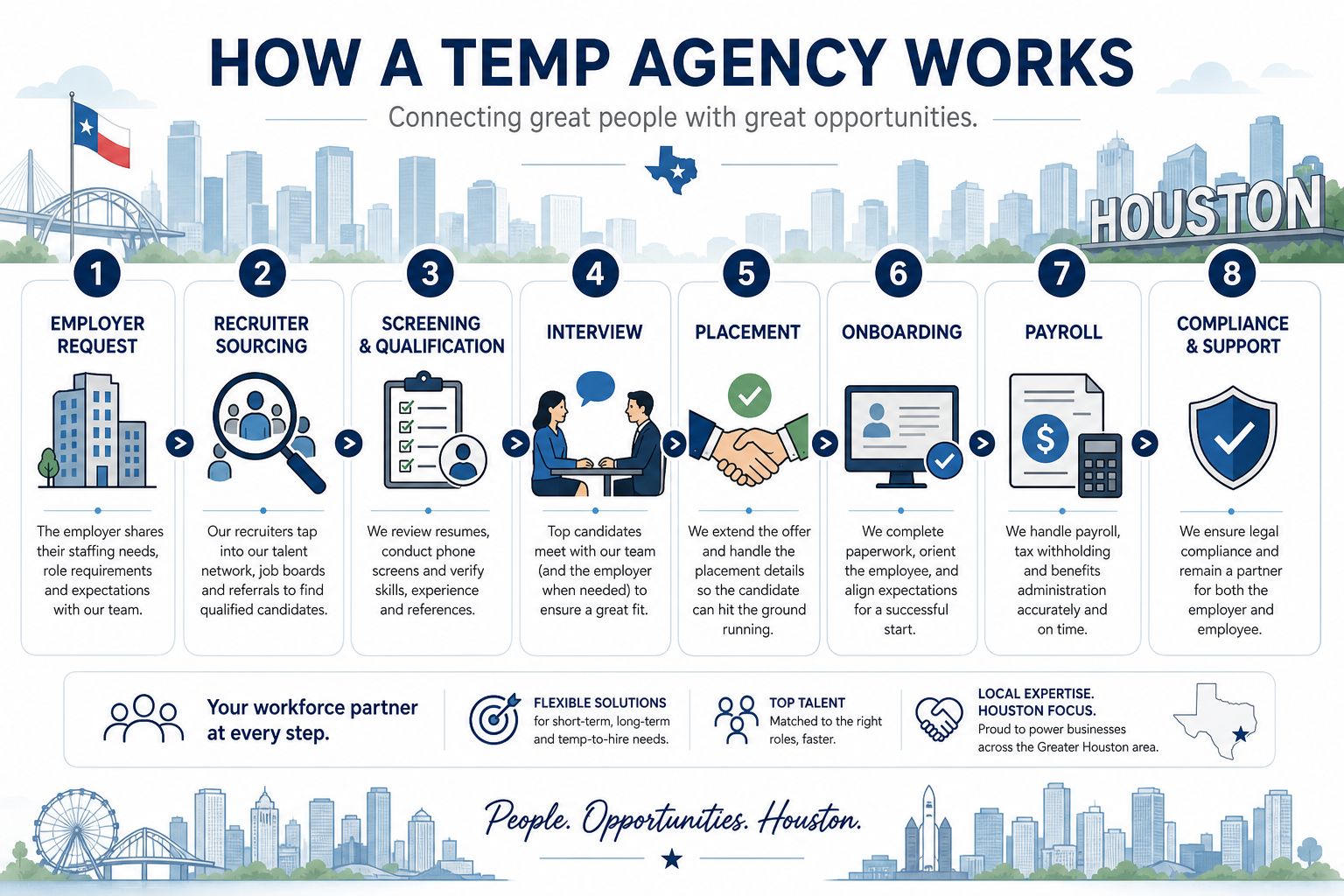
Step 1: The employer defines the hiring need
The process begins when a company contacts the staffing agency with details such as:
Job title and core responsibilities
Required skills, certifications, or software knowledge
Shift schedule or working hours
Assignment length
Work environment
Pay range or bill rate
Start date urgency
This intake step matters more than many articles acknowledge. A strong staffing agency does not just ask for a job title. It clarifies what success looks like, which skills are mandatory versus trainable, and whether the role should be temporary, temp-to-hire, or direct hire.
For Houston-area businesses, that nuance matters. The labor market for an administrative assistant, legal secretary, AP specialist, drafter, customer service rep, forklift operator, or engineering project coordinator can vary significantly by submarket, compensation level, and urgency.
Step 2: The agency recruits candidates
Once the need is defined, the staffing team begins sourcing candidates through:
Internal talent database
Local recruiter network
Job boards
Referrals
Passive candidate outreach
Previous applicants and redeployable workers
Clayton Services brings special value here because of its longstanding Houston candidate network built since 1984. That local history gives employers access to talent pools that national chains may not understand as well, especially in specialized Houston sectors such as energy, engineering, legal support, medical administrative, accounting, skilled trades, and industrial operations.
Step 3: Screening and qualification happens before submission
This is one of the most important parts of the process and one of the biggest content gaps in most competitor articles. They mention screening, but rarely explain what good screening actually includes.
A professional staffing process may involve:
Resume review
Recruiter interview
Skills testing
Software proficiency checks
Employment verification
Reference checks
Background screening, when required
Culture and communication assessment
Availability and schedule confirmation
Pay expectation confirmation
The point is not just to send resumes quickly. The point is to send qualified, available, interested candidates who fit the job and can start on time.
Step 4: The employer reviews candidates
Depending on the role and urgency, the employer may:
Review one or more resumes
Conduct a phone or video interview
Hold a final on-site interview
Request testing or credential confirmation
Approve immediate placement for short-term work
For urgent temporary roles, employers often want speed. For more specialized or temp-to-hire openings, a slightly more selective process makes sense.
Step 5: Offer, onboarding, and start date coordination
Once a candidate is selected, the staffing agency coordinates:
Assignment details
Offer communication
Start date logistics
Timekeeping process
Workplace instructions
Compliance and onboarding paperwork
For temporary assignments, the staffing agency is typically the one that handles the employee record, payroll processing, taxes, and related employment administration. That can significantly reduce HR workload for the client.
Step 6: Ongoing support during the assignment
A good temp agency does not disappear after day one. It stays involved to help with:
Attendance issues
Performance feedback
Extension decisions
Shift changes
Early replacement if needed
Conversion to permanent hire
Clayton Services emphasizes 100% satisfaction on temporary placements, which directly addresses one of employers’ biggest concerns: what happens if the fit is not right. That accountability lowers risk and keeps operations moving.
How Does a Temp Agency Work for Job Seekers?
For candidates, working with a temp agency is often much more straightforward than expected.
The typical candidate process
Apply online or connect with a recruiter
Complete intake and screening
Discuss work history, strengths, and preferences
Get matched to suitable roles
Interview if required
Complete onboarding
Start assignment
Receive pay from the staffing agency for temporary work
Why job seekers use temp agencies
Candidates often work with staffing firms because they want:
Faster access to open jobs
Flexible schedules
A foot in the door with good employers
Temporary work between permanent roles
Exposure to a new industry
Temp-to-hire opportunities
Support from a recruiter during the search
A major misconception is that temporary work is only a stopgap. In reality, temp staffing can be a strategic career move, especially when it leads to permanent employment or helps a candidate gain relevant experience in a new field.
For Houston job seekers, Clayton Services can be especially valuable because it recruits across a broad range of fields including:
Accounting and finance
Administrative and office support
Customer service
Electrical
Engineering
Human resources
Information technology
Legal
Marketing
Medical administrative
Oil and gas / energy
Sales
Supply chain and logistics
Light industrial
Skilled trades
Who Pays the Temp Agency?
This is one of the most common questions, and competitor articles generally get it right: job seekers do not pay legitimate temp agencies for placement services.
For employers
Employers pay the staffing agency a fee or bill rate. That rate generally covers:
Employee wages
Payroll taxes
Workers’ compensation, where applicable
Benefits burden, depending on arrangement
Recruiting and screening costs
Administrative overhead
Agency margin
For job seekers
Candidates on temporary assignments are typically paid by the staffing agency. If they later convert to a permanent role, they then move to the employer’s payroll.
If an agency asks candidates to pay to be considered for jobs, that is a red flag.
How Fast Can a Temp Agency Fill a Role?
One area where generic articles stay vague is speed. Employers need realistic expectations.
Typical staffing timelines
Need Type | Typical Timeline |
Same-day or next-day coverage | Possible for high-urgency, common roles |
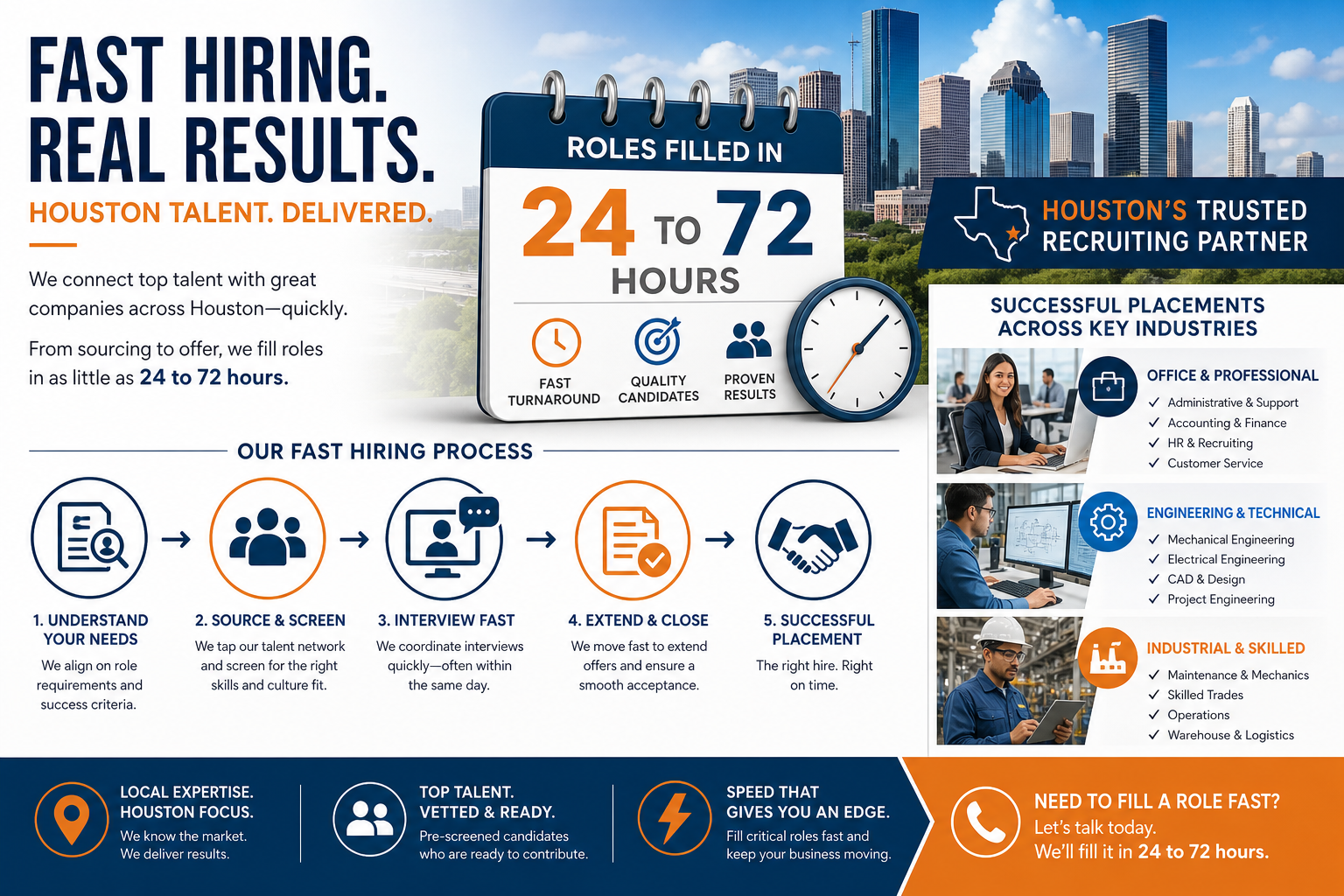
Standard temporary placement | Often 24 to 72 hours |
Temp-to-hire placement | Often a few days to 1 week |
Specialized direct hire search | Several weeks, depending on role |
Executive search | Longer, more targeted process |
Clayton Services highlights fast placement timelines within 24 to 72 hours for many staffing needs, which is especially important when a vacancy is affecting productivity, customer service, project schedules, or payroll deadlines.
"In the United States, the median time to fill a job vacancy is approximately 35 days." - Source
That gap is exactly why employers turn to staffing firms. If your internal process takes weeks and your work cannot wait, a qualified staffing partner can dramatically compress the timeline.
What Does a Temp Agency Screen For?
Many employers assume staffing agencies only check availability and basic work history. The better firms go much further.
Screening may include
Relevant industry experience
Communication ability
Reliability and attendance patterns
Software or system knowledge
Technical competencies
Safety awareness
Shift flexibility
Transportation reliability
Professionalism and culture fit
Compensation alignment
Why this matters
A bad hire is costly even in a temporary role. Poor attendance, poor communication, or skill gaps can disrupt teams and create rework. Thorough screening improves quality and helps employers avoid wasting time interviewing people who are not truly a fit.
At Clayton Services, this quality-first approach is reinforced by its service guarantees, including a 180-day direct hire replacement guarantee and 100% satisfaction guarantee on temporary placements. That kind of commitment reflects confidence in the screening process.
Benefits of Using a Temp Agency for Employers
Employers do not use staffing firms just because they are busy. They use them because staffing can solve specific business problems.
1. Faster access to talent
Temp agencies maintain active candidate pipelines, making it easier to move quickly when needs arise.
2. Lower administrative burden
The agency can manage recruiting, screening, onboarding, payroll, and compliance tasks.
3. Reduced hiring risk
Temp-to-hire allows employers to assess performance before making a permanent commitment.
4. Flexible workforce planning
Temporary staffing helps businesses respond to seasonality, projects, leaves of absence, and sudden demand spikes.
5. Better market coverage
A specialized recruiter often reaches candidates that internal teams cannot access quickly on their own.
6. Compliance and payroll support
When the staffing agency serves as the employer of record, it can handle payrolling, employment paperwork, and related compliance functions.
7. Scalable recruiting solutions
For larger or more complex hiring initiatives, employers may need onsite support, RPO, or executive search, not just transactional staffing.
Clayton Services is well positioned here because it supports both immediate staffing needs and long-term recruiting strategy, from a one-person backfill to high-volume hiring support.
"As of 2023, the U.S. staffing and recruiting industry was valued at over $200 billion, with temporary and contract staffing accounting for approximately $166 billion of this total." - Source
That scale reflects how mainstream and operationally important staffing has become for employers across industries.
Benefits of Working With a Temp Agency for Job Seekers
Job seekers also gain meaningful advantages from temp agencies.
Faster access to opportunities
A recruiter can connect candidates with openings that align with their skills and availability much faster than applying blindly to dozens of listings.
Career flexibility
Temporary jobs can work well for candidates who want interim income, project-based work, or schedule flexibility.
A path to permanent employment
Temp-to-hire roles are especially attractive for candidates who want to prove themselves on the job before committing long term.
More visibility into employer expectations
Recruiters often coach candidates on interviews, pay ranges, workplace culture, and job requirements.
Broader job access
Agencies may have roles that are not publicly posted, particularly for confidential searches or repeat client openings.
Temporary Staffing vs Temp-to-Hire vs Direct Hire
Employers often ask which option makes the most sense. The answer depends on urgency, risk tolerance, and the role itself.
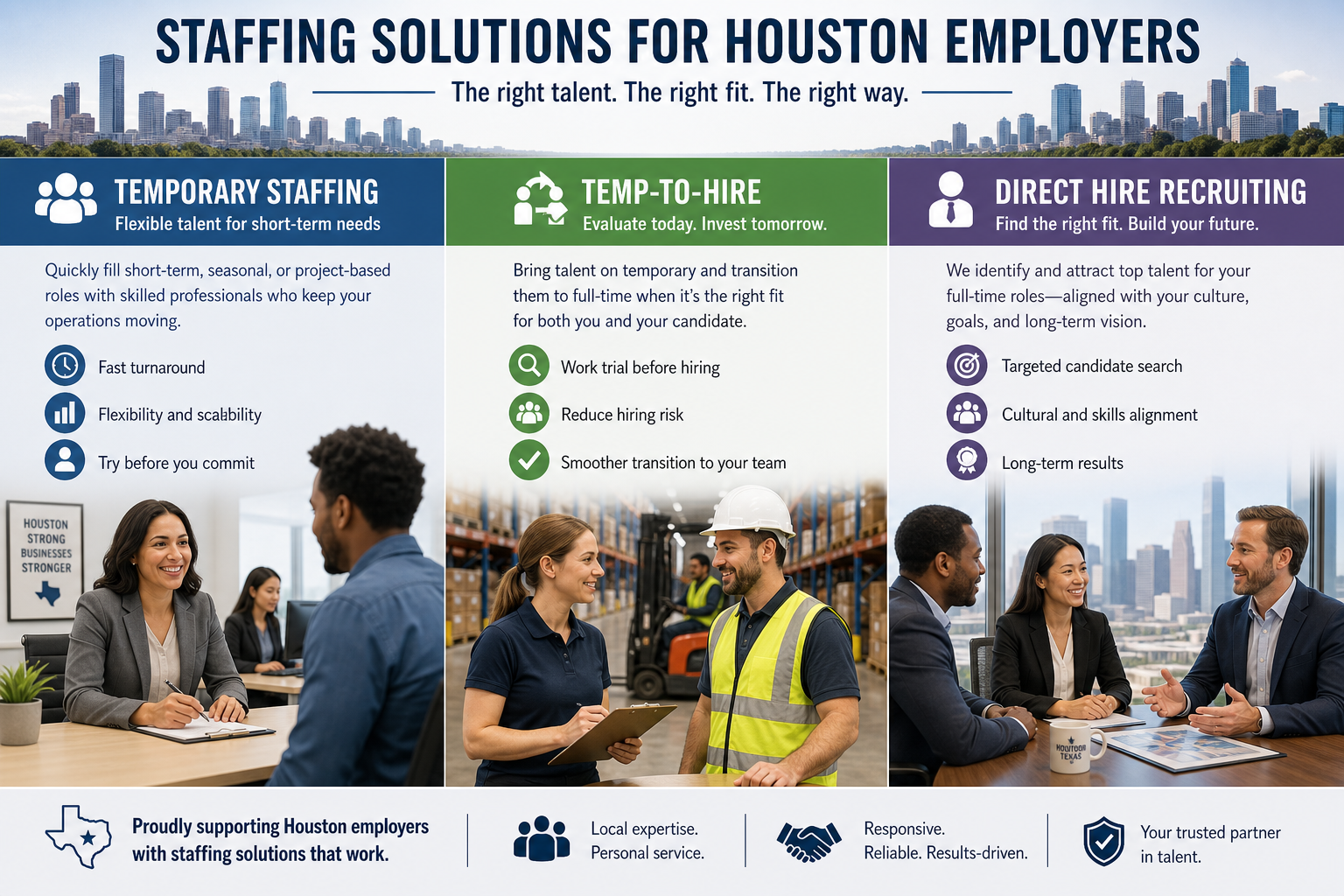
Temporary staffing
Best when you need help immediately and know the need is short term.
Examples:
Medical leave coverage
Year-end accounting support
Front desk coverage
Warehouse surge staffing
Project admin support
Temp-to-hire
Best when you want speed and flexibility but also want the option to hire permanently after observing performance.
Examples:
Customer service representatives
Administrative coordinators
Dispatchers
AP/AR specialists
Production or logistics support roles
Direct hire
Best when the role is clearly permanent, business critical, or too specialized to approach casually.
Examples:
Controllers
HR managers
Engineers
Legal professionals
Sales leadership
Executive-level hires
When Should a Houston Employer Use a Temp Agency?
Not every vacancy requires a staffing partner, but many do.
Strong use cases include
You need someone in place within days, not weeks
Your internal HR team is stretched thin
You are hiring for a leave, project, or seasonal demand spike
You want to evaluate someone before hiring permanently
You need payroll and compliance handled externally
You are opening multiple roles at once
You are hiring for niche roles in the Houston market
Your last hiring process took too long or produced poor-fit candidates
Houston employers especially benefit from a recruiter who understands the regional labor market, commute patterns, pay pressure, industry clusters, and candidate movement. That local knowledge is difficult to replicate through a generic national model.
What Are the Downsides of Temp Staffing?
To create a truly useful guide, it is important to address the tradeoffs honestly.
Potential drawbacks for employers
Hourly bill rates may appear higher than direct hourly pay
Not every temporary worker will be a long-term fit
Onboarding still takes some internal time
Poor agency communication can create mismatched expectations
Potential drawbacks for job seekers
Some assignments are short term
Benefits may differ from permanent employment
Work schedules may vary by assignment
Not every temp role converts to full time
The key point is that these downsides are often reduced or avoided by choosing the right staffing partner. Agencies with weak screening, generic recruiting, and little accountability create problems. Agencies with local market expertise, transparent communication, and service guarantees create solutions.
That is why Clayton Services’ model is important. Its guaranteed placements, temp-to-hire flexibility, employer-of-record support, and local Houston knowledge help reduce many of the most common staffing risks.
How Clayton Services Makes the Temp Agency Process Better
Many articles explain how staffing agencies work in general, but they do not help readers understand how to choose the right one. That is the real decision point.
What employers should look for in a staffing partner
What Matters | Why It Matters | Clayton Services Advantage |
Local market knowledge | Better pay guidance, faster sourcing, stronger fit | Houston-owned, serving Greater Houston since 1984 |
Service guarantees | Reduces hiring risk | 180-day direct hire replacement guarantee |
Temporary placement accountability | Ensures satisfaction and continuity | 100% satisfaction guarantee on temporary placements |
Speed | Limits downtime and productivity loss | Fast placement timelines within 24 to 72 hours |
Breadth of services | Supports changing hiring needs | Temporary, temp-to-hire, direct hire, payrolling, executive search, RPO/onsite |
Role specialization | Improves candidate quality | Broad industry and functional recruiting expertise |
Compliance support | Reduces administrative burden and risk | Employer-of-record and payrolling capabilities |
Industries and roles Clayton Services supports
Clayton Services helps Houston-area employers hire across many business-critical functions, including:
Accounting and finance
Administrative and office support
Customer service
Electricians
Engineering
HR
IT
Legal
Marketing
Medical administrative
Oil and gas / energy
Sales
Supply chain and logistics
Light industrial
Skilled trades
That breadth matters because hiring needs rarely stay static. A company may need temporary administrative coverage today, a direct hire controller next month, and onsite recruiting support next quarter. Working with one accountable local partner can simplify that entire process.
How to Choose the Right Temp Agency
If you are comparing staffing firms, ask these questions:
For employers
Do you specialize in the roles we need?
How quickly can you present candidates?
What does your screening process include?
Who handles payroll, taxes, and workers’ compensation?
What happens if the candidate does not work out?
Do you offer temp-to-hire, direct hire, and payrolling options?
What is your guarantee?
How well do you know the Houston market?
For job seekers
What industries and roles do you place?
Are there any fees to candidates?
How often do you communicate about openings?
Do you offer temp-to-hire opportunities?
How does onboarding work?
When and how am I paid?
A transparent answer to these questions usually tells you a great deal about the quality of the agency.
Final Verdict: Temp Agencies Work Best When the Partner Is Right
So, temp agency how does it work? It works by giving employers a faster, lower-risk path to qualified talent and giving job seekers a faster route to real opportunities. The agency recruits, screens, places, and often payrolls temporary workers while supporting temp-to-hire and direct hire needs as well.
But the real value is not in the concept alone. It is in the quality of execution. A staffing partner with deep local knowledge, strong screening, flexible hiring options, and real accountability can save employers time, reduce hiring risk, and improve results.
That is exactly where Clayton Services delivers. As a Houston-based staffing and recruiting firm serving Greater Houston since 1984, Clayton Services combines local market expertise with full-service recruiting solutions, including temporary staffing, temp-to-hire, direct hire, executive search, payrolling, and onsite/RPO support. Add in 24 to 72 hour placement capability, a 180-day direct hire replacement guarantee, and a 100% satisfaction guarantee on temporary placements, and employers gain a staffing partner built to solve urgent hiring problems without sacrificing quality.
If your Houston business needs dependable talent fast, or if you are a job seeker ready for your next opportunity, Clayton Services offers a more responsive and lower-risk way to move forward.
Frequently Asked Questions About Temp Staffing Agencies
How does a temp agency work for employers?
A temp agency helps employers find, screen, hire, and onboard qualified workers for temporary, temp-to-hire, and direct hire positions. The staffing agency typically handles recruiting, interviewing, payroll administration, tax withholding, onboarding paperwork, and compliance responsibilities, allowing employers to fill positions faster while reducing administrative burden.
How does a temp agency work for job seekers?
Job seekers apply through a staffing agency, complete screening and onboarding, and get matched with relevant opportunities. Temporary employees are typically paid by the staffing agency while working at the client company. Many temporary assignments can lead to permanent employment through temp-to-hire arrangements.
What is the difference between temporary staffing, temp-to-hire, and direct hire?
Temporary staffing fills short-term workforce needs for projects, leave coverage, or seasonal demand. Temp-to-hire allows employers to evaluate a worker before extending a permanent offer. Direct hire recruiting places candidates directly on the employer's payroll from day one. Each model serves different hiring goals, timelines, and risk levels.
Who pays a temp agency?
Employers pay staffing agencies for recruiting, screening, payroll administration, compliance management, and placement services. Job seekers do not pay legitimate staffing agencies to find employment opportunities. Candidates are paid by the staffing agency while working on temporary assignments.
How quickly can a staffing agency fill a position?
Many staffing agencies can provide qualified candidates within 24 to 72 hours for common office, administrative, customer service, warehouse, and light industrial positions. Specialized direct hire searches, executive recruiting, and highly technical roles may require additional time depending on market conditions and candidate availability.
What types of jobs do temp agencies fill?
Staffing agencies commonly fill positions in accounting, administrative support, customer service, engineering, human resources, information technology, legal support, marketing, sales, supply chain, logistics, manufacturing, warehouse operations, skilled trades, healthcare administration, and professional services.
What does a staffing agency screen candidates for?
Most staffing agencies evaluate work history, skills, experience, reliability, communication abilities, software proficiency, industry knowledge, availability, compensation expectations, and workplace fit. Additional screening may include background checks, reference checks, employment verification, and skills testing depending on the role.
Are temp jobs worth it?
Temp jobs can provide immediate income, flexible schedules, valuable experience, networking opportunities, and access to employers that may not publicly advertise openings. Many temporary positions also serve as a pathway to permanent employment through temp-to-hire opportunities.
Why do employers use temp agencies instead of hiring directly?
Employers use staffing agencies to reduce hiring timelines, improve candidate quality, manage workforce fluctuations, lower hiring risk, and reduce administrative workload. Staffing agencies also provide access to passive candidates and specialized recruiting expertise that may not exist internally.
What are the benefits of using a temp-to-hire staffing model?
Temp-to-hire staffing allows employers to evaluate a candidate's performance, attendance, technical abilities, and cultural fit before making a permanent hiring decision. This approach helps reduce turnover, improve retention, and lower the risk of costly hiring mistakes.
What is employer-of-record or payrolling support?
Employer-of-record and payrolling services allow staffing agencies to employ workers on behalf of a client company. The agency manages payroll, tax filings, workers' compensation, onboarding, and compliance while the client oversees daily job responsibilities. This model helps businesses remain flexible while reducing administrative complexity.
How do staffing agencies help reduce hiring risk?
Staffing agencies reduce hiring risk through candidate screening, skills assessments, reference checks, temp-to-hire options, replacement guarantees, and ongoing assignment management. These services help employers avoid poor hiring decisions and improve long-term retention outcomes.
Are staffing agencies only for temporary jobs?
No. Many staffing agencies offer temporary staffing, temp-to-hire recruiting, direct hire placement, executive search, payrolling services, and recruitment process outsourcing (RPO). Modern staffing firms often provide workforce solutions for both short-term and permanent hiring needs.
How do staffing agencies find qualified candidates?
Staffing agencies source candidates through recruiter networks, internal databases, job boards, employee referrals, passive candidate outreach, social media recruiting, and local market relationships. Established staffing firms often maintain extensive candidate pipelines that allow them to fill positions faster than traditional hiring methods.
What should employers look for when choosing a staffing agency?
Employers should evaluate industry expertise, local market knowledge, screening processes, placement speed, service guarantees, communication practices, candidate quality, and available hiring models. Staffing agencies that offer temporary staffing, temp-to-hire, direct hire, payrolling, and executive recruiting often provide greater long-term flexibility.
What industries benefit most from temporary staffing?
Industries that frequently use temporary staffing include accounting, administrative support, customer service, manufacturing, distribution, logistics, healthcare administration, engineering, legal support, energy, skilled trades, and office operations. Temporary staffing is particularly valuable when workloads fluctuate or urgent coverage is required.
Can staffing agencies help with urgent hiring needs?
Yes. Staffing agencies are specifically designed to respond quickly to workforce shortages, employee absences, project demands, seasonal spikes, and unexpected turnover. Many staffing firms can provide qualified candidates within days rather than weeks, helping businesses maintain productivity and service levels.
How long do temporary assignments usually last?
Temporary assignments can range from a single day to several months depending on the employer's needs. Some assignments support short-term projects or employee leave coverage, while others serve as temp-to-hire opportunities that may lead to permanent employment.
What are the advantages of working with a local Houston staffing agency?
A Houston staffing agency understands local compensation trends, labor market conditions, commuting patterns, industry demands, and candidate availability. Local recruiters often have stronger relationships with both employers and job seekers, leading to faster placements and better hiring outcomes.
What makes a great staffing and recruiting partner?
The best staffing partners combine speed, accountability, local market expertise, strong candidate networks, thorough screening processes, flexible hiring solutions, and service guarantees. Employers should look for staffing firms that can support both immediate hiring needs and long-term workforce planning.


