
7 Mistakes to Avoid With Manufacturing Staffing

7 Mistakes to Avoid With Manufacturing Staffing
TL;DR
If you are comparing manufacturing staffing agencies, the biggest mistakes are not just about price or speed. The real risks are poor screening, weak safety processes, unclear guarantees, limited local labor market knowledge, and staffing models that do not fit your production environment.
For Houston-area employers, the best manufacturing staffing partner should help you:
reduce turnover and absenteeism
protect production schedules
support safety and compliance
scale up within 24 to 72 hours when needed
lower hiring risk through temp-to-hire and guaranteed placements
Clayton Services helps employers avoid those risks with locally informed recruiting, flexible staffing options, payrolling and employer of record support, and strong guarantees that create accountability.
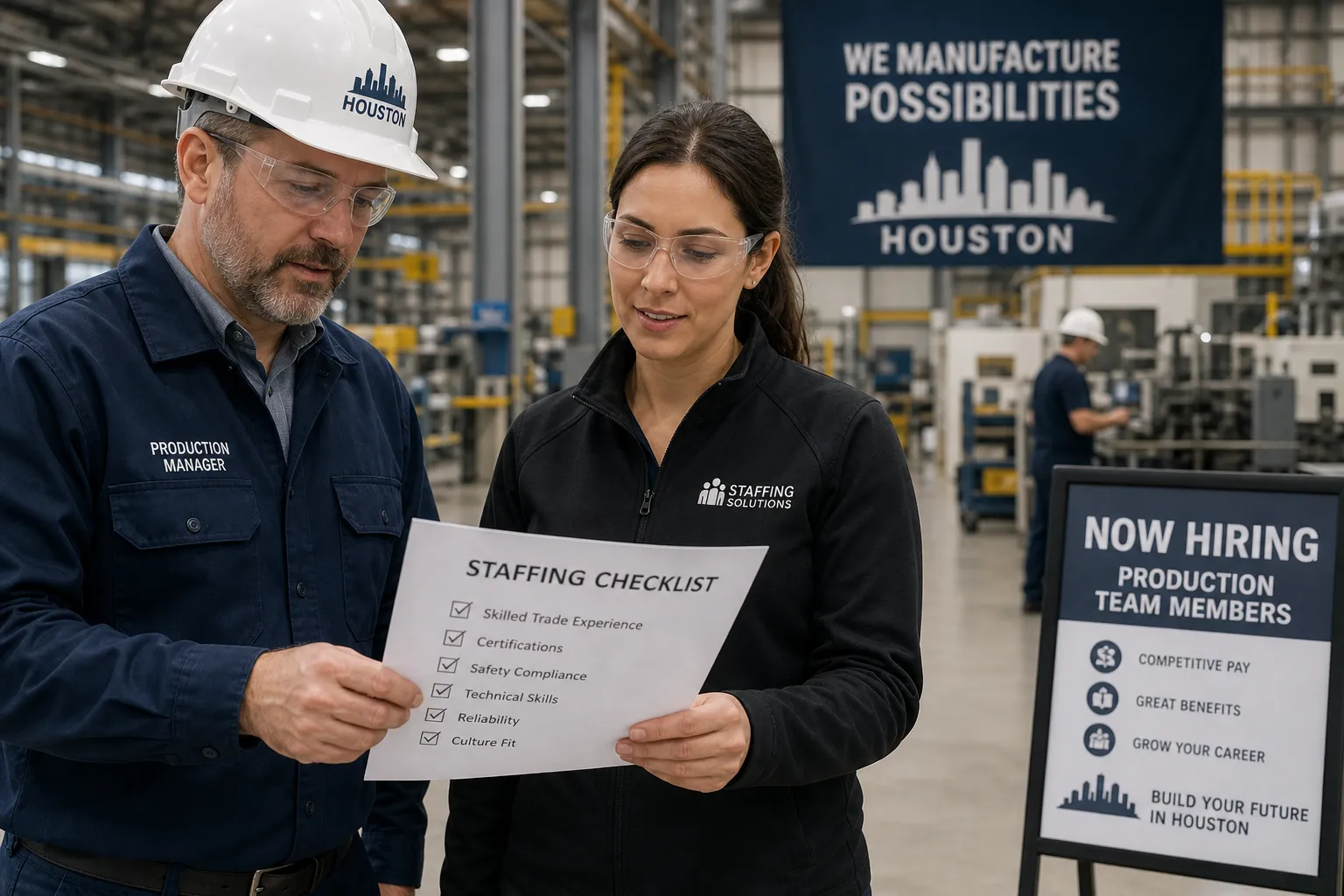
Quick Answer: What causes manufacturing staffing problems?
Most manufacturing staffing failures come from a mismatch between the employer’s production reality and the staffing partner’s process. That mismatch shows up in seven predictable ways:
Staffing mistake | What it causes |
Choosing on price alone | higher turnover, weaker screening, hidden costs |
Ignoring safety and compliance | injuries, workers' comp exposure, audit risk |
Moving too fast without role calibration | poor fit, retraining, productivity loss |
Using the wrong hiring model | unnecessary risk and delayed hiring outcomes |
Failing to validate manufacturing-specific skills | rework, downtime, quality issues |
Overlooking local labor market knowledge | slower fills and lower candidate quality |
Accepting vague service promises | no accountability when placements fail |
Why this matters more in manufacturing than in other industries
Manufacturing staffing has less margin for error than many office-based hiring environments. A poor placement does not just create inconvenience. It can slow output, increase scrap, strain supervisors, raise overtime, and create safety exposure on the floor.
"In 2025, the average weekly overtime in manufacturing was 3.8 hours." - U.S. Bureau of Labor Statistics
That matters because staffing gaps are often covered with overtime first. If that becomes the default plan, labor costs rise and fatigue risk increases.
"The cost of replacing an individual employee ranges from six to nine months of that person's salary." - SHRM
For employers running lean operations, a bad hire can become expensive very quickly, especially when it affects attendance, quality, team morale, and throughput.
What employers should look for in a manufacturing staffing partner
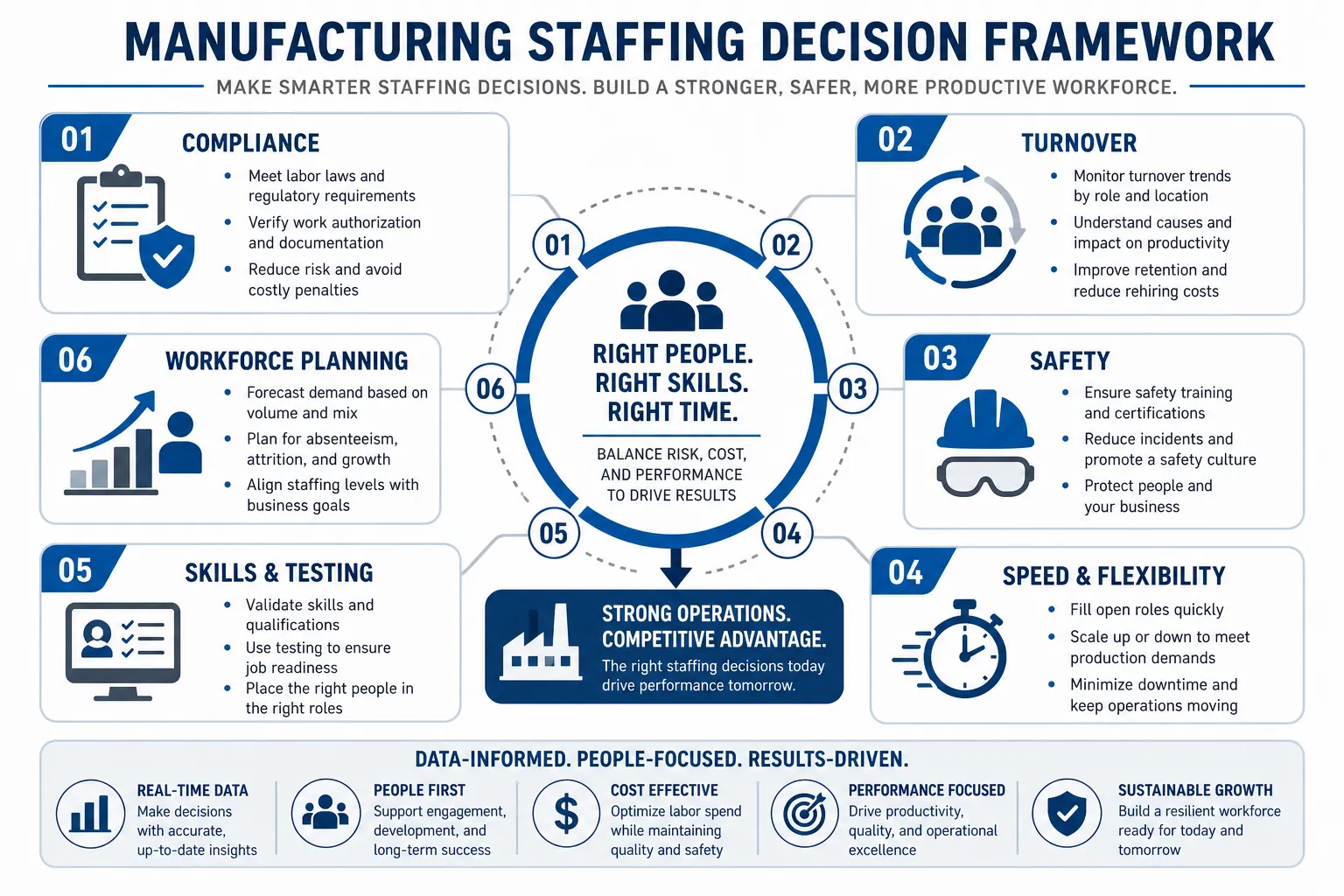
Before we break down the seven mistakes, here is a practical decision framework.
The 6-point manufacturing staffing evaluation checklist
A reliable manufacturing recruiter or manufacturing staffing company should be able to answer these questions clearly:
How do you screen for manufacturing-specific skills?
How do you verify safety readiness and job-site fit?
What is your process for reducing turnover and absenteeism?
Can you support temporary, temp-to-hire, and direct hire needs?
What guarantees or replacement terms do you provide?
How fast can you realistically fill roles in the Houston market?
If the answers are vague, generic, or overly sales-focused, that is usually a warning sign.
Mistake 1: Choosing a manufacturing staffing partner based on price alone
The lowest markup rarely creates the lowest total hiring cost. In manufacturing staffing, the bigger cost drivers are usually turnover, no-shows, retraining, quality issues, and supervisory time spent fixing bad placements.
Why price-first selection backfires
A lower-cost vendor may cut corners in areas that matter most:
candidate screening
job matching
attendance reliability checks
safety readiness
recruiter involvement after placement
That often means you save a little on hourly markup and lose much more in disruption.
Better approach
Evaluate total value, not just bill rate. Ask:
What is the average fill speed?
How is candidate quality measured?
What happens if the employee does not work out?
Is there a satisfaction guarantee?
Can the firm support scale when demand spikes?
Clayton Services helps employers reduce hiring risk with a 100% satisfaction guarantee on temporary placements and a 180-day direct hire replacement guarantee, which creates real accountability beyond the initial placement.
Mistake 2: Ignoring safety and compliance capabilities
In manufacturing, compliance is not a side issue. It is part of operational continuity. Employers that treat staffing as a simple headcount transaction often overlook whether their staffing partner can support safe and compliant placement practices.
Common compliance blind spots
These are some of the most common issues employers miss when comparing manufacturing employment agencies or manufacturing recruiting firms:
incomplete I-9 and onboarding processes
inconsistent documentation
poor role-specific safety communication
weak understanding of PPE requirements
inadequate workers' compensation coordination
unclear employer of record responsibilities
Why this matters in Houston manufacturing
Houston employers often hire across light industrial, logistics, energy-adjacent operations, fabrication support, and skilled trades environments. Each setting has different risk factors, pace, and compliance expectations. A staffing partner must understand that nuance.
Better approach
Work with a partner that can support payrolling and employer of record services when needed, especially if you want to reduce administrative burden, manage compliance consistently, and onboard workers quickly without sacrificing process discipline.
Mistake 3: Failing to define the job beyond the title
Many staffing breakdowns start with a vague request like "we need warehouse help," "we need assemblers," or "we need production workers by Monday." That may feel efficient, but it often produces mismatched candidates.
What a job title does not tell a recruiter
A strong manufacturing staffing process should clarify:
shift structure
temperature or physical environment
speed of line or output expectations
lifting requirements
machine exposure
quality standards
attendance sensitivity
team structure
supervisor style
commute realities
Better approach
Treat the intake process like production planning. The more accurate the scope, the better the placement.
A qualified manufacturing recruiter should ask questions that go beyond the job description. Clayton Services does this because fast placement only works when it is paired with accurate role calibration. That is one reason employers across Greater Houston use Clayton for both short-term coverage and long-term hiring needs.
Mistake 4: Using the wrong hiring model for the role
Not every manufacturing role should be filled the same way. One of the most common employer mistakes is defaulting to a single approach for every opening.
Which manufacturing staffing model fits best?
Hiring need | Best-fit model | Why |
Immediate absentee coverage | Temporary staffing | Fast response and flexible duration |
Evaluate reliability before making an offer | Temp-to-hire | Reduces hiring risk before commitment |
Critical long-term role | Direct hire recruiting | Best for retention-focused permanent hiring |
High-volume ramp or facility launch | RPO or onsite recruiting | Scalable process and dedicated support |
Need to onboard workers without internal payroll burden | Payrolling / employer of record | Simplifies compliance and administration |
Better approach
Choose the model based on operational risk, urgency, and role complexity.
For example:
Temporary staffing works well when you need coverage in 24 to 72 hours.
Temp-to-hire is ideal when attendance, coachability, and floor performance need to be proven first.
Direct hire recruiting makes sense when the role is specialized, strategic, or difficult to replace.
Executive search is more appropriate for plant leadership, operations management, or other key decision-makers.
RPO and onsite recruiting help when hiring volume is high or ongoing.
Clayton Services supports all of these models, which means employers do not have to force every opening into the same hiring process.
Mistake 5: Assuming all screening is equal
This is one of the biggest content gaps in many articles about staffing. Employers are often told to "screen candidates thoroughly," but few explain what that actually means in a manufacturing context.
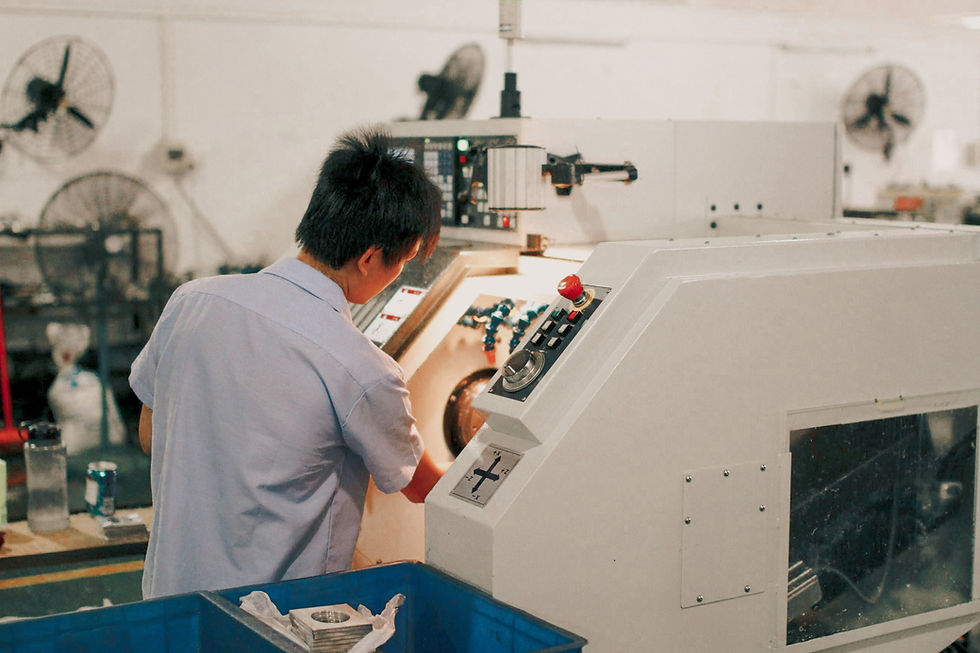
What strong manufacturing screening should include
Depending on the role, effective screening may involve:
work history pattern review
attendance and reliability validation
shift availability confirmation
transportation and commute check
communication assessment
basic math or measurement testing
machine or tool familiarity review
safety mindset evaluation
reference checks where appropriate
culture and supervisor fit discussion
Why this matters
A resume may say "production experience," but that does not tell you:
whether the person can keep pace on a line
whether they understand quality discipline
whether they show up consistently
whether they can adapt to your environment
Better approach
Ask any manufacturing staffing agency near you to walk through its exact screening process. If the answer is generic, that is a concern.
Clayton Services brings decades of recruiting experience in the Houston market and a long-built candidate network, which improves both speed and fit when hiring for professional, industrial, administrative, and skilled roles.
Mistake 6: Overlooking local labor market knowledge
National reach sounds impressive, but manufacturing hiring is intensely local. Shift accessibility, commute tolerance, pay competition, seasonality, and labor pool density all vary by submarket.
Why local matters in Greater Houston
A staffing plan that works in one part of Houston may fail in another because of:
traffic patterns
shift start times
warehouse and industrial cluster competition
wage compression
local candidate expectations
transportation constraints
That is why many employers searching for a manufacturing staffing agency near me or manufacturing recruiters near me are really looking for local market intelligence, not just candidate databases.
Better approach
Choose a Houston-owned recruiting team that understands the real dynamics of the market.
Clayton Services has served employers and job seekers across Greater Houston since 1984. That local experience helps employers hire more strategically, especially when timelines are tight and role requirements are nuanced.
Mistake 7: Accepting vague promises instead of measurable accountability
Some staffing firms promise speed, quality, or partnership but do not attach those promises to any meaningful service structure.
Red flags to watch for
Be cautious if a staffing partner cannot clearly explain:
fill timeline expectations
replacement process
service guarantees
communication cadence
escalation path
who owns post-placement follow-up
how candidate quality is measured
Better approach
Look for concrete commitments.
Clayton Services stands out because accountability is built into the service model:
24 to 72 hour placement timelines for many staffing needs
100% satisfaction guarantee on temporary placements
180-day direct hire replacement guarantee
support across temporary, temp-to-hire, direct hire, executive search, payrolling, and onsite/RPO recruiting
That structure reduces uncertainty for employers and lowers the risk of making the wrong hiring decision under pressure.
A practical comparison framework for manufacturing staffing agencies
If you are evaluating manufacturing staffing agencies, use this scorecard to compare options side by side.
Manufacturing staffing agency comparison scorecard
Evaluation area | What to ask | Why it matters |
Fill speed | How quickly can you provide qualified candidates? | Production downtime is costly |
Candidate quality | How do you screen for attendance, safety, and role fit? | Reduces turnover and rework |
Local market knowledge | What Houston-area roles and submarkets do you know best? | Improves realistic hiring outcomes |
Hiring model flexibility | Do you offer temp, temp-to-hire, direct hire, and RPO? | Aligns hiring method to business need |
Guarantees | What happens if the placement fails? | Creates accountability |
Compliance support | Can you support payrolling and employer of record services? | Reduces HR and legal burden |
Industry specialization | Have you staffed similar manufacturing environments before? | Speeds learning curve and fit |
Communication | Who owns follow-up after placement? | Improves retention and issue resolution |
Concise answer block: How do you avoid staffing mistakes in manufacturing?
To avoid manufacturing staffing mistakes:
define the job clearly
choose the right hiring model
verify safety and compliance processes
ask for manufacturing-specific screening detail
prioritize local market expertise
evaluate guarantees, not just price
use temp-to-hire when long-term fit is uncertain
This approach helps control turnover, reduce downtime, and improve placement success.
What many articles miss about manufacturing staffing
Most articles on temp agencies for manufacturing jobs or manufacturing recruiting agencies stop at broad advice like "screen thoroughly" or "start early." That is useful, but incomplete.
Here are the deeper issues employers should pay attention to:
Staffing quality is a process issue, not just a sourcing issue
A large candidate pool does not solve a weak intake process, poor communication, or unclear performance expectations.
The fastest fill is not always the best fill
Urgency matters, but rushed hiring without role calibration often creates a second vacancy within weeks.
Guarantees are a proxy for confidence
When a staffing partner stands behind placements with meaningful guarantees, it usually reflects stronger internal process discipline.
Temp-to-hire is a risk management tool
For many employers, temp-to-hire is not just a convenience. It is one of the smartest ways to evaluate dependability, coachability, and work style before making a long-term commitment.
Employer of record support is underused
For some businesses, payrolling and compliance support can be just as valuable as sourcing itself, especially during growth periods, project staffing, or organizational transitions.
When to use a manufacturing recruiter instead of hiring on your own
Direct internal hiring can work well when:
the role is easy to source
your team has time to screen properly
turnover risk is low
you are not under immediate production pressure
A manufacturing recruiter is often the better choice when:
hiring needs to happen quickly
the role is difficult to fill
production delays are expensive
your HR team is stretched
you want to reduce compliance burden
you need backup options if a placement fails
you are hiring at volume or across multiple role types
That is especially true in Houston, where labor competition can shift quickly across industrial, administrative, technical, and professional hiring categories.
Why employers choose Clayton Services for manufacturing staffing in Houston
Clayton Services is not a national chain trying to fit Houston employers into a generic process. It is a Houston-based staffing agency and recruiting firm with decades of local market knowledge and a broad service platform that helps employers hire with less risk.
What sets Clayton Services apart
Houston-owned and locally knowledgeable recruiting team
serving Greater Houston since 1984
staffing support for both short-term and long-term needs
temporary, temp-to-hire, and direct hire options
24 to 72 hour placement timelines for many urgent needs
180-day direct hire replacement guarantee
100% satisfaction guarantee on temporary placements
payrolling and employer of record support
executive search capabilities
high-volume RPO and onsite recruiting support
broad specialization across office, technical, industrial, and leadership roles
decades-long candidate network built in the Houston market
For employers, that means faster access to qualified talent and lower hiring risk. For job seekers, it means access to real opportunities across accounting, administration, engineering, customer service, legal, skilled trades, light industrial, supply chain, and more.
Final verdict
The biggest mistakes in manufacturing staffing are usually preventable. Employers run into trouble when they choose on price alone, skip detailed role calibration, overlook compliance, accept weak screening, ignore local labor realities, or work with partners who offer no real accountability.
The better path is to choose a staffing partner that understands the manufacturing environment, offers flexible hiring models, and stands behind its work.
If your team needs dependable support from a Houston recruiting firm that can move quickly without cutting corners, Clayton Services is built for that. Whether you need temporary production support, temp-to-hire risk reduction, permanent recruiting, or broader workforce support through payrolling or onsite recruiting, Clayton Services helps employers hire with confidence.
If you are preparing for a hiring push, dealing with turnover, or trying to reduce production disruption, now is the right time to speak with a local recruiting partner that knows the Houston market and can deliver accountable results.
Frequently Asked Questions
What causes most manufacturing staffing problems?
Most manufacturing staffing failures come from a mismatch between the employer's production reality and the staffing partner's process. That shows up in seven predictable ways: choosing on price alone, ignoring safety and compliance, moving too fast without role calibration, using the wrong hiring model, failing to validate manufacturing-specific skills, overlooking local labor market knowledge, and accepting vague service promises with no accountability. Each one drives turnover, downtime, rework, or safety exposure.
Why is a bad hire more costly in manufacturing than in office roles?
Manufacturing has far less margin for error. A poor placement doesn't just create inconvenience—it slows output, increases scrap, strains supervisors, raises overtime, and creates safety exposure on the floor. Staffing gaps are often covered with overtime first, and with average weekly manufacturing overtime at 3.8 hours in 2025 (per the U.S. Bureau of Labor Statistics), that quickly raises labor costs and fatigue risk. Replacing an employee can cost six to nine months of their salary, according to SHRM.
Why shouldn't I choose a manufacturing staffing agency on price alone?
The lowest markup rarely produces the lowest total hiring cost. The bigger cost drivers are turnover, no-shows, retraining, quality issues, and supervisory time spent fixing bad placements. A low-cost vendor often cuts corners on screening, job matching, attendance checks, and post-placement support—so you save a little on hourly markup and lose much more in disruption. Evaluate total value, fill speed, candidate quality, and what happens if the hire doesn't work out.
What should strong manufacturing candidate screening include?
Effective screening goes well beyond a resume that says "production experience." Depending on the role it should include work-history pattern review, attendance and reliability validation, shift availability confirmation, transportation and commute checks, communication assessment, basic math or measurement testing, machine or tool familiarity, safety-mindset evaluation, reference checks, and supervisor fit. Ask any agency to walk through its exact process—if the answer is generic, that's a concern.
Which staffing model is best for manufacturing roles?
Match the model to the need: temporary staffing for immediate absentee coverage (often within 24 to 72 hours), temp-to-hire to evaluate reliability and floor performance before committing, direct hire for critical long-term or specialized roles, executive search for plant leadership and operations management, and RPO or onsite recruiting for high-volume ramps or facility launches. Payrolling/EOR works when you need to onboard workers without internal payroll burden. Defaulting to one approach for every opening is a common, costly mistake.
How do I define a manufacturing role beyond the job title?
A request like "we need assemblers by Monday" usually produces mismatched candidates. Treat intake like production planning and clarify shift structure, temperature or physical environment, line speed and output expectations, lifting requirements, machine exposure, quality standards, attendance sensitivity, team structure, supervisor style, and commute realities. The more accurate the scope, the better the placement—fast hiring only works when paired with accurate role calibration.
How fast can a Houston manufacturing staffing agency fill roles?
For many staffing needs, qualified candidates can be delivered within 24 to 72 hours. Clayton Services supports these timelines while still calibrating the role properly, because the fastest fill isn't always the best fill—rushed hiring without role calibration often creates a second vacancy within weeks. Speed paired with screening discipline is what actually keeps production lines moving.
Why does local labor market knowledge matter in manufacturing staffing?
Manufacturing hiring is intensely local. Shift accessibility, commute tolerance, pay competition, seasonality, and labor-pool density all vary by submarket, so a plan that works in one part of Houston may fail in another due to traffic patterns, shift start times, warehouse cluster competition, and wage compression. Employers searching "manufacturing staffing agency near me" are really seeking local market intelligence, not just a candidate database. Clayton Services has served Greater Houston since 1984.
What guarantees should a manufacturing staffing partner offer?
Look for concrete commitments rather than vague promises—a clear fill timeline, a defined replacement process, service guarantees, communication cadence, and ownership of post-placement follow-up. Guarantees are a proxy for confidence: a partner that stands behind placements usually has stronger internal process discipline. Clayton Services offers 24 to 72 hour placement timelines, a 100% satisfaction guarantee on temporary placements, and a 180-day direct hire replacement guarantee.
When should I use a manufacturing recruiter instead of hiring on my own?
Internal hiring works when the role is easy to source, your team has time to screen, turnover risk is low, and you're not under production pressure. Use a recruiter when hiring must happen quickly, the role is hard to fill, production delays are expensive, your HR team is stretched, you want to reduce compliance burden, you need backup options if a placement fails, or you're hiring at volume across multiple role types—especially in Houston, where labor competition shifts quickly.


