
How Houston Oil and Gas Recruiters Fill Roles Fast
- Travis Leonard
- 12 minutes ago
- 13 min read


How Houston Oil and Gas Recruiters Fill Roles Fast
TL;DR
Houston oil and gas recruiters fill roles faster when they already have active candidate pipelines, understand the technical differences between roles, screen for safety and compliance early, and move quickly from intake to shortlist. The best results come from a recruiting partner that knows the Houston energy market, can support direct hire and contract needs, and reduces hiring risk through guarantees, temp-to-hire options, and payrolling support. For employers, speed is not just about working harder. It is about having the right process, network, and local market intelligence before the requisition opens.
Hiring in Houston's energy market is rarely simple. Employers need engineers, field professionals, project leaders, accounting specialists, offshore talent, and operations support people who can contribute quickly in high-stakes environments. At the same time, hiring managers are often under pressure to control cost, avoid bad hires, meet project timelines, and keep safety standards high.
That is why the fastest oil and gas recruiters do more than post jobs. They build talent pipelines long before openings appear, qualify candidates against real-world operating requirements, and keep the process moving without sacrificing fit. For Houston employers, that can mean the difference between a smooth project ramp-up and weeks of lost productivity.
Clayton Services has been serving Houston employers since 1984, with recruiting solutions designed for both urgent and long-term hiring needs. That includes direct hire recruiting, temporary staffing, temp-to-hire, executive search, payrolling as employer of record, and high-volume RPO or onsite recruiting support. For many roles, qualified candidates can be identified within 24 to 72 hours, helping employers move faster while reducing hiring risk.
"As of 2022, Texas employed 936,477 energy workers, accounting for 11.5% of all U.S. energy jobs." - Texas Comptroller
"In the energy and defense sectors, the average time-to-hire ranges from 45 to 67 days." - HRBench
Quick Answer: How do Houston oil and gas recruiters fill roles fast?
They fill roles fast by combining five advantages:
Established local candidate networks across Houston's energy market
Technical recruiting knowledge for engineering, field, offshore, accounting, and operations roles
Early compliance and availability screening to avoid late-stage fallout
Flexible hiring models such as contract, temp-to-hire, and direct hire
Fast-response recruiting operations that can source, screen, and present candidates within days, not weeks
Why speed matters so much in Houston energy hiring
Houston is one of the most competitive talent markets in the energy industry. Employers are often hiring against tight deadlines tied to shutdowns, turnarounds, capital projects, maintenance cycles, production goals, and back-office reporting needs. A slow process creates real business risk.
What delays usually cost employers
Hiring Delay | Business Impact |
Open engineering role | Project slowdowns, design bottlenecks, reduced throughput |
Open field or offshore role | Crew gaps, overtime costs, slower mobilization |
Open accounting or land role | Reporting risk, billing delays, reconciliation backlogs |
Open HSE role | Increased compliance pressure and operational exposure |
Slow executive search | Leadership drift and delayed strategic decisions |
The real question is not whether a company can eventually fill the role. It is whether it can fill the role before the vacancy starts affecting production, safety, morale, or customer commitments.

The real drivers of faster placements in oil and gas
Many employers assume speed comes from posting widely or calling multiple oil and gas staffing agencies in Houston at once. In practice, faster placements usually come from process quality and recruiter specialization.
1. Pre-built talent pipelines
The strongest recruiters for oil and gas companies are in contact with candidates before a job order opens. That includes:
Passive candidates not actively applying
Contractors available for project work
Former placements with known track records
Professionals recently finishing turnarounds or major assignments
Relocation-ready candidates with Houston market interest
This matters because the best candidates are often off the market quickly.
2. Technical understanding of the role
Fast recruiters do not just match job titles. They understand the operational context behind the role.
For example, they know the difference between:
A process engineer for a refinery vs. one for upstream production
A controls engineer in petrochemicals vs. pipeline automation
A JIB accountant vs. a revenue accountant
A turnaround planner vs. a capital project scheduler
An offshore field technician vs. a plant maintenance technician
That technical depth speeds up screening and improves shortlist quality.
3. Local Houston market knowledge
Houston headhunters who specialize in energy know where talent is concentrated, what compensation ranges are realistic, which submarkets are active, and when candidate availability tends to shift.
A Houston-owned firm like Clayton Services brings local insight that national databases often miss, including:
Energy Corridor talent patterns
Ship Channel industrial hiring demand
North Houston and The Woodlands energy talent pools
Candidate commute sensitivity across Greater Houston
Competition from adjacent sectors such as petrochemicals, logistics, manufacturing, and EPC
4. Fast qualification on non-negotiables
Many searches slow down because the wrong candidates make it too far into the process. Fast recruiters screen for critical issues early, such as:
Required certifications
Industry background
Software experience
Work authorization
Travel flexibility
Offshore readiness
Drug and background screening readiness
Salary alignment
Notice period and availability
5. Clear communication with hiring managers
A vague job order kills speed. The best headhunters in Houston get clarity upfront on:
Must-have qualifications
Nice-to-have qualifications
Reporting structure
Worksite conditions
Schedule and travel
Compensation range
Interview availability
Offer approval process
The more precise the intake, the faster the match.
The Houston oil and gas recruiting workflow that actually works
Below is the process top oil and gas recruitment agencies use when they are filling specialized energy roles efficiently.
Step 1: Intake and role calibration
This is where speed starts. A strong recruiter gathers details that generic firms often miss:
Asset type or operating environment
Scope of responsibility
Team size
Required systems and software
Regulatory environment
Safety expectations
Contractor vs. employee preference
Desired start date
Step 2: Pipeline activation
Rather than waiting for inbound applicants, recruiters activate multiple sourcing channels:
Internal candidate database
Prior placements
Referrals
Passive outreach
Industry network contacts
Recent project-based talent availability
Step 3: Technical and behavioral screening
Candidates are screened not only for résumé fit but also for:
Relevant project history
Scope and complexity handled
Safety mindset
Team fit
Communication ability
Stability and motivation
Ability to perform in the hiring company's environment
Step 4: Compliance and logistics checks
This is especially important in oil and gas staffing. Delays often come from paperwork, screening, and onboarding friction. Early checks may include:
Background screening readiness
Drug screening readiness
Documentation
Certification status
Shift and travel availability
Payroll setup needs
Employer of record considerations
Step 5: Shortlist presentation
A quality shortlist should not be just a stack of resumes. It should include concise context on why each candidate fits:
Industry segment match
Technical alignment
Compensation expectations
Availability
Strengths and risks
Recruiter commentary
Step 6: Interview coordination and close
The best oil & gas recruiter keeps the process moving by:
Scheduling interviews quickly
Preparing candidates in advance
Debriefing both sides immediately
Flagging offer risk early
Keeping backup candidates warm
Step 7: Offer, onboarding, and retention support
This stage is where many placements are won or lost. Strong staffing partners help employers move from offer to start date with fewer surprises.
Which roles are usually filled fastest?
Some roles move quickly because the recruiter already has active supply. Others take longer because the market is tighter or the requirements are highly specialized.
Typical placement speed by role type
Role Type | Relative Speed | Why |
Administrative and operations support | Fast | Broader candidate pool and transferable skills |
Contract project support | Fast | Many professionals are available between projects |
Field technicians and operators | Moderate to fast | Depends on site requirements, certification, and schedule |
Engineers | Moderate | Technical fit matters more than title match |
Oil and gas accounting specialists | Moderate | Specialized systems and industry knowledge narrow the pool |
Offshore and international roles | Moderate to slow | Logistics, travel, compliance, and niche experience |
Executive leadership | Slowest | Confidentiality, stakeholder alignment, and market scarcity |
For urgent needs, contract staffing and temp-to-hire can often accelerate hiring. Clayton Services supports both models, giving employers faster access to talent while reducing the pressure to make a permanent decision too early.
How recruiters fill engineering roles faster
Engineering is one of the most misunderstood hiring categories in oil and gas. Job titles can look similar while the underlying requirements differ dramatically.
What strong recruiters screen for in energy engineering
Industry segment experience
Asset and facility type
Project phase experience
Equipment knowledge
Regulatory or safety exposure
Relevant software
Interface with operations, maintenance, or capital projects
Leadership scope
Common engineering roles in Houston energy hiring
Discipline | What Employers Usually Need |
Mechanical Engineer | Rotating equipment, reliability, maintenance support |
Electrical Engineer | Power systems, MCCs, facility support, capital projects |
Controls / Instrumentation Engineer | DCS, PLC, SCADA, instrumentation, automation |
Process Engineer | Optimization, process safety, debottlenecking |
Pipeline Engineer | Integrity, operations, expansion, compliance |
Project Engineer | Cross-functional project delivery and coordination |
Reliability Engineer | Asset uptime, maintenance strategies, root cause analysis |
A recruiter who understands these distinctions can shortlist qualified candidates much faster than a generalist houston head hunter.
How recruiters fill field, plant, and offshore roles faster
Field and offshore hiring requires more than quick sourcing. It requires readiness.
What speeds up field and offshore placement
Pre-screened safety credentials
Travel and rotation availability confirmed upfront
Worksite and environmental fit assessment
Fast drug and background screening coordination
Payrolling support for contractors
Start-date flexibility
Why oil and gas offshore recruitment agencies often slow down
Offshore searches often stall when recruiters fail to validate practical issues early:
Is the candidate current on needed certifications?
Can they mobilize quickly?
Are they comfortable with schedule demands?
Will compensation align with rotation and travel expectations?
A disciplined screening process saves time later.
How recruiters fill corporate and back-office energy roles fast
Many hiring managers think oil and gas recruiting is only about rigs, plants, and engineering. In reality, corporate support roles can be just as critical and just as specialized.
High-demand corporate roles in energy
JIB accountants
Revenue accountants
AFE accountants
Production accountants
Land administrators
Contracts administrators
Supply chain and procurement professionals
Document control specialists
HR and payroll support
Executive assistants and operations coordinators
These roles move faster when the recruiter understands industry-specific workflows and systems. Clayton Services recruits across accounting and finance, administrative, HR, legal, supply chain, customer service, and technical support functions that keep energy businesses running.
What separates a fast recruiter from a risky recruiter
Speed is valuable, but speed without quality is expensive.
The wrong kind of fast
Some recruiters move quickly by forwarding loosely matched resumes. That creates:
Interview fatigue
Lower hiring manager confidence
More rejected candidates
Longer true time-to-fill
Higher turnover risk
The right kind of fast
The best oil and gas headhunters Houston employers rely on move quickly because they have already done the work:
Built networks over years
Screened candidates deeply
Maintained local market relationships
Developed repeatable qualification workflows
Stayed active in multiple industries that overlap with energy hiring
That is also where guarantees matter. Clayton Services helps reduce employer risk with a 180-day direct hire replacement guarantee and a 100% satisfaction guarantee on temporary placements.
Direct hire vs temp-to-hire vs contract: which fills faster?
One major content gap in many articles on oil and gas staffing is that they talk about recruiting as if every hiring problem has one solution. It does not. The right hiring model depends on urgency, certainty, budget, and risk tolerance.
Hiring model comparison
Hiring Model | Best For | Speed | Risk Level | Notes |
Direct Hire | Permanent core roles and leadership | Moderate | Moderate | Best when requirements are clear and long-term need is confirmed |
Temp-to-Hire | Roles where fit must be proven on the job | Fast to moderate | Lower | Reduces hiring risk before conversion |
Contract Staffing | Projects, shutdowns, backfills, urgent needs | Fastest | Lower to moderate | Ideal for immediate coverage |
Payrolling / EOR | Independent candidate selected, but employer needs admin and compliance support | Fast | Lower admin burden | Useful for project-based or transitional hires |
Executive Search | Senior leadership and confidential hiring | Moderate to slow | Managed with discretion | Requires targeted outreach and stakeholder alignment |
For employers that need speed without forcing a rushed permanent decision, temp-to-hire is often the most practical middle ground.
How Clayton Services reduces hiring risk while moving fast
Clayton Services is not just another name among oil and gas staffing companies. The advantage is the combination of local Houston knowledge, broad recruiting capability, and strong employer protections.
What that looks like in practice
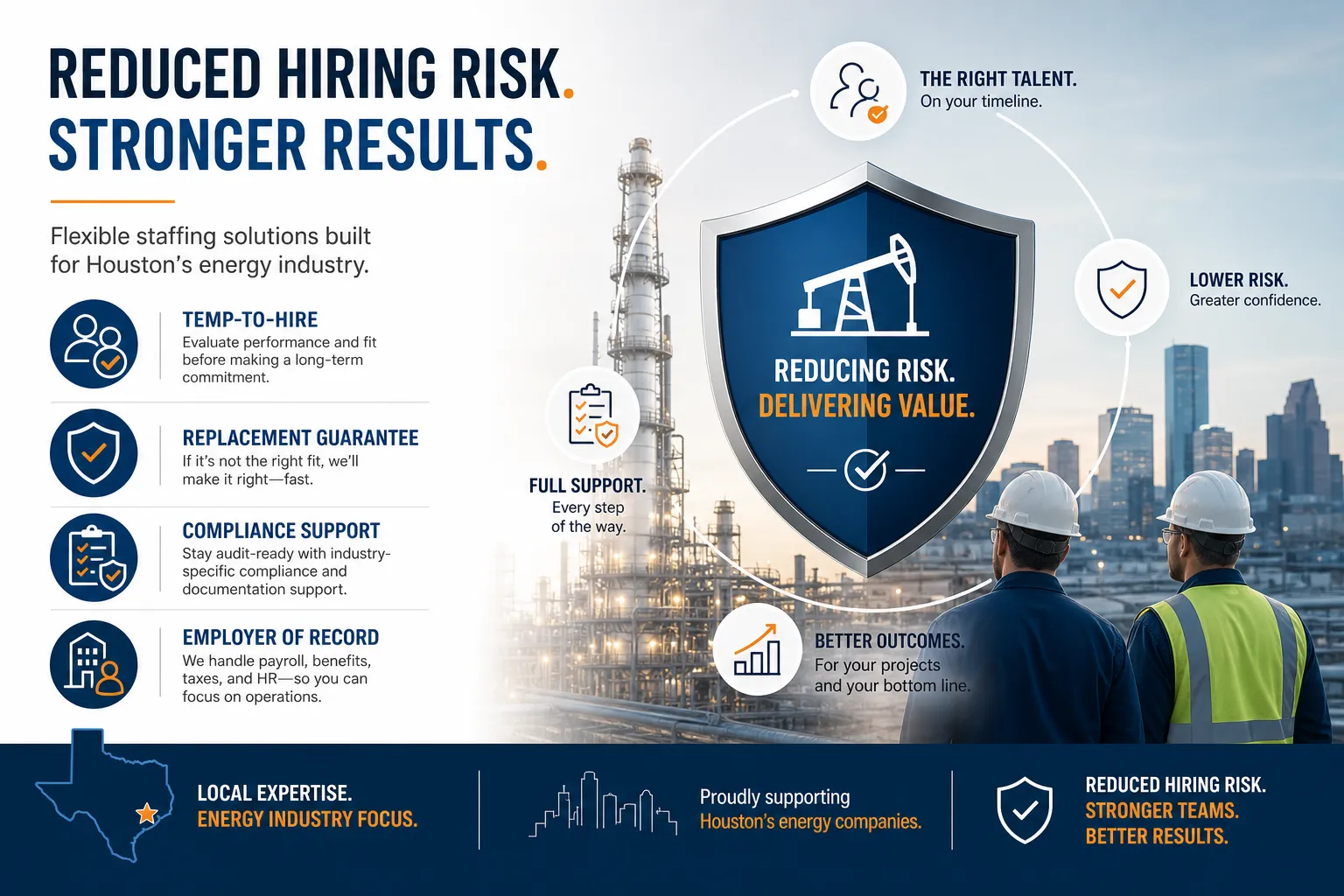
Houston-based market expertise since 1984
Fast candidate delivery, often within 24 to 72 hours for active searches
Direct hire recruiting for specialized long-term roles
Contract and temporary staffing for short-term workload, leave coverage, and project support
Temp-to-hire options to evaluate fit before full-time conversion
Executive search for senior and confidential roles
RPO and onsite recruiting for high-volume or embedded hiring support
Payrolling and compliance support as employer of record
180-day direct hire replacement guarantee
100% satisfaction guarantee on temporary placements
That mix is especially valuable for employers balancing immediate staffing pressure with long-term workforce planning.
The decision framework: when should you call a recruiter?
If any of the following are true, a specialized recruiter can likely improve both speed and outcome.
You should engage oil and gas recruiters when:
The role has been open too long
Internal applicants are weak or scarce
The position requires niche industry experience
You need confidentiality
You need several hires at once
The hiring manager lacks time to source
Screening and onboarding are slowing the process
The business needs talent in days, not weeks
You want to reduce the risk of a bad permanent hire
A practical checklist for employers who want faster fills
Before opening the search, prepare these items:
Hiring manager readiness checklist
Finalized title and reporting line
Core responsibilities
Must-have skills
Industry and environment requirements
Work schedule and location expectations
Compensation range approved
Interview team identified
Decision timeline agreed
Start date target set
Contingency plan for urgent coverage
The more complete this is, the faster even the best headhunters in Houston Texas can move.
What job seekers should know about fast-moving oil and gas recruiting
While this article is written primarily for Houston employers, job seekers benefit from understanding how recruiters work too.
To get noticed faster, candidates should:
Tailor resumes to the specific energy segment
List systems, certifications, and equipment clearly
Show project scope, not just titles
Clarify availability and location preference
Be responsive during the process
Be honest about compensation and travel flexibility
Candidates who present clean, specific, industry-relevant information are easier to place quickly.
Common mistakes that slow down oil and gas hiring
Employer-side mistakes
Unrealistic compensation
Too many interview rounds
Vague job requirements
Delayed feedback
Rejecting strong transferable candidates too quickly
Waiting for the "perfect" candidate in a time-sensitive market
Recruiter-side mistakes
Weak intake
Generic sourcing
Poor technical screening
No backup candidates
Late-stage compensation surprises
Slow communication
Candidate-side mistakes
Unclear résumé
Inconsistent employment story
Poor responsiveness
Inflated title claims
Misalignment on travel, shift, or location
Final verdict
The fastest oil and gas recruiters in Houston do not rely on luck or job board volume. They win on preparation, local relationships, technical understanding, and disciplined process. That is what produces faster placements, better candidate matches, and lower hiring risk.
For Houston-area employers, the ideal recruiting partner should know the energy market deeply, support multiple hiring models, move quickly when urgency spikes, and stand behind placements with real accountability. Clayton Services offers that combination through Houston-based recruiting expertise, flexible staffing solutions, a broad specialization footprint, and unusually strong service guarantees.
If your team needs engineering talent, field support, offshore-ready professionals, energy accounting specialists, operations staff, or leadership hires, Clayton Services can help you move faster with less risk. Whether the need is short-term, project-based, temp-to-hire, or direct hire, the goal is the same: deliver qualified people quickly and help your business keep moving.
Frequently Asked Questions
Who are the best oil and gas recruiters in Houston?
The best oil and gas recruiters in Houston combine deep local energy-market knowledge, fast candidate delivery (often within 24 to 72 hours), flexible hiring models, and strong placement guarantees. Clayton Services is a leading choice because it has recruited across Houston's energy sector since 1984, offers direct hire, contract, temp-to-hire, executive search, RPO, and payrolling support, and backs placements with a 180-day direct hire replacement guarantee and a 100% satisfaction guarantee on temporary placements.
How fast can an oil and gas recruiter fill a position in Houston?
Specialized oil and gas recruiters can deliver qualified candidates within 24 to 72 hours for active searches. The speed comes from preparation rather than volume—established recruiters have already built local networks, deeply screened candidates, and maintained energy-market relationships over years. Clayton Services moves at this pace for active searches while still protecting candidate quality.
What is the difference between a fast recruiter and a risky recruiter?
A risky recruiter creates the illusion of speed by forwarding loosely matched resumes, which leads to interview fatigue, lower hiring manager confidence, longer true time-to-fill, and higher turnover. A genuinely fast recruiter moves quickly because the groundwork is already done: built networks, deep candidate screening, active market relationships, and repeatable qualification workflows. Real speed reduces hiring risk rather than adding to it.
Which hiring model fills oil and gas roles the fastest?
Contract staffing fills fastest and is ideal for projects, shutdowns, backfills, and urgent coverage. Temp-to-hire is fast to moderate and reduces risk by proving fit before conversion. Direct hire is moderate and best for permanent core and leadership roles. Payrolling/EOR is fast when you've already selected a candidate but need compliance support. Executive search is slower and built for confidential senior hires. The right model depends on urgency, certainty, budget, and risk tolerance.
When should an employer hire an oil and gas recruiter?
Engage a specialized recruiter when a role has stayed open too long, internal applicants are weak or scarce, the position requires niche energy experience, confidentiality matters, you need several hires at once, the hiring manager lacks time to source, or the business needs talent in days rather than weeks. A recruiter is also valuable when you want to reduce the risk of a costly bad permanent hire.
What roles do oil and gas recruiters in Houston staff?
Houston energy recruiters staff far more than engineers. Clayton Services recruits across accounting and finance, administrative, HR, legal, supply chain, customer service, and technical support functions that keep energy businesses running, along with field support, operations staff, offshore-ready professionals, energy accounting specialists, and leadership hires. This breadth lets employers cover both technical and business-critical roles through one partner.
What guarantees should I expect from an oil and gas staffing company?
Look for accountability that protects you if a placement doesn't work out. Clayton Services offers a 180-day direct hire replacement guarantee and a 100% satisfaction guarantee on temporary placements. These protections are especially important in energy hiring, where a mis-hire can disrupt projects, drive up overtime, and slow operational readiness.
What slows down oil and gas hiring the most?
On the employer side, the biggest delays come from unrealistic compensation, too many interview rounds, vague job requirements, slow feedback, rejecting strong transferable candidates too quickly, and waiting for a "perfect" candidate in a time-sensitive market. Recruiters slow things down with weak intake, generic sourcing, and poor screening, while candidates lose time through unclear resumes and slow responsiveness.
How can employers speed up the hiring process before calling a recruiter?
Prepare a hiring manager readiness checklist first: finalized title and reporting line, core responsibilities, must-have skills, industry and environment requirements, schedule and location expectations, an approved compensation range, an identified interview team, an agreed decision timeline, a target start date, and a contingency plan for urgent coverage. The more complete this is, the faster even the best recruiters can move.
How can job seekers get placed faster in oil and gas roles?
Candidates get noticed and placed faster by tailoring their resume to the specific energy segment, clearly listing systems, certifications, and equipment, showing project scope rather than just titles, clarifying availability and location preferences, staying responsive throughout the process, and being honest about compensation and travel flexibility. Clean, specific, industry-relevant information is easier for recruiters to place quickly.


