
Direct Hire Placement Agencies for Better Hiring


Direct Hire Placement Agencies for Better Hiring
TL;DR
If you need a permanent employee and cannot afford a weak hire, a slow search, or high turnover, direct hire placement agencies can reduce risk and improve hiring outcomes. The best partners do far more than send resumes. They define the role, map the talent market, screen for skills and fit, manage the process, and stand behind the placement with a meaningful guarantee.
For Houston employers, the right recruiting partner should offer local market knowledge, fast response times, broad role coverage, and flexible hiring options beyond direct hire alone. Clayton Services brings all of that together with Houston roots dating back to 1984, a decades-deep candidate network, a 180-day direct hire replacement guarantee, and staffing solutions that range from temporary and temp-to-hire to executive search, payrolling, and onsite/RPO support.
For job seekers, direct hire recruiting can also open doors to permanent roles that may never be posted publicly, while giving you guidance on positioning, timing, and employer expectations in the Houston market.

What Direct Hire Placement Agencies Actually Do
A direct hire placement agency helps employers fill permanent positions. The employee is hired directly onto the company payroll, rather than working through the staffing firm first. That sounds simple, but the real value is in everything that happens before the offer is accepted.
A strong direct hire recruiting process usually includes:
intake meetings to define the role and ideal candidate profile
compensation and market guidance
targeted sourcing across active and passive talent pools
screening for technical qualifications and soft skills
interview coordination and candidate communication
offer support and negotiation guidance
replacement coverage if the hire does not work out
In other words, the agency is not just a resume source. It acts as an extension of your hiring team.
For Houston employers dealing with urgent openings, growth hiring, or hard-to-fill positions, this support can save weeks of internal effort and help avoid expensive misfires.
Quick Answer: When Should a Business Use Direct Hire Recruiting?
Use direct hire recruiting when:
the role is permanent and business critical
a vacancy is hurting productivity, service, or leadership capacity
internal teams do not have time to source and screen effectively
the market is competitive and good candidates move quickly
confidentiality matters
you need access to passive candidates, not just job board applicants
a hiring mistake would be costly
Do not think of direct hire as only an executive solution. It is often the right move for accountants, administrative professionals, HR staff, engineers, legal support, customer service leaders, supply chain professionals, light industrial supervisors, and skilled trades talent as well.
Direct Hire Recruiting Agencies vs Internal Hiring
Many employers start with the assumption that internal hiring is cheaper. Sometimes it is. But only if your team can attract the right candidates, move quickly, and land someone who stays.
The hidden costs of handling a search alone often include:
manager time spent reviewing weak resumes
lost productivity from an open seat
slower project timelines
repeated interviews with unqualified candidates
lower offer acceptance rates
turnover from poor fit
A direct hire partner can reduce those costs by narrowing the field early and managing the process with discipline.
"The median time-to-fill for nonexecutive positions decreased from 44 days in 2025 to 39 days in 2026." - SHRM
That figure is useful because it shows how long hiring can take even in a more responsive market. For employers that need talent faster than the market average, a well-connected local recruiting firm can make a measurable difference.
Direct Hire vs Temp-to-Hire vs Temporary Staffing
One major content gap in most articles on this topic is that they treat direct hire as a standalone decision. In reality, smart hiring leaders compare it with other staffing models based on risk, urgency, and role type.
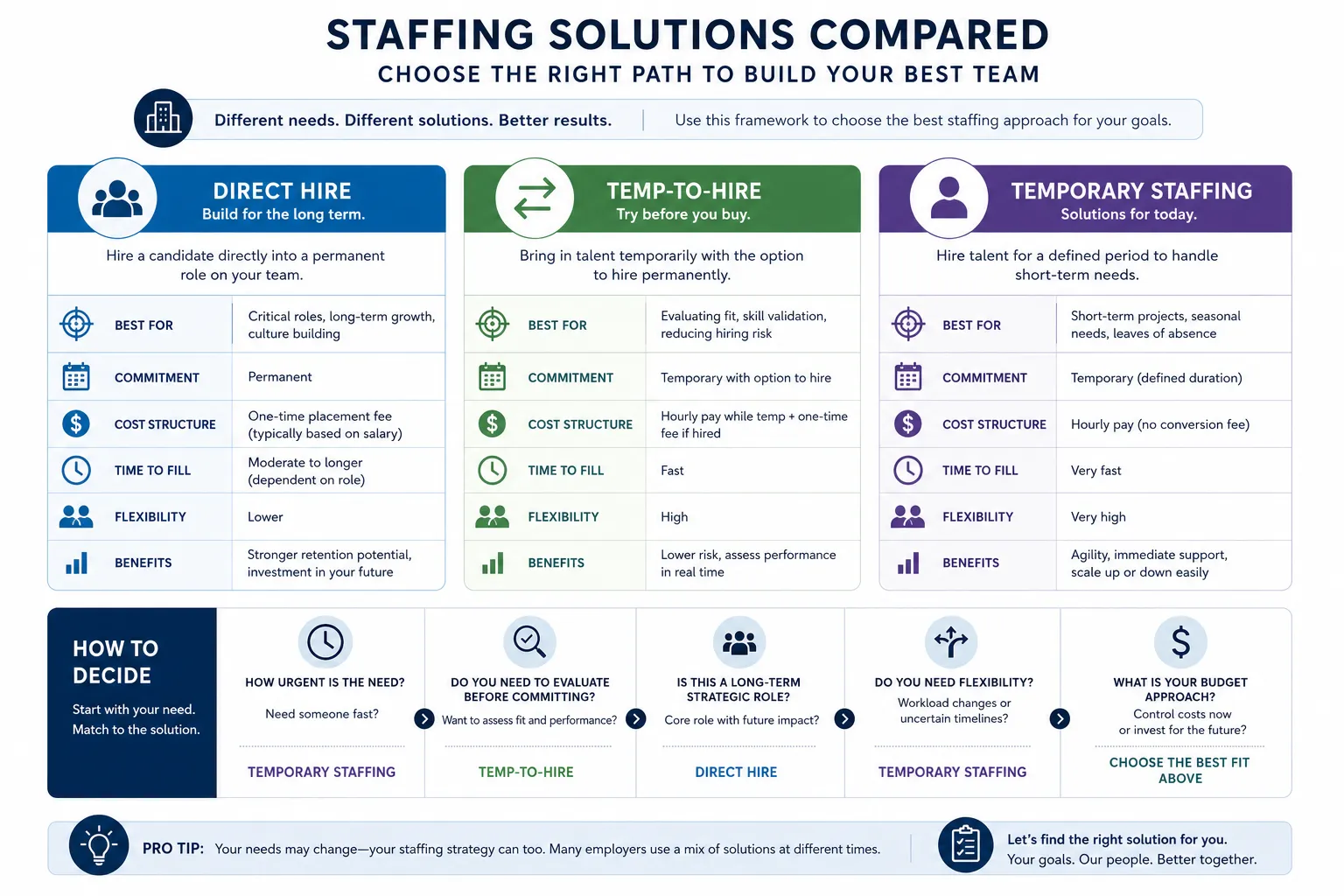
Comparison Table
Hiring Model | Best For | Payroll Employer at Start | Main Advantage | Main Tradeoff |
Direct Hire | Permanent professional, technical, leadership, and hard-to-fill roles | Client company | Strong long-term commitment from day one | Higher stakes if fit is wrong |
Temp-to-Hire | Roles where fit must be proven on the job | Staffing firm initially | Reduces hiring risk through a working trial | Permanent conversion takes more time |
Temporary Staffing | Coverage gaps, seasonal spikes, short projects, leave coverage | Staffing firm | Fast flexibility and immediate support | Not designed for long-term permanent hiring |
Practical Decision Framework
Choose direct hire when you know the role is permanent and want the strongest possible candidate commitment from day one.
Choose temp-to-hire when the role is permanent but you want to reduce risk by observing performance and fit before making a final decision.
Choose temporary staffing when speed and flexibility matter more than permanence.
This is where Clayton Services is especially useful to Houston employers. Instead of forcing every need into one model, Clayton Services supports short-term, long-term, and trial-to-permanent hiring through one local team. That means less confusion, faster pivots, and better workforce planning.
What Makes a Good Direct Hire Placement Agency?
Not all direct hire placement agencies operate at the same level. If you are evaluating a recruiting partner, focus on these factors.
1. Local Market Knowledge
A recruiter should know more than job titles. They should understand:
what candidates are earning in Houston
which industries are competing for the same talent
commute realities across the metro area
how urgency, flexibility, and benefits affect acceptance rates
where talent pools are deep or scarce
Clayton Services has worked in the Houston market since 1984. That matters because local hiring is rarely just about skills. It is about timing, geography, competition, and credibility.
2. Role and Industry Range
A strong partner should be able to support more than one niche, especially if your hiring needs span departments. Employers often need a mix of:
accounting and finance
administrative and clerical
customer service and call center
engineering
human resources
information technology
legal
marketing
medical administrative
oil and gas and energy
sales
supply chain and logistics
light industrial
skilled trades
leadership and executive roles
Clayton Services covers this full range, which is valuable for growing companies that need one trusted source for multiple business functions.
3. Speed Without Cutting Corners
Fast hiring only helps if the candidates are right. The best recruiting firms balance urgency with discipline.
Clayton Services is built for speed, with placement timelines often moving within 24 to 72 hours for many staffing needs, while still maintaining structured screening and quality control. For permanent searches, speed depends on market conditions and role complexity, but responsiveness still matters from the first call onward.
4. A Real Guarantee
A placement fee means very little if the agency disappears after the offer is signed. Look for a partner willing to stand behind the hire.
Clayton Services offers a 180-day direct hire replacement guarantee, which significantly reduces employer risk. That is a meaningful sign of accountability.
5. Flexibility Beyond Direct Hire
One of the biggest hiring mistakes companies make is choosing a staffing model before diagnosing the business need. A great partner helps you select the right approach, whether that is direct hire, temp-to-hire, temporary staffing, payrolling, executive search, or onsite recruiting support.
Why Direct Hire Is About More Than Filling a Vacancy
Most articles stop at "we help you fill permanent roles." That is not enough. The better question is: what business outcome are you trying to protect or improve?
Direct hire recruiting helps employers:
stabilize teams
improve retention
reduce manager burnout
maintain customer service levels
keep projects on track
support succession planning
build stronger leadership benches
When viewed this way, direct hire is not just a recruiting method. It is a business continuity decision.
The Hidden Advantage: Access to Passive Candidates
Job boards mostly reach people who are already applying. That leaves out a major portion of the market.
Many strong candidates are not unemployed or actively searching. They are working, selective, and open only to the right opportunity. Reaching them requires relationships, credibility, and timing.
That is one of the clearest advantages of experienced direct hire recruiting agencies. Clayton Services has spent decades building candidate relationships in Houston, which gives employers access to people who are often invisible to standard posting-based hiring.
What the Best Direct Hire Process Looks Like
Below is a practical blueprint for how a high-performing search should run.
Step 1: Define the Real Need
This goes beyond the job description. Good recruiters ask:
What must this person accomplish in the first 90 days?
What has made this role hard to fill before?
What personality traits thrive on your team?
What are the true non-negotiables?
What compensation and flexibility will the market support?
Step 2: Build a Targeted Search Strategy
The search should be based on:
local talent availability
role seniority
compensation competitiveness
industry crossover opportunities
urgency level
whether passive outreach is required
Step 3: Screen for Skill and Fit
This is where weak firms tend to fail. A good shortlist is not just technically qualified. It also reflects communication style, reliability, motivation, career stability, and team fit.
Step 4: Manage the Candidate Experience
Top candidates often drop out because of slow communication, poor interview scheduling, vague feedback, or unclear compensation. A recruiting partner should protect your employer brand by keeping the process tight and professional.
Step 5: Support Offer Acceptance and Transition
Strong recruiters help manage:
compensation expectations
resignation timing
counteroffer risk
start date coordination
preboarding communication
Step 6: Stay Engaged After the Hire
The work is not over when someone signs. Follow-up helps catch early issues, support onboarding, and reduce preventable turnover.

How Houston Employers Can Decide If Direct Hire Is Worth It
Here is a simple test. Direct hire is usually worth the investment when one or more of these are true:
Question | If Yes, Direct Hire May Be the Right Move |
Is the role revenue-impacting or operationally critical? | Yes |
Has the role been open too long already? | Yes |
Do hiring managers lack time to recruit properly? | Yes |
Is the market tight for this skill set? | Yes |
Is turnover from a bad hire likely to be expensive? | Yes |
Does the role require discretion or confidentiality? | Yes |
Are you hiring for long-term growth, not just immediate coverage? | Yes |
If your answers are mostly yes, a direct hire search is often more efficient and less risky than trying to solve the problem internally with job postings alone.
What Employers Should Ask Before Signing With a Recruiting Partner
This is another area where many articles stay too generic. If you are evaluating agencies, ask direct questions.
Essential Questions
How do you source passive candidates, not just active applicants?
What roles and industries do you place most often?
How do you evaluate soft skills and team fit?
Who will actually manage our search?
What is your average time to present qualified candidates?
What happens if the hire does not work out?
Can you support temp-to-hire or temporary staffing if our needs change?
Do you offer payrolling or employer-of-record support?
Can you help with executive search or high-volume recruiting if we scale?
How well do you know the Houston labor market specifically?
Clayton Services gives employers a stronger answer set here than many firms because its capabilities extend beyond one hiring lane. Whether you need direct hire support, temp coverage, employer-of-record services, or an onsite/RPO solution for volume hiring, you can stay with one accountable partner.
Direct Hire for Different Role Types
Another common content gap is assuming direct hire is only for senior professionals. In reality, the value of direct hire varies by role type, but it can work across the organization.
Professional and Corporate Roles
Direct hire is especially effective for:
accountants and financial analysts
executive assistants and office managers
HR professionals
sales professionals
legal support staff
engineers
IT professionals
supply chain specialists
These positions often require a stronger long-term commitment and a higher degree of screening for fit.
Leadership and Executive Roles
For managers, directors, and executives, the cost of a weak hire rises sharply. Search discipline, confidentiality, market mapping, and candidate vetting become even more important. Clayton Services supports executive search needs as part of its broader recruiting capability.
Industrial and Skilled Roles
Direct hire can also be the right solution for supervisors, lead technicians, skilled trades professionals, and certain hard-to-find industrial roles where long-term stability matters. When hiring risk is a concern, temp-to-hire may be the better first step, which is why model flexibility matters so much.
The Risk Reduction Side of Staffing That Employers Overlook
A smart hiring decision is not just about speed. It is about reducing downside.
Here is how the right staffing partner lowers employer risk:
Replacement protection through a direct hire guarantee
Trial-to-permanent options through temp-to-hire
100% satisfaction protection on temporary placements
Compliance and payroll support through employer-of-record services
Scalable delivery through onsite and RPO solutions
Better screening discipline across skill, fit, and motivation
For Houston employers, Clayton Services combines all of these in one market-focused partner. That means less fragmentation, fewer vendors, and more control.
A Better Way to Think About Hiring ROI
Hiring ROI is not just about fee percentage. It should be measured against:
time saved by managers and HR
reduction in vacancy costs
lower turnover risk
stronger productivity ramp
better cultural fit
fewer hiring process breakdowns
If a recruiting partner fills a critical role faster, with better retention and less internal disruption, the financial return often outweighs the fee.
What Job Seekers Should Know About Direct Hire Opportunities
While this article is primarily for employers, job seekers benefit from understanding the model too.
A direct hire placement means:
you are being considered for a permanent role
you go directly onto the employer payroll if hired
the recruiter may help position your background more effectively
you may gain access to openings not posted publicly
there is no fee charged to you by the staffing firm
For professionals in Houston looking for roles in accounting, administration, customer service, engineering, HR, legal support, IT, skilled trades, and related fields, working with a well-connected local recruiting team can improve access and visibility.
The Local Houston Advantage Matters More Than Many Realize
A national process can look polished on paper, but local hiring is often won by market familiarity.
Houston employers deal with unique realities such as:
cross-industry competition for talent
energy market influence on compensation
varied commute corridors and geographic preferences
neighborhood-based labor availability
urgency created by growth cycles and project demand
A Houston-owned recruiting firm understands these patterns in a way that a remote desk often cannot. Clayton Services has built its reputation on that local knowledge and long-standing employer and candidate relationships across Greater Houston.
Authority Check: Why Hiring Is Still Hard Even When Talent Is Available
Many employers feel confused by the labor market. Openings may draw applicants, yet qualified hiring still feels difficult. That is not your imagination.
"In Q1 2026, the hiring difficulty index remained relatively constant, reflecting ongoing challenges in attracting qualified candidates." - SHRM
This is exactly why direct hire support remains valuable. The issue is rarely just volume. It is finding qualified, motivated people who align with the role, the manager, the pay range, and the long-term opportunity.
Final Verdict
Direct hire placement agencies are most valuable when they do more than search. The best ones reduce hiring risk, improve speed, strengthen candidate quality, and give employers flexible options when business needs change.
For Houston-area companies, that means choosing a partner with true local depth, broad specialization, meaningful guarantees, and the operational ability to support both immediate and long-range workforce needs.
Clayton Services stands out on those points. As a Houston-based staffing and recruiting firm serving the market since 1984, Clayton Services offers direct hire recruiting backed by a 180-day replacement guarantee, temporary staffing backed by a 100% satisfaction guarantee, fast response timelines, deep candidate networks, employer-of-record and compliance support, and the ability to scale from single critical hires to executive search and high-volume onsite/RPO recruiting.
If you need a better way to fill permanent roles in Houston, the smartest next step is to work with a recruiting team that understands the market, stands behind the hire, and can adapt the solution to your actual risk level and business goals.
Ready to Hire More Confidently?
If your team needs help with permanent hiring, confidential searches, temp-to-hire evaluation, temporary coverage, or payrolling and compliance support, Clayton Services can help you move faster with less risk.
Whether you are hiring one key employee or building a larger team, Clayton Services brings the local market knowledge, proven recruiting process, and accountability Houston employers need to make better hires.
Frequently Asked Questions
What is direct hire recruiting?
Direct hire recruiting is a permanent placement model where a recruiting firm manages the search and the hired employee goes directly onto the employer's payroll from day one. But it's about more than filling a vacancy—done well, it protects business continuity by stabilizing teams, improving retention, reducing manager burnout, maintaining customer service levels, keeping projects on track, and supporting succession planning. It's best understood as a business decision, not just a recruiting method.
How is direct hire different from temp-to-hire and temporary staffing?
With direct hire, the employee joins your payroll immediately as a permanent team member—ideal for long-term, revenue-impacting, or leadership roles. Temp-to-hire lets you evaluate performance and fit on the job before converting to permanent, which lowers risk when fit is uncertain. Temporary staffing covers short-term or urgent needs with the worker on the agency's payroll. The right choice depends on urgency, role permanence, and how much hiring risk you want to absorb.
When is direct hire worth the investment?
Direct hire is usually worth it when the role is revenue-impacting or operationally critical, has been open too long, or sits in a tight talent market. It also makes sense when hiring managers lack time to recruit properly, turnover from a bad hire would be expensive, the role requires discretion or confidentiality, or you're hiring for long-term growth rather than immediate coverage. If most of those are true, a direct hire search is typically more efficient and less risky than job postings alone.
Why do direct hire recruiters access candidates job boards can't reach?
Job boards mostly reach people already actively applying, which leaves out a large share of the market. Many strong candidates aren't unemployed or searching—they're working, selective, and open only to the right opportunity. Reaching them requires relationships, credibility, and timing rather than a posting. That passive-candidate access is one of the clearest advantages of an experienced recruiting firm; Clayton Services has built those relationships across Houston for decades.
What does a strong direct hire process look like?
A high-performing search runs through six steps: defining the real need beyond the job description (what must this person accomplish in 90 days?), building a targeted search strategy based on local availability and compensation, screening for both skill and fit, managing the candidate experience to prevent drop-off, supporting offer acceptance and transition (compensation, resignation timing, counteroffer risk), and staying engaged after the hire to catch early issues. The work doesn't end when someone signs.
What roles can direct hire recruiting fill?
Direct hire isn't only for senior professionals. It works across professional and corporate roles (accountants, financial analysts, executive assistants, HR, sales, legal support, engineers, IT, supply chain), leadership and executive roles where a weak hire is costly and confidentiality matters, and industrial or skilled roles like supervisors, lead technicians, and hard-to-find trades where long-term stability matters. When hiring risk is a concern for those roles, temp-to-hire can be a smarter first step.
How does a staffing partner reduce hiring risk?
The right partner lowers downside through replacement protection via a direct hire guarantee, trial-to-permanent options through temp-to-hire, satisfaction protection on temporary placements, compliance and payroll support through employer-of-record services, scalable delivery through onsite and RPO solutions, and better screening discipline across skill, fit, and motivation. Clayton Services combines these in one Houston-focused partner, which means less fragmentation, fewer vendors, and more control.
What should I ask before signing with a direct hire recruiting agency?
Ask how they source passive candidates (not just active applicants), which roles and industries they place most often, how they evaluate soft skills and team fit, who will actually manage your search, their average time to present qualified candidates, what happens if the hire doesn't work out, whether they can support temp-to-hire or temporary staffing if needs change, whether they offer payrolling or EOR support, whether they can scale to executive or high-volume search, and how well they know the Houston market specifically.
How should I measure hiring ROI on a direct hire search?
Hiring ROI isn't just fee percentage—it should be measured against time saved by managers and HR, reduced vacancy costs, lower turnover risk, a stronger productivity ramp, better cultural fit, and fewer hiring-process breakdowns. If a recruiting partner fills a critical role faster, with better retention and less internal disruption, the financial return often outweighs the fee. Comparing firms on cost alone usually hides the more important cost drivers.
Why does local Houston market knowledge matter in direct hire recruiting?
A national process can look polished but local hiring is often won by market familiarity. Houston employers face cross-industry competition for talent, energy-market influence on compensation, varied commute corridors and geographic preferences, neighborhood-based labor availability, and urgency from growth cycles and project demand. A Houston-owned firm understands these patterns in a way a remote desk can't. Clayton Services has built its reputation on that local knowledge and long-standing relationships across Greater Houston since 1984.


