
Temp Service Houston: 7 Mistakes Employers Avoid

Temp Service Houston: 7 Mistakes Employers Avoid
Houston employers rarely struggle because they do not care about hiring. They struggle because they need people fast, need them to show up, and need them to perform in real-world conditions where delays cost money. That is exactly why many companies turn to a temp service in Houston Texas - but not every staffing strategy reduces risk. In many cases, employers accidentally create new problems by choosing the wrong partner, using the wrong hiring model, or skipping key process steps.
For business owners, HR leaders, operations managers, and department heads across Greater Houston, the goal is not just to fill seats. It is to build a workforce that can keep production moving, support customer demand, and protect quality, compliance, and morale. This guide breaks down the seven most common mistakes employers make with temp services in Houston Texas and how to avoid them.
For job seekers, these same mistakes matter too. When employers work with the right staffing partner, candidates get better matches, faster communication, and more reliable access to temporary, temp-to-hire, and direct hire opportunities.

Why Temporary Staffing Can Go Wrong So Fast
Temporary staffing is supposed to create flexibility. It should help employers respond to call-outs, seasonal swings, project surges, backlogs, leave coverage, and uncertain headcount planning. But when it is handled poorly, temporary staffing can create:
slower fill times
low-quality candidate flow
attendance problems
higher turnover
payroll or classification risk
poor culture fit
repeated rework for managers
Many competitor articles focus on generic hiring mistakes like rushing, relying too much on resumes, or skipping screening. Those points are valid - but they often stop short of addressing what Houston employers really need to know:
how to choose the right staffing model for the role
how to balance speed with quality
how to evaluate local market knowledge
how to reduce legal and payroll risk
how guarantees lower employer exposure
how temp-to-hire can be used strategically, not reactively
That is where a stronger staffing strategy matters.
"Nearly 90% of staffing employees believe that temporary or contract work made them more employable." - American Staffing Association
That matters because temporary staffing is not just a stopgap. Done correctly, it can become a high-quality path to stronger long-term hiring outcomes.
"The cost of a bad hire can be up to 30% of the employee's first-year salary." - SHRM / U.S. Department of Labor reference
For Houston employers, that means the wrong temp staffing decision does not just create inconvenience - it creates measurable business loss.
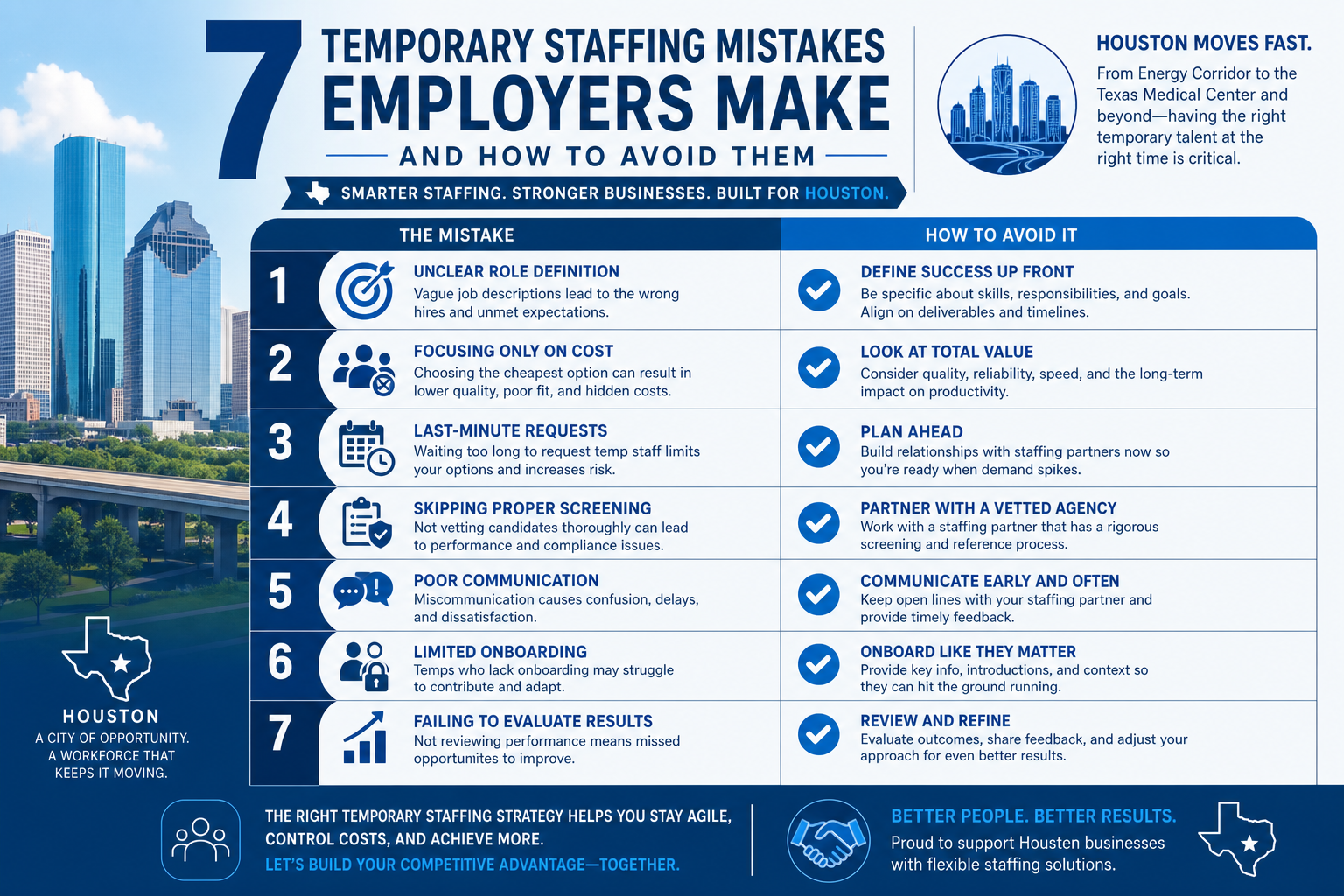
The 7 Biggest Temp Staffing Mistakes Houston Employers Should Avoid
1. Choosing a Staffing Agency Based on Speed Alone
Fast placement matters. In Houston, many employers need talent in 24 to 72 hours, especially for administrative support, customer service, supply chain, accounting support, skilled trades, and light industrial roles. But speed without vetting creates a revolving door.
A temp agency that promises immediate resumes but fails to screen for reliability, shift alignment, communication ability, or work environment fit often delivers short-term relief and long-term frustration.
What to do instead
Look for a staffing partner that can fill quickly and explain its screening process. Ask:
How do you qualify candidates before submission?
How do you verify experience?
What do you assess beyond the resume?
How do you reduce no-shows and early turnover?
Clayton Services is built for this balance. As a Houston-owned staffing and recruiting firm, the team understands local labor conditions and employer expectations across Greater Houston. That local knowledge helps support fast turnaround without treating speed as the only KPI.
2. Using Temporary Staffing for the Wrong Type of Role
Not every opening should be filled the same way. One of the most overlooked mistakes in competitor content is the assumption that “staffing” is one thing. It is not.
Different hiring needs require different solutions:
Hiring Need | Best-Fit Model | Why It Works |
Same-week coverage | Temporary staffing | Fast response for gaps, absences, and surges |
Try-before-you-hire | Temp-to-hire | Reduces hiring risk before a permanent offer |
Long-term permanent role | Direct hire | Best for strategic or career-track openings |
Large-scale hiring demand | RPO / onsite recruiting | Supports consistent, high-volume recruiting |
Payroll and compliance support | Payrolling / employer of record | Reduces admin burden and employer exposure |
If you use a temporary worker for a role that really needs long-term commitment, you may create churn. If you force a permanent model for an urgent short-term project, you may slow hiring unnecessarily.
What to do instead
Match the model to the business need. Clayton Services supports:
temporary staffing
temp-to-hire
direct hire recruiting
executive search
RPO and onsite recruiting
payrolling services as employer of record
That flexibility matters because the right staffing partner should not force every role into the same funnel.
3. Failing to Define the Job Clearly Before Requesting Talent
A common reason temp placements fail has nothing to do with the worker. It starts with an unclear order.
When employers provide vague job requirements, inconsistent schedules, unclear reporting structures, or incomplete expectations, recruiters are forced to guess. That leads to mismatched submissions, slower fill times, and dissatisfied hiring managers.
Common missing details
exact duties
schedule and shift expectations
location and commute realities
software, tools, or equipment used
physical demands
required certifications or licenses
team environment
possible path to permanent hire
What to do instead
Treat your staffing request like an operational brief, not a generic job opening. The better the intake process, the better the candidate match.
A strong temp service in Houston should ask detailed questions at the start - not just take an order and send resumes. Clayton Services’ recruiting model is consultative, which helps employers align role requirements with labor market realities before recruiting begins.
4. Ignoring Culture Fit Because the Need Feels “Temporary”
Many employers assume culture fit only matters for permanent hires. That is a costly mistake.
Temporary employees still affect:
customer interactions
production quality
internal morale
attendance coverage
supervisor workload
safety and accountability
Even for short-term roles, a poor-fit employee can create friction quickly. Competitors mention culture fit, but often do not connect it to day-to-day management cost. In reality, culture mismatch creates extra supervision, training fatigue, and often early assignment failure.
What to do instead
Screen for more than technical qualifications. Ask your staffing partner how they evaluate:
professionalism
communication style
reliability
adaptability
workplace demeanor
shift readiness
team compatibility
This is where temp-to-hire staffing becomes especially valuable. It gives employers the chance to evaluate real performance, dependability, and fit before making a long-term decision. Clayton Services uses temp-to-hire as a practical risk-reduction strategy, not just a staffing buzzword.
5. Overlooking Compliance, Payroll, and Employment Risk
This is one of the biggest content gaps in many hiring articles. Employers often think staffing help is only about recruiting. In reality, one of the biggest advantages of working with a quality staffing firm is risk transfer and administrative support.
When temporary staffing is handled incorrectly, employers can face problems tied to:
payroll accuracy
wage and hour compliance
onboarding documentation
workers’ compensation exposure
co-employment misunderstandings
classification issues
timekeeping disputes
What to do instead
Work with a staffing partner that can serve as employer of record for temporary workers and clearly explain what responsibilities they manage. This is especially important for fast-moving operations, multi-shift environments, and businesses scaling headcount quickly.
Clayton Services offers payrolling and compliance support, helping employers reduce internal administrative burden while maintaining workforce flexibility. For many Houston companies, that means less time spent managing paperwork and more time focused on operations.
6. Not Asking About Guarantees and Replacement Policies
One of the easiest ways to spot a weak staffing partner is this: they are eager to place, but vague about accountability.
If an agency will not clearly explain what happens when a placement does not work out, the employer absorbs too much risk. This is particularly important in direct hire and temp-to-hire scenarios, where a bad fit can cost far more than the placement fee.
What to do instead
Choose a staffing firm that stands behind its work with clear service guarantees.
Clayton Services offers:
a 180-day direct hire replacement guarantee
a 100% satisfaction guarantee on temporary placements
Those guarantees matter because they show the firm is not just selling candidate flow. It is taking responsibility for outcomes. For Houston employers comparing staffing partners, this is a real differentiator and a meaningful way to reduce hiring risk.
7. Treating Your Staffing Agency Like a Vendor Instead of a Hiring Partner
Transactional staffing usually produces transactional results.
If you only contact your staffing agency when there is an emergency, provide minimal feedback, and do not share workforce plans, the agency can only react. That limits quality, planning, and speed.
The best employers use staffing partners strategically. They share:
upcoming hiring forecasts
recurring pain points
retention issues
manager preferences
peak business cycles
conversion goals
long-term growth plans
What to do instead
Build an ongoing relationship with a staffing firm that understands your business, hiring patterns, and local talent market. That is where a Houston-based recruiting partner has an advantage over a national chain using a one-size-fits-all process.
Clayton Services has served Greater Houston since 1984. That means decades of local candidate network development, employer relationships, and market insight across professional, administrative, technical, industrial, and leadership hiring.
What Houston Employers Should Look for in a Temp Service
If you are comparing temp services in Houston Texas, use this checklist.
Staffing Partner Evaluation Checklist
What to Evaluate | Why It Matters |
Local Houston market knowledge | Improves pay-rate guidance, sourcing strategy, and fit |
Speed to fill | Helps cover urgent openings quickly |
Screening depth | Reduces no-shows, poor fit, and turnover |
Industry specialization | Improves quality in technical and niche roles |
Hiring model flexibility | Supports temporary, temp-to-hire, and direct hire needs |
Compliance support | Reduces payroll and employment risk |
Guarantees | Protects your budget and lowers hiring exposure |
Communication responsiveness | Keeps hiring managers informed and moving |
Candidate pipeline depth | Increases access to ready-to-work talent |
Scalability | Supports both single placements and high-volume hiring |
Why Local Matters in Houston Staffing
Houston is not one labor market. It is a network of submarkets, industries, commuting realities, and hiring cultures. What works in North Houston may not work in the Energy Corridor, Katy, Pasadena, Baytown, The Woodlands, or downtown.
That is why local recruiters often outperform national call-center-style staffing models. A local team understands:
compensation expectations by area and role
commute barriers
industry-specific talent pools
employer competition
local candidate behavior
urgency patterns in Houston hiring cycles
Clayton Services is not a branch office following a national script. It is a Houston-owned recruiting firm with long-standing roots in the market. That translates into better context, faster alignment, and more practical staffing recommendations.
Industries and Roles Where Temp Staffing Often Delivers the Most Value
Temporary staffing works especially well when employers need speed, flexibility, or a lower-risk evaluation path.
Common business cases
vacation and leave coverage
seasonal volume spikes
special projects
back-office backlog relief
rapid growth periods
confidential replacement needs
uncertain headcount situations
temporary-to-permanent evaluation
Common roles Houston employers fill through staffing support
administrative assistants
customer service representatives
call center staff
accounting clerks
AP/AR specialists
HR coordinators
legal support staff
engineering support roles
supply chain and logistics personnel
medical administrative staff
light industrial workers
skilled trades professionals
sales and marketing support
Clayton Services supports employers across these categories and more, including executive search and high-volume RPO/onsite recruiting for larger workforce initiatives.
How to Reduce Hiring Risk With a Smarter Temporary Staffing Strategy
A strong temp staffing strategy is not just “call agency, receive candidate.” It should include a repeatable framework.
A better process looks like this
Define the role and success metrics clearly.
Choose the correct staffing model.
Align on pay rate, schedule, and non-negotiables.
Confirm screening and compliance steps.
Establish communication timelines.
Give feedback quickly after interviews or starts.
Measure attendance, performance, and conversion potential.
Signs your current process needs improvement
too many short-duration assignments
repeated no-shows
weak candidate quality
hiring managers rejecting most submissions
slow response from the agency
confusion about billing or payroll
no clear plan for converting strong performers
If these issues sound familiar, the problem may not be temporary staffing itself. It may be the way the staffing relationship is structured.
Why Clayton Services Is a Strong Choice for Temp Service Houston Needs
Houston employers need more than resumes. They need a staffing partner that can move quickly, communicate clearly, and stay accountable after the placement.
Clayton Services stands out because it combines:
Houston-owned, local recruiting expertise
staffing support across short-term, temp-to-hire, and long-term hiring needs
fast placement timelines within 24 to 72 hours for many roles
specialization across professional, office, technical, industrial, and leadership hiring
180-day direct hire replacement guarantee
100% satisfaction guarantee on temporary placements
payrolling and compliance support as employer of record
executive search capability
RPO and onsite recruiting for larger-scale workforce needs
a candidate network built across the Houston market since 1984
For employers, that means lower hiring risk, stronger service accountability, and better access to qualified local talent.
For job seekers, it means working with recruiters who understand Houston employers and can connect candidates to real opportunities across a wide range of fields.
Final Takeaway
Using a temp service in Houston Texas should make hiring easier, not harder. The employers who get the best results are the ones who avoid the most common mistakes: rushing for speed alone, using the wrong hiring model, providing unclear job details, ignoring fit, overlooking compliance, skipping guarantees, and treating staffing as a transaction instead of a partnership.
If you want a staffing partner that understands Houston, moves fast, reduces hiring risk, and backs its work with real guarantees, Clayton Services is built for that role.
Whether you need temporary coverage, temp-to-hire flexibility, direct hire recruiting, payrolling support, or large-scale recruiting help, Clayton Services can help you hire with more confidence and less friction.
Frequently Asked Questions About Temp Services in Houston
What is a temp service in Houston?
A temp service in Houston helps employers quickly fill short-term, temp-to-hire, and sometimes permanent positions with qualified workers. Staffing agencies often handle recruiting, screening, payroll administration, and employment support to help businesses reduce hiring delays and workforce strain.
How do temp services help Houston employers reduce hiring risk?
Temp services reduce hiring risk by allowing employers to evaluate workers before making permanent offers, maintain productivity during staffing shortages, and avoid rushing direct hire decisions. Many staffing firms also provide screening, payroll support, and placement guarantees.
What mistakes do employers commonly make when using temporary staffing?
Common mistakes include prioritizing speed over quality, choosing the wrong staffing model, providing unclear job requirements, ignoring culture fit, overlooking compliance concerns, failing to ask about guarantees, and treating staffing agencies like transactional vendors instead of long-term hiring partners.
Why is choosing a staffing agency based only on speed a problem?
Fast placements matter, but speed without proper screening can lead to no-shows, poor performance, attendance issues, and high turnover. A strong staffing partner balances fast turnaround times with candidate quality and role fit.
What is the difference between temporary staffing, temp-to-hire, and direct hire?
Temporary staffing is designed for short-term or urgent workforce needs. Temp-to-hire allows employers to evaluate a worker before making a permanent offer. Direct hire recruiting focuses on filling long-term permanent positions from the start.
When should employers use temp-to-hire staffing?
Employers should use temp-to-hire staffing when they need to fill a role quickly but still want time to evaluate performance, attendance, communication skills, and culture fit before committing to a permanent hire.
Why does culture fit matter in temporary staffing?
Culture fit matters because temporary employees still affect team morale, customer interactions, productivity, accountability, and workplace communication. A poor-fit temporary worker can create operational problems even during short assignments.
How can employers reduce no-shows and turnover with temp staffing?
Employers can reduce no-shows and turnover by partnering with staffing firms that thoroughly screen candidates, verify work history, confirm availability, discuss shift expectations clearly, and evaluate reliability before placement.
Why is local Houston staffing knowledge important?
Houston is made up of multiple labor submarkets with different pay expectations, commute realities, and industry concentrations. A local Houston staffing agency understands hiring conditions in areas like Katy, Pasadena, Downtown Houston, The Woodlands, Baytown, and the Energy Corridor.
What compliance risks can temporary staffing agencies help reduce?
Temporary staffing agencies can help reduce payroll, onboarding, workers’ compensation, wage and hour, classification, timekeeping, and employment documentation risks by serving as employer of record and managing workforce administration properly.
What should employers ask before choosing a temp service in Houston?
Employers should ask about candidate screening processes, placement speed, industry specialization, guarantees, compliance support, communication expectations, local market knowledge, and whether the agency supports temporary, temp-to-hire, and direct hire staffing.
Why do staffing guarantees matter?
Staffing guarantees matter because they reduce employer risk if a placement does not work out. Guarantees demonstrate accountability and confidence in the recruiting process, especially for temp-to-hire and direct hire placements.
What industries benefit most from temp staffing in Houston?
Industries that commonly benefit from temp staffing in Houston include oil and gas, manufacturing, logistics, accounting, administrative support, healthcare administration, customer service, legal support, engineering, supply chain, and skilled trades.
What jobs are commonly filled through temp staffing agencies in Houston?
Houston temp staffing agencies frequently fill roles such as administrative assistants, customer service representatives, AP/AR specialists, HR coordinators, accounting clerks, legal support staff, logistics personnel, engineering support roles, light industrial workers, and skilled trades professionals.
How can employers improve their temporary staffing strategy?
Employers can improve their staffing strategy by clearly defining role expectations, selecting the right hiring model, communicating feedback quickly, aligning on pay and scheduling requirements, and building an ongoing relationship with a trusted staffing partner.
Why do many Houston employers prefer local staffing firms over national agencies?
Many Houston employers prefer local staffing firms because local recruiters better understand regional labor trends, compensation expectations, commute barriers, candidate behavior, and industry hiring cycles across Greater Houston.
Is temporary staffing only for emergency hiring situations?
No. Temporary staffing can also support long-term workforce planning, project work, seasonal hiring, leave coverage, business growth, confidential replacement searches, and temp-to-hire evaluation strategies.
How can temporary staffing support long-term hiring goals?
Temporary staffing supports long-term hiring goals by helping employers maintain productivity while evaluating potential permanent employees, reducing rushed hiring decisions, and improving workforce flexibility during periods of growth or transition.


