
How Engineering Recruiting Firms Find Top Talent

How Engineering Recruiting Firms Find Top Talent
Hiring engineers is rarely as simple as posting a job and waiting for qualified applicants to appear. In today’s market, the best candidates are often already employed, selective, and difficult to reach through traditional channels alone. That is why many employers turn to an engineering recruiting firm or engineering recruiting company to shorten hiring timelines, improve candidate quality, and reduce the risk of a costly mis-hire.
For Houston-area employers especially, the challenge is even more nuanced. Competition for engineering talent spans energy, manufacturing, industrial services, construction, infrastructure, logistics, technology, and emerging sectors. If your team is trying to fill a critical role while also managing operations, projects, and internal recruiting priorities, partnering with a specialized recruiting firm can make the difference between a prolonged vacancy and a successful hire.
Clayton Services has supported Greater Houston employers since 1984 with direct hire recruiting, temp-to-hire staffing, temporary staffing, executive search, onsite/RPO recruiting, and payrolling support. As a Houston-owned recruiting partner with decades of local candidate relationships, Clayton Services helps employers find qualified talent quickly, often within 24 to 72 hours for active staffing needs, while also reducing hiring risk through guarantees and flexible hiring models.
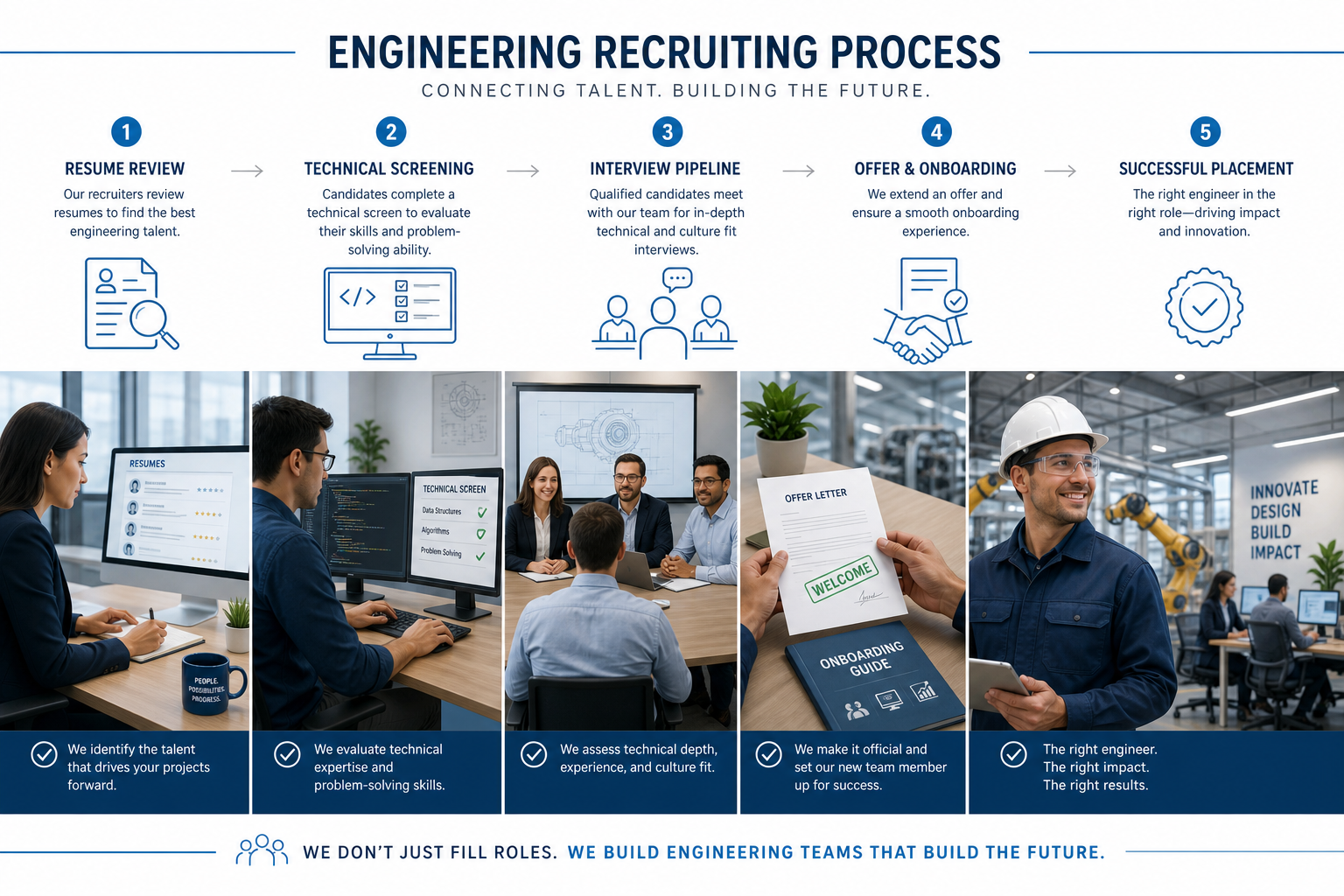
What Engineering Recruiting Firms Actually Do
At a high level, engineering recruiting firms help employers identify, attract, evaluate, and secure engineering talent faster than many internal teams can manage on their own. But the real value goes beyond resume sourcing.
A strong engineering recruiting firm typically helps with:
Defining the role and market requirements
Benchmarking compensation and candidate availability
Reaching both active and passive candidates
Pre-screening for technical fit and soft skills
Coordinating interviews and candidate communication
Managing offer presentation and acceptance
Supporting onboarding, payrolling, and compliance when needed
The best engineering recruitment agencies also understand that every opening is not the same. A plant engineer, project engineer, design engineer, controls engineer, quality engineer, and engineering manager each require a different sourcing strategy, technical vocabulary, and evaluation process.
For employers in Houston, that local understanding matters. Clayton Services works across engineering and adjacent functions including accounting, administration, customer service, HR, legal, IT, supply chain, skilled trades, and light industrial roles. That cross-functional reach is important because engineering hiring often affects operations, maintenance, procurement, production, project controls, and leadership hiring at the same time.
Why Internal Recruiting Alone Often Falls Short
Internal talent acquisition teams play a critical role, but engineering hiring can strain even strong in-house functions. Specialized positions often require niche sourcing, fast response times, and technical screening capabilities that general recruiting workflows are not built to handle at scale.
Common internal hiring obstacles
Challenge | Why It Slows Hiring |
Limited candidate reach | Internal teams often rely too heavily on job boards and inbound applicants |
Lack of passive candidate access | Top engineers may never apply unless approached directly |
Technical screening gaps | Recruiters may not know how to assess highly specialized experience |
Slow coordination | Hiring managers, HR, and operations teams may move at different speeds |
Competing priorities | High-volume or urgent staffing needs can overwhelm internal resources |
Risk of bad hires | Misalignment on technical skill, culture fit, or compensation can be expensive |
Engineering recruiting agencies fill these gaps by maintaining deeper candidate pipelines, conducting proactive outreach, and managing the process with urgency.
"Approximately 70% of professionals are passive candidates, while only about 30% are actively job hunting." - Source
That statistic matters because the strongest engineering hires are often not browsing job boards. They are performing well where they are, open to the right opportunity, and responsive only to trusted, well-informed outreach.
How Engineering Recruiting Firms Source Top Talent
The sourcing process is where elite engineering recruiting firms separate themselves from generalist staffing providers. The goal is not to collect the most resumes. It is to identify the right people quickly and present only qualified, relevant candidates.
1. They start with a detailed intake
Before searching, an experienced recruiter clarifies:
Core technical requirements
Must-have certifications, licenses, or software proficiency
Industry background preferences
Reporting structure and team makeup
Compensation range
Commute expectations or relocation flexibility
Project urgency
Cultural fit and leadership style
This step is often underdeveloped in traditional hiring. But when done well, it prevents wasted interviews and improves offer acceptance rates.
2. They tap existing networks first
A high-performing engineering recruiting company maintains long-standing relationships with candidates built over years, not days. That includes:
Previously placed engineers
Referred professionals
Former finalists
Industry-specific contacts
Local talent pools built by geography and discipline
Clayton Services has built its candidate network in the Houston market over decades. That local depth allows for faster, more informed outreach than a recruiter trying to build a pipeline from scratch every time a requisition opens.
3. They target passive candidates directly
The best engineering recruiting firms do not wait for applications. They conduct targeted outbound recruiting through:
Direct phone outreach
Email campaigns
LinkedIn sourcing
Referral networks
Industry associations
Local market intelligence
Re-engagement of prior contacts

4. They use role-specific search language
Top recruiters understand how engineers describe their experience and how employers describe their needs. For example, a controls engineer might also appear under terms like:
Automation engineer
PLC programmer
SCADA specialist
instrumentation and controls engineer
process controls engineer
That search precision expands the candidate pool without sacrificing quality.
5. They build multi-channel pipelines
Strong firms do not depend on one source. They combine:
Database searches
Referrals
Social platforms
Niche job boards
Industry groups
Local recruiting campaigns
Internal talent mapping
This is especially important for hard-to-fill roles, confidential searches, and executive-level engineering leadership needs.
How Engineering Recruiting Firms Screen Candidates
Finding talent is only half the job. Screening determines whether a resume becomes a productive hire.
Technical screening
Engineering recruiters evaluate factors such as:
Relevant engineering discipline
Industry experience
Project scope and complexity
Tools, systems, or software used
Regulatory and compliance exposure
Leadership or cross-functional coordination experience
Education, licensure, and certifications
For example, hiring a mechanical design engineer for an industrial manufacturer requires different screening than hiring a civil project engineer for infrastructure, or a process engineer for a chemical operation.
Soft skills and workplace fit
Even highly technical hires fail when communication, adaptability, or team fit is overlooked. Leading engineering recruiting agencies screen for:
Problem-solving style
Communication with non-technical stakeholders
Accountability and follow-through
Leadership potential
Safety mindset
Collaboration under deadlines
Motivation and retention factors
A candidate may be qualified and still be a poor hiring decision if the move does not align with their goals. Recruiters also assess:
Why the candidate would consider leaving
Compensation expectations
Commute tolerance
Schedule preferences
Interest in long-term growth
Counteroffer risk
Availability timeline
This is one of the most overlooked areas in internal hiring. Clayton Services places strong emphasis on matching not just technical qualifications, but the practical conditions that influence long-term retention.
What the Best Engineering Candidates Look Like
A top engineering candidate is not always the person with the flashiest resume. The strongest hires usually combine technical credibility with reliability, communication skills, and proven results in environments similar to yours.
Traits top engineering recruiters prioritize
Trait | Why It Matters |
Relevant technical depth | Reduces training time and improves time-to-productivity |
Stable work history | Signals dependability and follow-through |
Strong communication | Essential for cross-functional work and project execution |
Industry alignment | Helps candidates ramp up faster in similar environments |
Adaptability | Important in changing project, plant, or field conditions |
Professionalism | Improves team fit and client-facing credibility |
Clear motivation | Leads to better retention and lower offer fallout |
Engineering recruiting firms also know when a nontraditional candidate may still be the right fit. A great recruiter can identify transferable skills, adjacent industry experience, and growth potential that a strict keyword screen might miss.
How Engineering Recruiting Firms Deliver Candidates Faster
Speed matters, especially when vacancies delay production, projects, service delivery, or revenue. A quality engineering recruiting firm accelerates hiring without sacrificing screening rigor.
Why they move faster
They already have:
Active candidate pipelines
Existing relationships with engineers
Proven screening workflows
Dedicated recruiters focused on filling roles
Interview coordination processes
Offer management experience
This is why Clayton Services can often provide qualified candidates within 24 to 72 hours for urgent staffing needs, depending on role complexity and market conditions. That responsiveness is especially valuable for short-term coverage, temp-to-hire roles, contract support, and fast-moving operational hiring needs.
"The average time to fill technical positions varies by role, with backend engineers at 48 days, full-stack engineers at 50 days, and site reliability engineers at 75 days." - Source
While not every engineering role follows those exact benchmarks, the broader point is clear: technical hiring takes time, and delays are costly. Specialized recruiting support helps compress that timeline.
When Employers Should Use an Engineering Recruiting Firm
Some roles can be managed internally. Others benefit significantly from outside support. Employers typically see the greatest value from engineering recruiting agencies when:
The role is specialized or hard to fill
Examples include controls, process, design, manufacturing, quality, project, systems, and leadership roles with narrow requirements.
The vacancy is costing money
If projects are delayed, overtime is rising, or team burnout is increasing, the cost of waiting often exceeds the recruiting fee.
You need confidential hiring support
Executive changes, succession planning, and strategic expansions often require discretion.
You need hiring flexibility
Temp, temp-to-hire, direct hire, and payrolling models allow employers to manage risk while maintaining productivity.
Your internal team is stretched thin
RPO, onsite recruiting, or project-based recruiting support can stabilize hiring during growth periods, plant expansions, seasonal spikes, or large-scale workforce changes.
The Difference Between General Recruiters and Specialized Engineering Recruitment Agencies
Not all recruiters approach engineering hiring the same way. Generalist firms may fill roles occasionally, but specialized engineering recruiting firms bring deeper market understanding.
Comparison at a glance
General Recruiting Firm | Specialized Engineering Recruiting Firm |
Broad role coverage | Technical and engineering-specific focus |
More generic keyword sourcing | Discipline-specific search strategy |
Limited technical screening | Better alignment on tools, projects, and skill sets |
Smaller passive talent access | Stronger engineering candidate networks |
Less market nuance | Better compensation and availability insight |
Slower on niche roles | Faster on specialized searches |
Clayton Services offers a practical advantage here. While not limited to only one function, the firm supports engineering alongside the administrative, industrial, operational, and leadership roles that often surround engineering hiring. That makes it easier for employers to solve one vacancy or an entire workforce need through one accountable partner.
The Hiring Models Engineering Recruiting Firms Offer
One reason employers work with engineering recruiting companies is flexibility. Different hiring models fit different business needs.
Direct hire recruiting
Best for permanent positions where long-term retention matters. Clayton Services backs direct hire recruiting with a 180-day replacement guarantee, helping reduce employer risk.
Temp-to-hire staffing
Best when you want to evaluate performance before making a permanent commitment. This model helps reduce hiring risk while keeping work moving.
Temporary staffing
Best for short-term projects, leaves, demand spikes, and urgent operational support. Clayton Services offers a 100% satisfaction guarantee on temporary placements.
Executive search
Best for engineering managers, directors, plant leaders, operations executives, and strategic technical leadership roles where confidentiality and precision matter.
Onsite/RPO recruiting
Best for high-volume hiring, sustained growth, or organizations that need a scalable recruiting function embedded into their operation.
Payrolling and employer-of-record support
Best when you have identified talent but need help with onboarding, payroll administration, workers' compensation, employment compliance, and related employer responsibilities.
What Employers Should Ask Before Choosing an Engineering Recruiting Company
Choosing the right recruiting partner is as important as choosing the right candidate. Ask these questions before engaging a firm:
Questions to evaluate a recruiting partner
Do you understand our industry and engineering roles?
How do you source passive candidates?
What does your screening process include?
How quickly can you deliver qualified candidates?
What hiring models do you support?
Do you offer guarantees?
Can you support compliance, payrolling, or volume hiring?
Do you know the local labor market?
How do you communicate throughout the search?
What happens if the hire does not work out?
For Houston employers, local market knowledge should be a major factor. A Houston-owned firm like Clayton Services understands area compensation expectations, commute patterns, industry clusters, and candidate movement in a way national chains often cannot replicate.
Content Gaps Most Competitor Articles Miss
Many articles about engineering recruiting firms explain the basics of sourcing and screening, but they often leave out the employer-side realities that matter most in actual hiring decisions.
What is often missing
How local labor market knowledge affects speed and quality
Why passive candidate outreach matters more than job postings
The operational cost of prolonged engineering vacancies
The value of temp-to-hire as a risk-reduction strategy
The importance of guarantees in choosing a recruiting partner
The role of payrolling and employer-of-record support
When executive search and RPO make more sense than one-off recruiting
How adjacent functions like operations, administration, and skilled trades impact engineering hiring success
Those gaps matter because real-world hiring is not just about finding resumes. It is about reducing risk, preserving productivity, and making sound workforce decisions under time pressure.
How Clayton Services Helps Houston Employers Hire Engineers More Effectively
Clayton Services brings several advantages to engineering hiring in Houston and Greater Houston:
Houston-owned and locally knowledgeable
Clayton Services is not a distant national chain. The firm has served this market since 1984 and understands local industries, employers, and candidate expectations.
Faster response times
For many staffing and recruiting needs, qualified candidates can be delivered within 24 to 72 hours, helping employers keep hiring momentum.
Lower hiring risk
Employers can choose direct hire, temp-to-hire, temporary staffing, executive search, or RPO support depending on urgency and risk tolerance. Clayton Services further reduces risk through a 180-day direct hire replacement guarantee and a 100% satisfaction guarantee on temporary placements.
Broad specialization
Engineering hiring rarely happens in a vacuum. Clayton Services supports engineering, accounting, administration, customer service, HR, IT, legal, marketing, medical administrative, oil and gas and energy, sales, supply chain and logistics, light industrial, and skilled trades.
Scalable recruiting support
Whether you need one engineer, a leadership hire, or high-volume recruiting support, Clayton Services can adapt the model to your business need.
Employer-of-record and payrolling support
When speed, compliance, or workforce administration is a concern, Clayton Services can step in with payrolling and related employer support.
Final Thoughts
The best engineering recruiting firms do far more than post jobs. They combine market knowledge, passive candidate outreach, technical screening, hiring process management, and flexible workforce solutions to help employers hire better people faster.
If your organization is struggling to fill engineering roles, losing time to slow hiring cycles, or trying to balance short-term staffing demands with long-term workforce planning, outside recruiting support can create immediate value. And if you want a partner that understands Houston, stands behind its placements, and offers both speed and accountability, Clayton Services is positioned to help.
Whether you need direct hire recruiting, temporary staffing, temp-to-hire flexibility, executive search, onsite/RPO support, or payrolling services, Clayton Services delivers staffing and recruiting solutions built around your business goals, timeline, and risk tolerance.
Ready to strengthen your engineering hiring process? Partner with Clayton Services to access qualified talent, reduce hiring risk, and move faster with a trusted Houston recruiting team behind you.
Frequently Asked Questions About Engineering Recruiting Firms
What does an engineering recruiting firm do?
An engineering recruiting firm helps employers identify, attract, screen, and hire qualified engineering professionals faster. Engineering recruiters support hiring for roles such as mechanical engineers, electrical engineers, controls engineers, project engineers, process engineers, manufacturing engineers, civil engineers, and engineering leadership positions. Many firms also provide temporary staffing, temp-to-hire recruiting, executive search, and payrolling support.
How do engineering recruiting firms find top engineering talent?
Top engineering recruiting firms use a combination of direct outreach, referral networks, LinkedIn sourcing, local market intelligence, internal candidate databases, industry connections, and passive candidate recruiting. The best engineering recruiters do not rely only on job boards. They proactively target experienced engineers who may not be actively applying for jobs.
Why do companies use engineering recruiting agencies?
Companies use engineering recruiting agencies to reduce hiring timelines, improve candidate quality, access passive talent, lower turnover risk, and relieve pressure on internal hiring teams. Engineering recruiters are especially valuable for difficult-to-fill, urgent, confidential, or highly specialized technical roles.
What industries use engineering recruiting firms the most?
Engineering recruiting firms commonly support employers in oil and gas, manufacturing, industrial services, construction, infrastructure, energy, chemicals, logistics, aerospace, technology, utilities, and automation industries. Houston employers frequently use engineering recruiters because competition for technical talent is extremely high across multiple sectors.
How long does it take engineering recruiters to fill positions?
Hiring timelines depend on the role complexity, market demand, and required experience level. Some engineering staffing firms can provide qualified candidates within 24 to 72 hours for active staffing needs, while specialized or executive engineering searches may take several weeks. Fast-moving recruiting processes typically produce better hiring outcomes in competitive markets.
What engineering positions do recruiting firms fill?
Engineering recruiting companies commonly fill roles including:
Mechanical Engineers
Electrical Engineers
Controls Engineers
PLC Programmers
Automation Engineers
Process Engineers
Manufacturing Engineers
Civil Engineers
Project Engineers
Design Engineers
Quality Engineers
Engineering Managers
Plant Managers
Operations Leaders
Many engineering staffing firms also recruit for adjacent technical and operational positions.
What is the difference between direct hire and temp-to-hire engineering recruiting?
Direct hire engineering recruiting places engineers permanently with the employer from day one. Temp-to-hire engineering staffing allows companies to evaluate an engineer’s technical skills, reliability, and workplace fit before extending a permanent offer. Temp-to-hire recruiting helps reduce hiring risk while maintaining operational productivity.
How do engineering recruiting firms screen candidates?
Engineering recruiters screen candidates through technical interviews, resume evaluations, project experience reviews, software proficiency assessments, reference checks, communication evaluations, and culture-fit screening. Specialized recruiters also evaluate industry background, certifications, leadership experience, safety awareness, and long-term retention potential.
Why is passive candidate recruiting important in engineering hiring?
Many of the strongest engineering professionals are passive candidates who are currently employed and not actively applying to job postings. Engineering recruiting firms use direct outreach and long-term industry relationships to connect with these professionals before competitors do. Passive recruiting expands access to higher-quality engineering talent.
What should employers look for in an engineering recruiting company?
Employers should look for industry expertise, technical recruiting experience, local market knowledge, speed, communication, proven screening processes, hiring flexibility, and replacement guarantees. A strong engineering recruiting partner should also understand compensation trends, hiring competition, and the operational impact of engineering vacancies.
Are engineering staffing agencies worth the cost?
Engineering staffing agencies often save employers money by reducing overtime, minimizing project delays, shortening vacancy timelines, improving retention, and preventing costly hiring mistakes. The cost of an unfilled engineering role or a poor hire can exceed the recruiting investment significantly.
What are the benefits of working with a Houston engineering recruiting firm?
A Houston engineering recruiting firm understands the local labor market, compensation expectations, commute patterns, industry competition, and regional talent availability. Local recruiters often have stronger relationships with engineering professionals throughout Greater Houston, allowing them to move faster and recruit more effectively.
How do engineering recruiters help reduce hiring risk?
Engineering recruiters reduce hiring risk through stronger technical screening, better candidate matching, reference validation, temp-to-hire options, and replacement guarantees. Recruiters also evaluate retention factors such as compensation expectations, commute tolerance, leadership preferences, and career motivations before presenting candidates.
What is engineering executive search?
Engineering executive search focuses on recruiting senior technical and operational leaders such as engineering managers, directors, plant managers, operations executives, and strategic leadership hires. Executive recruiting typically involves confidential outreach, targeted sourcing, and a more customized hiring process.
Can engineering recruiting firms support contract and project staffing?
Yes. Many engineering staffing agencies support contract staffing, temporary staffing, project-based hiring, onsite recruiting, and payrolling services. This flexibility helps employers scale engineering teams quickly during plant expansions, shutdowns, construction projects, seasonal demand spikes, or specialized technical initiatives.
What is payrolling or employer-of-record support in engineering staffing?
Payrolling and employer-of-record services allow companies to utilize engineering talent without placing workers directly on internal payroll. Staffing firms manage payroll taxes, onboarding, workers’ compensation, HR administration, and compliance responsibilities while employers maintain operational oversight.
Why do engineering roles take longer to fill than other jobs?
Engineering positions often require specialized technical experience, industry-specific knowledge, software proficiency, certifications, leadership ability, and strong communication skills. Competition for experienced engineers is also extremely high, particularly in markets like Houston where multiple industries compete for the same talent pool.
What makes a great engineering candidate?
Strong engineering candidates typically combine technical expertise, communication skills, problem-solving ability, reliability, adaptability, leadership potential, and industry-specific experience. The best engineering hires also align with the company’s operational environment, team structure, and long-term growth goals.
When should a company partner with an engineering recruiting agency?
Companies should consider engineering recruiting support when:
Roles stay open too long
Projects are delayed due to staffing shortages
Internal recruiters lack technical specialization
Hiring managers are overwhelmed
Engineering turnover increases
Confidential leadership hiring is needed
Rapid growth creates hiring pressure
Specialized technical skills are difficult to source internally
What makes Clayton Services different from other engineering recruiting firms?
Clayton Services combines local Houston market expertise, fast recruiting response times, flexible hiring models, and decades of candidate relationships to help employers hire engineers more effectively. Since 1984, Clayton Services has supported Greater Houston employers with direct hire recruiting, temp-to-hire staffing, temporary staffing, executive search, onsite/RPO recruiting, and payrolling support across engineering and related business functions.


